 by
by 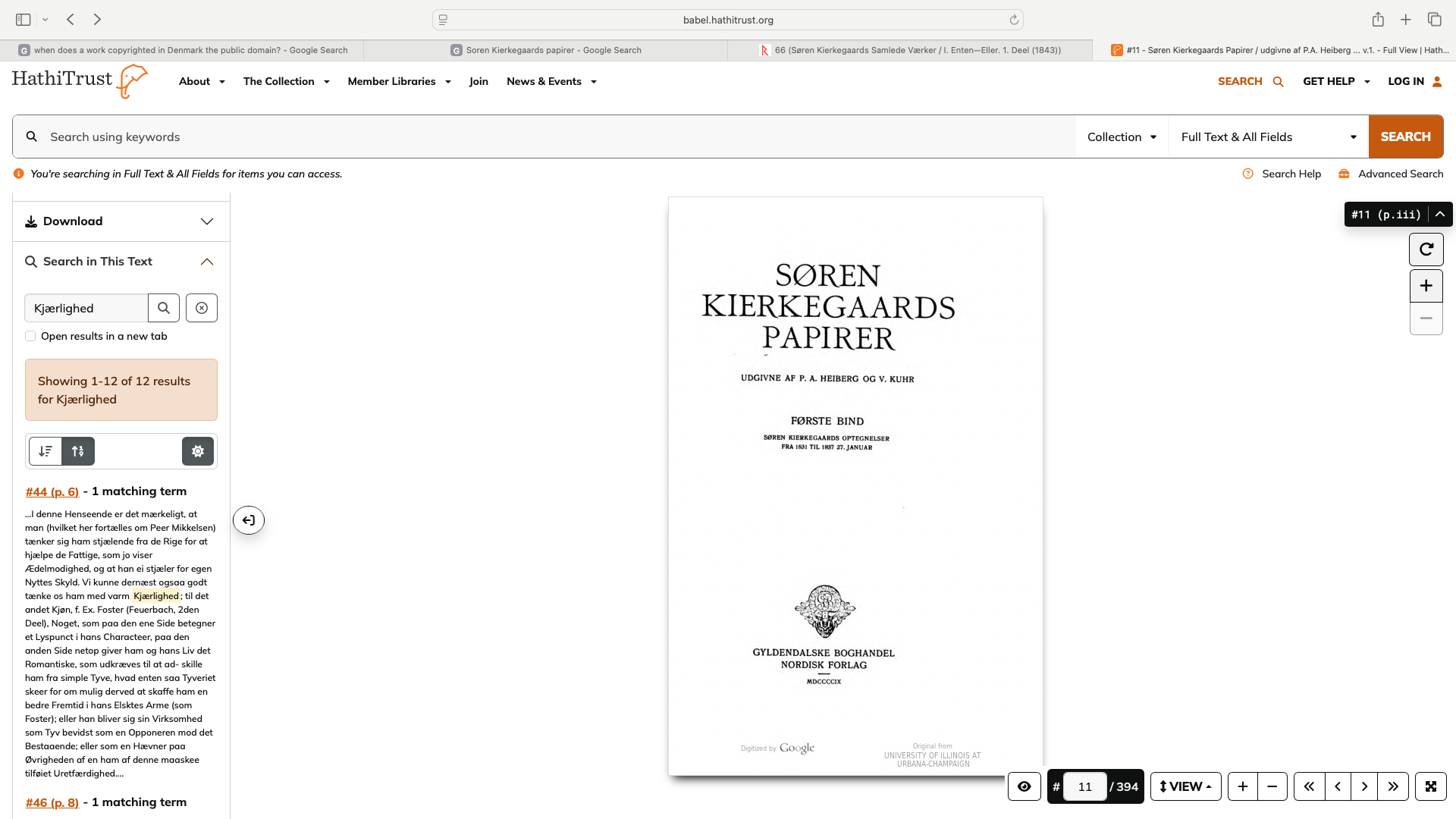
This brief post is a little holiday weekend gift to Kierkegaard scholars. As most readers of this blog will realize by now, the new 55 volume Søren Kierkegaards Skrifter, that purports to be the definitive edition of Kierkegaard’s works in Danish is deeply flawed in that it is not actually complete, but missing quite a bit of the material the editors had originally promised it would include. That is, it was supposed to include everything, but it doesn’t. And some of the stuff that it leaves out, such as Kierkegaard’s unequivocal identification of himself as a universalist, is hugely important to understanding Kierkegaard as a thinker.
The problem of missing material unfortunately affects the new 12 volume English translation of Kierkegaard’s unpublished works, Kierkegaard’s Journals and Notebooks, as well, since this work was based on Søren Kierkegaard’s Skrifter.
Sadly, so much time and effort went into the production of these two new editions of Kierkegaard’s works, it will be at least a generation before we can expect a genuinely complete and reliable edition of Kierkegaard’s works in either Danish or English. Happily, some, at least some of the volumes of the earlier, but also complete, collection of Kierkegaard’s unpublished works, Søren Kierkegaards Papirer are available online through the Hathi Trust website and are actually searchable via a little field to the left of the text (see illustration above). Unhappily, one can search only a single volume at a time and it appears that vols. 7 and 8 are not available in searchable editions (though one hopes perhaps they will be soon).
Happily, I have two copies of the Papirer, a nice hardcover that used to belong to the library of Franklin and Marshal College and which I bought on eBay (yes, you can occasionally get stuff like that on eBay!) and an older severely dilapidated softcover edition that I bought many years ago from Bob Perkins and Sylvia Walsh Perkins, and I have decided to tear that one apart, scan it, and throw it up online as one huge searchable file. The scanning shouldn’t actually be too complicated or take too long. What I expect will take some time is finding a suitable home for the huge file once it is ready to be uploaded to the web. I can’t house such a file here on this blog. First, I doubt I would have the space for it. Second, what would happen to it after I died? It clearly needs to be housed on some library website. I’m applying for a sabbatical for the 2027-2028 academic year and plan to use some of that sabbatical on the project of making a searchable edition of the Papirer available online.
Another bit of happy news is the fact that what is generally considered the best and most reliable edition of Kierkegaard’s published works, the second edition of Søren Kierkegaard’s Samlede Værker (Søren Kierkegaard’s Collected Works) is available online through something called Project Runeberg. This edition, despite being lauded as the best, is not popular among contemporary scholars because it was produced during a period the resurgence of Nordic nationalism and hence uses the old Fraktur, or what the Danes call Gothisk, typeface and many contemporary scholars find it difficult to read. In fact, it takes very little time to read it. Those who don’t have the patience to master it, however, will be pleased to learn that there is a Roman typeface version of each page immediately below the scanned version.
Unhappily, this version hasn’t been proofread, so it is possible there might be some errors in it. Happily, anyone who has the truly minimal amount of patience that is required to learn to read Fraktur, can get some valuable proofreading experience, or “service” credit, for helping out Project Runeberg by proofreading some, or even all, the pages of a particular volume. You wouldn’t even need to be able to read Danish to be able to do that proofreading. You’d just have to learn to read Fraktur so that you could tell in the words were rendered properly in the Roman version of the text. In fact, it might actually be a disadvantage to be able to read Danish because of the well-known capacity the brain has to “fix” spelling, etc., if it knows how the word should be spelled, without ever consciously alerting the reader to the fact that the word in the text in question was misspelled. That bane of the existence of proofreaders would not trouble a proofreader who did not know Danish!


Leave a Reply