Kierkegaard’s Papirer Available Online!

This brief post is a little holiday weekend gift to Kierkegaard scholars. As most readers of this blog will realize by now, the new 55 volume Søren Kierkegaards Skrifter, that purports to be the definitive edition of Kierkegaard’s works in Danish is deeply flawed in that it is not actually complete, but missing quite a bit of the material the editors had originally promised it would include. That is, it was supposed to include everything, but it doesn’t. And some of the stuff that it leaves out, such as Kierkegaard’s unequivocal identification of himself as a universalist, is hugely important to understanding Kierkegaard as a thinker. 

The problem of missing material unfortunately affects the new 12 volume English translation of Kierkegaard’s unpublished works, Kierkegaard’s Journals and Notebooks, as well, since this work was based on Søren Kierkegaard’s Skrifter. 

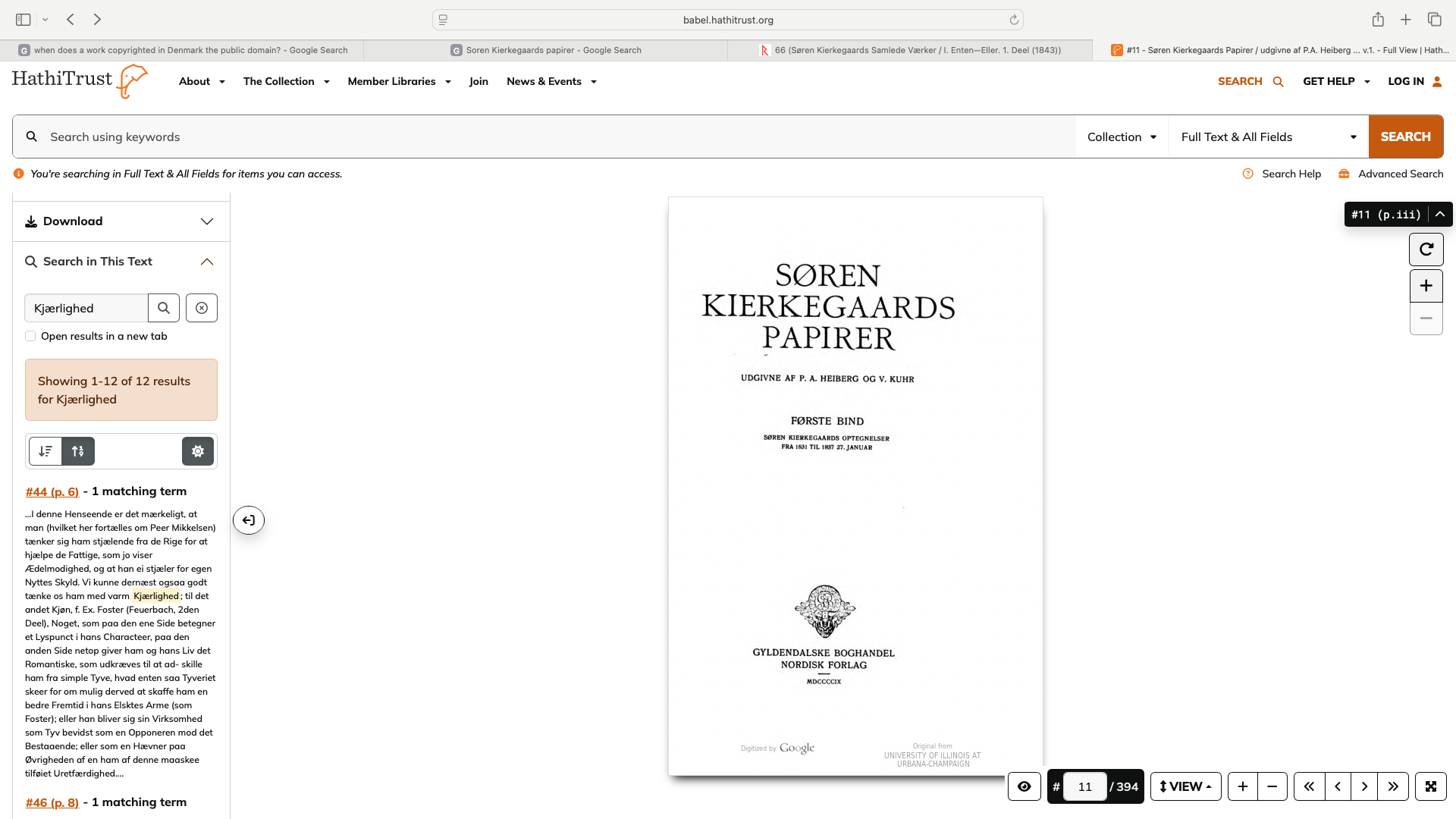
Sadly, so much time and effort went into the production of these two new editions of Kierkegaard’s works, it will be at least a generation before we can expect a genuinely complete and reliable edition of Kierkegaard’s works in either Danish or English. Happily, some, at least some of the volumes of the earlier, but also complete, collection of Kierkegaard’s unpublished works, Søren Kierkegaards Papirer are available online through the Hathi Trust website and are actually searchable via a little field to the left of the text (see illustration above). Unhappily, one can search only a single volume at a time and it appears that vols. 7 and 8 are not available in searchable editions (though one hopes perhaps they will be soon). 

Happily, I have two copies of the Papirer, a nice hardcover that used to belong to the library of Franklin and Marshal College and which I bought on eBay (yes, you can occasionally get stuff like that on eBay!) and an older severely dilapidated softcover edition that I bought many years ago from Bob Perkins and Sylvia Walsh Perkins, and I have decided to tear that one apart, scan it, and throw it up online as one huge searchable file. The scanning shouldn’t actually be too complicated or take too long. What I expect will take some time is finding a suitable home for the huge file once it is ready to be uploaded to the web. I can’t house such a file here on this blog. First, I doubt I would have the space for it. Second, what would happen to it after I died? It clearly needs to be housed on some library website. I’m applying for a sabbatical for the 2027-2028 academic year and plan to use some of that sabbatical on the project of making a searchable edition of the Papirer available online. 

Another bit of happy news is the fact that what is generally considered the best and most reliable edition of Kierkegaard’s published works, the second edition of Søren Kierkegaard’s Samlede Værker (Søren Kierkegaard’s Collected Works) is available online through something called Project Runeberg. This edition, despite being lauded as the best, is not popular among contemporary scholars because it was produced during a period the resurgence of Nordic nationalism and hence uses the old Fraktur, or what the Danes call Gothisk, typeface and many contemporary scholars find it difficult to read. In fact, it takes very little time to read it. Those who don’t have the patience to master it, however, will be pleased to learn that there is a Roman typeface version of each page immediately below the scanned version. 

Unhappily, this version hasn’t been proofread, so it is possible there might be some errors in it. Happily, anyone who has the truly minimal amount of patience that is required to learn to read Fraktur, can get some valuable proofreading experience, or “service” credit, for helping out Project Runeberg by proofreading some, or even all, the pages of a particular volume. You wouldn’t even need to be able to read Danish to be able to do that proofreading. You’d just have to learn to read Fraktur so that you could tell in the words were rendered properly in the Roman version of the text. In fact, it might actually be a disadvantage to be able to read Danish because of the well-known capacity the brain has to “fix” spelling, etc., if it knows how the word should be spelled, without ever consciously alerting the reader to the fact that the word in the text in question was misspelled. That bane of the existence of proofreaders would not trouble a proofreader who did not know Danish!

Some Praise for the Hongs as Translators

I’ve been hard on the Hongs’ translations of Kierkegaard’s works in posts on this blog. My criticisms of the Hongs’ translations don’t stem from any personal animosity. That’s how I was trained. That is, I was taught that scholars needed to be hard on one another in order to push scholarship forward. I sincerely hope, however, that my criticisms of the Hongs’ translations have not blinded my readers to the debt everyone in the community of Kierkegaard scholars owes to them. Where would we be without their years of that selfless dedication? The Hong Kierkegaard Library at St. Olaf College has been a real force for good, and for scholarly progress in the world of Kierkegaard studies. Don’t take my work for that, though, please check out the library’s website if you are not already familiar with the many programs they offer. 

I first met Howard and Edna Hong in the summer of 1987 when I had a fellowship to study at the Kierkegaard Library. They were both lovely people and wonderful hosts to all the visiting scholars. Howard was a ubiquitous presence around the library, which at that time was housed on the very top floor of one of the classroom buildings and was outfitted with large black slate tables that must have come from some science classroom. It was cool and dark and quite, just like a library should be. It was a wonderful place to work. 

Howard had put together a collection of used books that were duplicates of some of the books in the library. He invited the visiting scholars to purchase, at very modest prices, any of these books that took their interest. My purchases from Howard’s duplicates were the beginning of my own library of works on Kierkegaard. Both he and Edna were, as I mentioned, wonderful hosts. I was only a graduate student at the time, but I felt as welcome in the community there at the library as if I had been a full-blown scholar!

I like to think that neither Howard nor Edna would be offended by my criticisms of their work, that they would accept them in the spirit of commitment to the progress of scholarship, because it is certainly from such a commitment that those criticisms spring rather than, as I mentioned above, any personal animosity. I had nothing but admiration and affection for both of the Hongs, and for everything they did to advance Kierkegaard scholarship. I’m able to engage with Kierkegaard’s texts in the manner I do, at least partly because of the work they did before me. Everyone in Kierkegaard studies is enormously indebted to the Hongs for their selfless commitment to the promotion of Kierkegaard’s thought. 

I’m, therefore, deeply honored to have been invited to be the keynote speaker at the 10th International Kierkegaard Conference at St. Olaf College this summer and thought I would use this occasion to highlight some places where one of the Hongs translations has corrected some errors in an earlier translation. 

I’ve decided to focus on Works of Love because I am currently reading through it with Mark Lama, a newcomer to Kierkegaard studies, but an enormously talented scholar with a truly enviable affinity for Kierkegaard’s thought (check out this fantastic post by Mark on a mathematical metaphor in Works of Love)! And while reading through it, I’ve discovered several places where the Hongs’ translations, both the older translation for Harper and Brothers (1962) and the new translation for Princeton (1995), correct errors in the Swensons’ translation (Princeton, 1946). I generally love the Swensons’ translations, but there is no getting around that there are actual errors in their translation of Works of Love. 

The first of the Swensons’ errors concerns the translation of Kierkegaard’s “Christenhed” as “Christianity” on page 39. The Danish for the passage is:

Det kunde rigtignok synes, at da Christenheden nu saa længe har bestaaet, maa den vel have gennemtrængt all Forhold og  — og os Alle. Men dette er et Sandsebedrag. Og fordi Christendomen har bestaaet saa længe, dermed er jo dog vel ikke sagt, at det er os, der har levet saa længe eller saa længe været Christne. (SKS 9, p. 53.)

The Swensons have:

It might certainly seem that since Christianity has now existed for so long, it must by now have penetrated every relationship—and all of us. But this is an illusion. And because Christianity has existed so long, that is certainly not saying that we have lived as long, or have so long been Christian. (p. 39.)

The Hongs’ translation from 1962 has:

It might well seem that since Christendom has existed so long now it must have penetrated all relationships—and all of us. But this is an illusion. Because Christianity has existed so long it cannot thereby be said that it is we who have lived so long or have been Christian for so long. (p. 60.)

That is, the Hongs correctly translated Kierkegaard’s “Christenhed” as “Christendom” and Kierkegaard’s “Christendom” as “Christianity.” The passage is clearly talking about two different things, the enduring nature of Christian culture, or what one might think of as the visible church, on the one hand, and the enduring nature of genuine Christian faith, or the invisible church, on the other hand. 

Unfortunately, the newer Hongs’ translation for Princeton appears to make the same mistake as the Swensons’ translation (see page 46). My own experience with the copyediting that is done by publishing houses leads me, however, to believe that this was likely not an error on the Hongs’ part but on the part of some editor at Princeton. This belief is supported by the fact that both the second edition of Kierkegaard Samlede Værker, or “collected works” (which is generally considered the best of the three editions of the Samlede Værker), and the new Søren Kierkegaards Skrifter have first “Christenhed” and then “Christendom” in the passage in question and the Hongs knew well how each of these terms should be translated.

The next error in the Swensons’ translation occurs in the context of an analogy Kierkegaard draws between learning to read by first learning the alphabet and only later learning to recognize the letters in the combinations that constitute words. No child, observes Kierkegaard, has ever deluded itself that it could read long before it could spell. “But in spiritual matters, how seductive! Does not everything here begin with the great moment of the resolution, the intention, the promise—where one can read as fluently as the most accomplished lecturer presents the most practiced reading.” The problem, Kierkegaard points out, is that one then has to go out and live according to one’s resolution. That is, one has to conform one’s will and subsequent individual mundane, or everyday, actions to one’s great resolution. But how is one to do that? “[J]ust as it is with spelling,” Kierkegaard explains, “which separates the words and takes them apart” so that the meaning of the whole is lost, the mundane actions of everyday life do not stand in an obvious relation to the meaning of one’s great resolution (Hongs’ p. 133). 

That’s a pretty straightforward, and yet hugely important, point that the Hongs get right. Unfortunately, the Swensons seem to have been confused by the presence of the definite article on the end of the Danish “Stavning,” or “spelling” (the definite article is enclitic in Danish), and hence rendered Kierkegaard’s “Stavningen” (SKS, 136) as “the spelling which tears the words apart into letters” (Swenson, 109 emphasis added) with the result that it looks like Kierkegaard is talking about a particular kind of spelling, or a particular approach to spelling, when he is simply talking about spelling in general.  

The most egregious translation error in Swenson’s translation, though (or at least the most egregious I have found so far) occurs on page 126 where the Swensons have:

[F]or this is just the mystery of love, that there is no higher certainty than the beloved’s renewed assurance; humanly understood it is unconditionally to be certain of being loved, not of loving, since it is superior to the relation between friend and friend (Swenson, 126).

Does that make sense to you? I have to confess that it does not make much sense to me. The Danish is:

[T]hi dette er just Kjærlighedens Gaade, at der ingen høiere Vished er end den Elskedes fornyede Forsikkring; menneskeligt forstaaet er det, ubetinget at være vis paa at være elsket, ikke at elske, da det er at staae over Forholdet mellem Vennen og Vennen (SKS 9, 157.)

The Swensons appear to have been confused about the function of “er det,” literally “is it” but in this instance more properly understood as “it is.” That is, it actually qualifies “ikke at elske” or “not to love,” rather than “ubetinget at være vis paa at være elsket,” or “unconditionally to be certain of being loved.”

The Hongs, thankfully, again, get it right. They have:

[T]he very enigma of love is this—that there is no higher certainty than the beloved’s renewed assurances. In the human sense, to be absolutely certain of being loved is not to love, since this means to stand above the relationship between friend and friend (Hongs, 156). 

It might be tempting to assume that Kierkegaard is contrasting erotic love here with friendship. It is precisely friendship he is referring to in this passage, however, because the passage concerns Christ’s repeated question to Peter “Simon, son of John, do you love me?” That is, Kierkegaard is talking about Christ’s very human need to be loved by his friend, Peter, and loved in what philosophers call the preferential sense, or “more than these” (John 21:15-17).

I’d like to close with reference to what it is tempting to think of as a very mundane sort of error in the Swensons’ translation. That is, the Swensons translated “Vor Pligt at elske de Mennesker, vi see” (SKS 9, 155) as “Our Duty to Love the Men We See” (Swenson, 125)! I kid you not, Swenson translates the Danish “Mennesker,” which even a beginning student of Danish knows means “human beings” not “men,” as “men,” hence lending credence to the view that Kierkegaard was sexist, or even worse, a misogynist! Fortunately, the Hongs, again, get this right!

I don’t mean to suggest that I have suddenly done an about face on my view of the Hongs’ translations. I still prefer the the Swensons’, and Swenson-Lowrie translations, as well as Alastair Hannay’s translations for Penguin, to the new Hongs’ translations for Princeton from the perspective of style. I think it’s important for me to acknowledge, however, that there are instances where the Hongs get points of translation correct, where some of the works I prefer on stylistic grounds do not. I think it’s also important to point out that I like the style of the Hongs’ translations of Kierkegaard’s Journals and Papers for Indiana University Press, better than the style of much of the new Kierkegaard’s Journals and Notebooks from Princeton. Just as is the case with the Hongs’ translations, though, style was sacrificed by the team that produced the Journals and Notebooks for what they were hoping would be increased accuracy and certainly the commitment to accuracy is a laudable one. 

My hope is that translators of Kierkegaard will one day get beyond what I believe is the false dichotomy of style vs. accuracy. We can do that, however, only by being relentlessly meticulous in both our reading of Kierkegaard and our holding one another to account in how we read him. This, I believe, is the responsibility of all scholars. At least that is what I was taught by my scholarly mentors, and I believe they were correct. We make progress by pushing one another forward, so a little rough and tumble is just as it should be. 

That said, by “rough and tumble” I mean holding one another to account for the quality of our scholarship by exposing flaws or weaknesses in it. I emphatically do not mean that it is ever acceptable to engage in ad hominem attacks of one another, or to misrepresent the substance of one another’s scholarship in an attempt to discredit it, etc., etc. There is too much of that now in the scholarly community, and not only is it contributing, I believe, to the diminishing esteem in which the humanities are held by the general public, it is antithetical to the objective of all scholarship — the search for truth. I’m sure the Hongs would agree with me there.
Yet Another Error in the New Kierkegaard’s Journals and Notebooks

I’ve found yet another significant error in the new Søren Kierkegaard’s Journals and Notebooks. I don’t go looking for errors, as I believe I’ve explained in earlier posts, I discover them by accident, usually when I’m updating references from the old Søren Kierkegaard’s Journals and Papers. Due to the generosity of my friend Sylvia Walsh Perkins, I have a complete set of both KJN and the earlier JP. Most of the journal references in my earlier writing, as well as the notes I’ve made over the years, are to the JP, so when I need to update those references to the new KJN, I go first to the relevant JP entry because that entry always includes a reference to the passage in Søren Kierkegaards Papirer, the only complete edition of Kierkegaard’s journals and papers in Danish. When I find the passage in the Pap. I type the Danish into the searchable edition of the new Danish Søren Kierkegaards Skrifter. That then gives me the location of the passage in SKS. The new KJN is keyed to SKS, so once I have the SKS info I can find the passage in the new KJN.

Unfortunately, I keep discovering problems with the new KJN. The problem I am going to talk about in this post concern the following passage from KJN

For a thinker there can be no worse anguish than having to live in suspense while people pile up detail upon detail; it always looks as if the idea, the conclusion, will arrive very soon. If a researcher in the natural sciences does not feel this anguish he must not be a thinker. This is the terrible tantalization of the intellectual! A thinker is, as it were, in hell as long as he has not found certainty of spirit. (KJN 4, 72.)

The Danish for this passage is:

For en Tænker kan der ikke gives nogen rædsommere Qval end at skulde leve hen i den Spænding at medens man opdynger Detail, det bestandig seer ud som kom nu Tanken næste Gang, Conclusionen. Føler Naturforskeren ikke denne Qval saa maa han ikke være Tænker. Dette det Intellectuelles rædsomme Tantalisme! En Tænker er som i Helvede saa længe han ikke har fundet Aandens Vished.

The Hongs render the Danish as:

For a thinker there is no more horrible anguish than to have to live in the tension that while one is heaping up details it continually seems as if the thought, the conclusion, is just about to appear. If the natural scientist does not feel this anguish, he must not be a thinker. This is the most dreadful tantalization of the intellectual! A thinker is literally in hell as long as he has not found certainty of spirit.

Here is how I would translate the passage: 

There is no torment more dreadful to a thinker than to have to live in the tension that while one is heaping up details it constantly seems as if the conclusion will come with the next thought. If the natural scientist [Naturforsker] does not feel this anguish, he must not be a thinker. This is the most dreadful tantalization of the intellectual! A thinker is in hell as long as he has not found certainty [Aandens Vished].

The Hongs’ translation of this passage is generally superior to the new KJN translation. There are numerous problems with the translation in KJN. First, the term translated in KJN merely as “worse” (rædsommere) is the same term that is translated later as “terrible” (rædsomme). The latter translation is more accurate in that rædssom has connotations of fear given that it is derived from ræd which Ferrall-Repp translates as “fearful, timid, afraid, frightened, timorous.” One can’t actually call the translation of rædsommere  as “worse” a error, though. It just isn’t ideal. The Hongs’ “more horrible” is actually preferable.

The same thing could be said of KJN’s tortured attempt to keep Kierkegaard’s simile “som i Helvede” a simile by translating in as “is, as it were, in hell.” The phrase sounds intolerably pedantic in English, whereas the original Danish, som i Helvede would not sound pedantic to a native Danish speaker. The tone of the original is far better preserved by rendering the simile as a metaphor. That is, som i Helvede is better translated as “is in hell,” without the Hongs’ “literally,” since if some translation of som were necessary, “figuratively” would be more appropriate, but would, again, render a passage that sounds more pedantic in English than it does in Danish.

The last annoying departure from the Hongs’ translation of the passage in question that I’m going to list in this post is the rendering of opdynger Detail  as “pile up detail upon detail.” Opdynge, according to Ferrall-Repp means  “to heap up, amass, accumulate,” so the Hongs’ “heaping up,” is arguably preferable to KJN’s “pile up,” but again, the new translation does not actually alter the sense of the passage. Even the fact that KJN renders Detail (which has no plural in Danish but which is clearly used in the plural sense in this passage) as “detail upon detail” doesn’t doesn’t actually alter the sense of the passage. 

There are lots of these unnecessary deviations from the Hongs’ translations in the new KJN translations. Rendering “Spænding” as “suspense” rather than “tension” is less desirable than the Hongs’ “tension” given that Ferrall-Repp does not list “suspense” as one of the possible English translations of Spænding. Those translations are: “1. tension; 2. estrangement; 3. excitement.” That said, “suspense” isn’t actually misleading. It’s just an unnecessary deviation from the earlier translation. One gets the sense, going through the new KJN, that many of the deviations from the Hongs’ earlier translations were made not because there was any problem with the original, but because the more changes the new translation team could come up with, the greater would be the impression that a new translation was necessary.  

No such justification for a new translation of Kierkegaard’s journals and papers was necessary, however, because the Hongs’ translation was not complete. That is, there was definitely a need for a complete English translation of Kierkegaard’s journals and papers. Sadly, KJN is not a complete translation of all of Kierkegaard’s journals and papers because is it based on SKS and SKS is not complete. That is, there’s lots of important material missing from SKS (see earlier posts on the problems with SKS).

The error in the new KJN translation of the above passage is the translation of the Danish man as “people.” Not only is this incorrect, it is seriously misleading. Man, in Danish, just like man in German, is properly translated as “one” (as indeed the Hongs did render it in their translation of this passage). That is, it isn’t other people who Kierkegaard describes as piling up “detail upon detail” (opdynger Detail), but the researcher who is the subject of the passage. 

The error in KJN actually gives the passage a different meaning. That is, it makes it look as if the thinker in question experiences rising anxiety, or whatever, as he or she watches other people’s research amass more and more material that would be relevant to some issue to which the thinker is seeking a resolution, or some question to which he or she is seeking an answer. In fact, such a view could be attributed to Kierkegaard, as I in fact did attribute it in the paper I gave at Princeton in July. That is, I pointed out in that paper that science and scholarship, according to Kierkegaard, are collective endeavors, that no individual scholar or scientist can be the sole arbiter of truth in his or her discipline. 

The new KJN translation of the passage in question from Kierkegaard’s journals would appear to support such a view and could easily be appropriated by scholars as a reference that would support such a view. The thing is, it doesn’t. It isn’t inconsistent with such a view. It just doesn’t speak to the issue of how the establishment of truth in science and scholarship is a collective endeavor. The issue of this passage is how intellectuals, or scholars and scientists, are actually unwittingly searching for a kind of certitude, or mental calm, that cannot be found in the realm of science and scholarship, or of ideas more generally, but only in the realm of spirit. 

So scholars beware. If you are not actually fluent in Danish and have your own edition of Soren Kierkegaards Papirer (or easy access to a library that has it). Then you are going to want to get ahold of a copy of the Hongs’ Søren Kierkegaard’s Journals and Papers. As hard as I sometimes am on the Hongs, I think they actually did a very nice job with the journals and papers. Sadly, as I mentioned about, their translation is only a selection, so serious Kierkegaard scholars are going to need to supplement it with references to the Papirer, and that, of course, means they are going to have to learn Danish!