Kierkegaard’s Papirer Available Online!
This brief post is a little holiday weekend gift to Kierkegaard scholars. As most readers of this blog will realize by now, the new 55 volume Søren Kierkegaards Skrifter, that purports to be the definitive edition of Kierkegaard’s works in Danish is deeply flawed in that it is not actually complete, but missing quite a bit of the material the editors had originally promised it would include. That is, it was supposed to include everything, but it doesn’t. And some of the stuff that it leaves out, such as Kierkegaard’s unequivocal identification of himself as a universalist, is hugely important to understanding Kierkegaard as a thinker. 

The problem of missing material unfortunately affects the new 12 volume English translation of Kierkegaard’s unpublished works, Kierkegaard’s Journals and Notebooks, as well, since this work was based on Søren Kierkegaard’s Skrifter. 

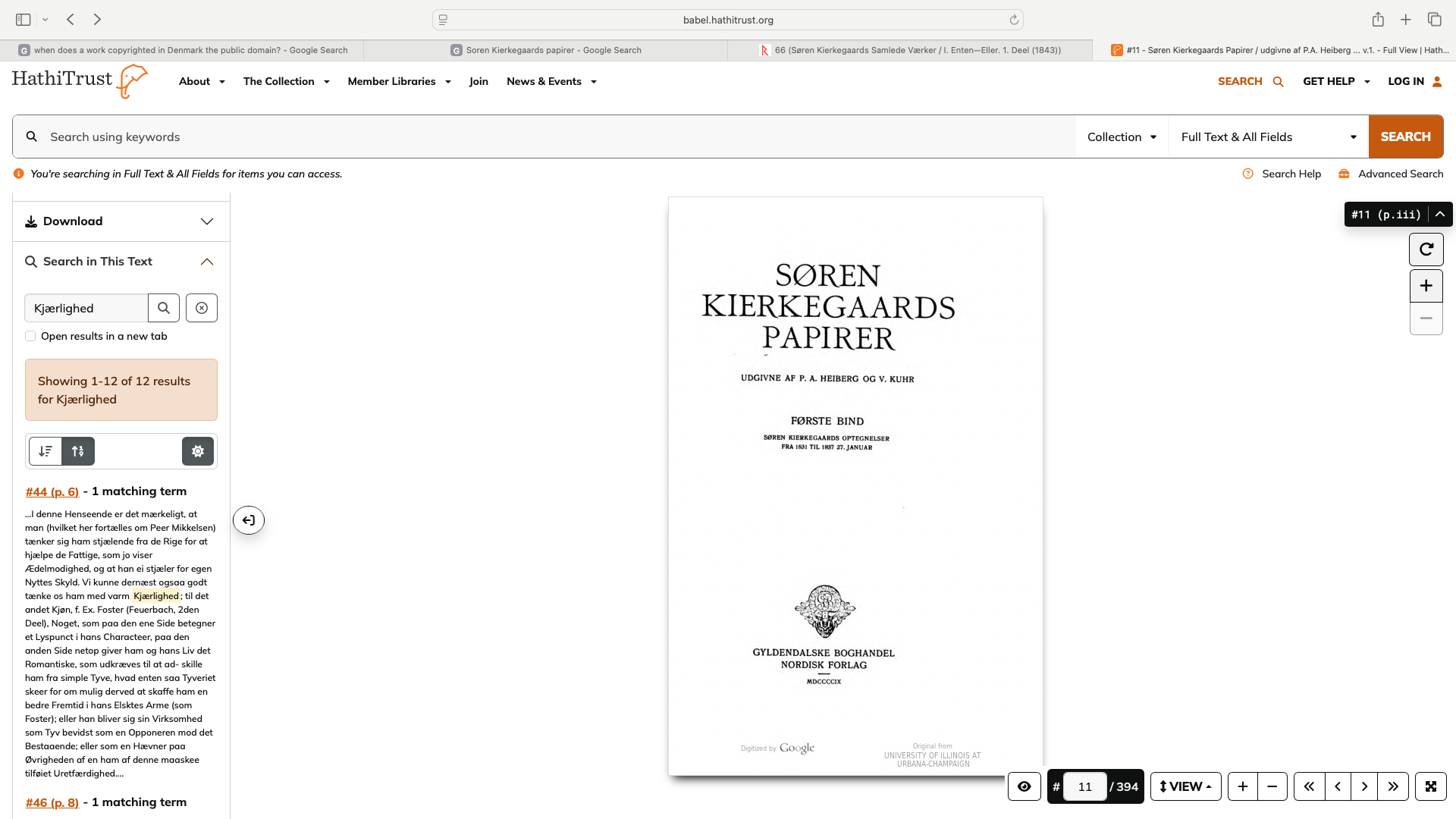
Sadly, so much time and effort went into the production of these two new editions of Kierkegaard’s works, it will be at least a generation before we can expect a genuinely complete and reliable edition of Kierkegaard’s works in either Danish or English. Happily, some, at least some of the volumes of the earlier, but also complete, collection of Kierkegaard’s unpublished works, Søren Kierkegaards Papirer are available online through the Hathi Trust website and are actually searchable via a little field to the left of the text (see illustration above). Unhappily, one can search only a single volume at a time and it appears that vols. 7 and 8 are not available in searchable editions (though one hopes perhaps they will be soon). 

Happily, I have two copies of the Papirer, a nice hardcover that used to belong to the library of Franklin and Marshal College and which I bought on eBay (yes, you can occasionally get stuff like that on eBay!) and an older severely dilapidated softcover edition that I bought many years ago from Bob Perkins and Sylvia Walsh Perkins, and I have decided to tear that one apart, scan it, and throw it up online as one huge searchable file. The scanning shouldn’t actually be too complicated or take too long. What I expect will take some time is finding a suitable home for the huge file once it is ready to be uploaded to the web. I can’t house such a file here on this blog. First, I doubt I would have the space for it. Second, what would happen to it after I died? It clearly needs to be housed on some library website. I’m applying for a sabbatical for the 2027-2028 academic year and plan to use some of that sabbatical on the project of making a searchable edition of the Papirer available online. 

Another bit of happy news is the fact that what is generally considered the best and most reliable edition of Kierkegaard’s published works, the second edition of Søren Kierkegaard’s Samlede Værker (Søren Kierkegaard’s Collected Works) is available online through something called Project Runeberg. This edition, despite being lauded as the best, is not popular among contemporary scholars because it was produced during a period the resurgence of Nordic nationalism and hence uses the old Fraktur, or what the Danes call Gothisk, typeface and many contemporary scholars find it difficult to read. In fact, it takes very little time to read it. Those who don’t have the patience to master it, however, will be pleased to learn that there is a Roman typeface version of each page immediately below the scanned version. 

Unhappily, this version hasn’t been proofread, so it is possible there might be some errors in it. Happily, anyone who has the truly minimal amount of patience that is required to learn to read Fraktur, can get some valuable proofreading experience, or “service” credit, for helping out Project Runeberg by proofreading some, or even all, the pages of a particular volume. You wouldn’t even need to be able to read Danish to be able to do that proofreading. You’d just have to learn to read Fraktur so that you could tell in the words were rendered properly in the Roman version of the text. In fact, it might actually be a disadvantage to be able to read Danish because of the well-known capacity the brain has to “fix” spelling, etc., if it knows how the word should be spelled, without ever consciously alerting the reader to the fact that the word in the text in question was misspelled. That bane of the existence of proofreaders would not trouble a proofreader who did not know Danish!

Kierkegaard, MacDonald, and Universalism at the 2025 AAR

As usual, this year’s annual meeting of the American Academy of religion was rich with Kierkegaard sessions. I will say more about those sessions in a later post. The point of this post is to describe what were, for me, the highlights of the conference. 

I don’t know whether I mentioned this in any earlier posts, but I’m a member of an Anglo-Catholic church here in Philadelphia called S. Clement’s. It is a wonderful community of generally politically progressive, but liturgically conservative, Christians and it has the most beautiful services I’ve ever attended. Michael Glass, a Kierkegaard scholar who recently received his Ph.D. from Temple is also a member of S. Clement’s.

So anyway, my husband, Brian Foley decided we should try to attend the High Mass at an Anglo Catholic church while we were in Boston for the AAR meeting. I can’t remember whether I directed him to The Church of the Advent (which I had somehow learned the Kierkegaard scholar Jeff Hanson had been affiliated with at one time), or whether he found it on his own. Jeff was there, of course, that Sunday and we were able to chat briefly with him after the service. The highlight of the service, though, was a bell chorus and the flamboyant “Queen Anne’s” incense move shown in the video that accompanies this post. 

Wild, eh? 

The church was wonderful. The incense, unfortunately, set off the smoke alarm so everyone, congregation, choir, etc., etc. had to file out into the cold and conclude the services in the street. Everyone was very good natured about it, though, and when we received the all-clear, we headed downstairs for a sumptuous coffee hour and a trip to the little bookstore in the basement.

We’ll definitely be visiting The Church of the Advent again!

The second highlight of the conference for me was a special session on adoption of the Scriptural Reasoning Unit of the AAR. I presented a paper at that session entitled “The Dark Side of Adoption” that defended George MacDonald’s argument that Paul’s υίοθεσία (cf., e.g., Romans 8:15) should not be translated as “adoption.” I was surprised at how positive was the reception of my defense of MacDonald on this point. People often become very wedded to the precise wording of the writings they hold sacred, so I expected some pushback, but there was virtually none. I was also very fortunate to have MacDonald scholar Laurie Wilson present in the audience and she graciously helped me out with a couple of questions that stumped me. (I’ll say more about Wilson, who had earlier presented a paper at the joint session of the Kierkegaard, Religion, and Culture Unit and the Nineteenth Century Theology Unit, in a later post.) 

MacDonald was a genius at, among other things, interpreting the Greek of the New Testament. He argued in a sermon entitled “Creation in Christ,” from Unspoken Sermons Series Three (published in 1889), that Biblical translators had mistranslated the beginning of the Gospel of John. As I mentioned, people often become very wedded to the precise wording of the writings they hold sacred, so it took a full one hundred years for MacDonald’s insight to be incorporated into any English translation of the Bible. It was finally incorporated, though, into the New Revised Standard Version (published in 1989) (I’m indebted to Ben White for pointing this out to me), so perhaps one day MacDonald’s point about the proper translation of υίοθεσία will be incorporated into an English translation of Romans.

The real highlight of the conference for me, though, was a special session that Lee Barrett, Robin Parry, and I organized on universalism. Parry, the author of the best-selling The Evangelical Universalist (published under the pseudonym Gregory MacDonald), chaired the session, Barrett, of Moravian Seminary, and Tom Greggs, of The Center for Theological Inquiry at Princeton, were the presenters, and I served as a respondent after Thomas Talbott was forced to withdraw as a speaker for family reasons. 

I had no idea what to expect in terms of attendance. The session was what is called an “Other Event” at the AAR, meaning that it was not sponsored by an existing AAR unit. It was listed in the conference program, and the Søren Kierkegaard Society had generously promoted it to its members, but I had no idea how many people would actually read the program that closely, or how many Kierkegaard people would be interested in universalism. We’d discussed ordering refreshments for the session, but had decided against it out of fear that there might not be enough people to justify spending the money.

How wrong we were! The venue, albeit small, was packed. There was literally standing room only. The papers were excellent and the discussion was exceptionally lively. There was a palpable energy among those present, even my husband, who showed up only as the session was concluding, remarked on it. Parry explained that the session organizers were in the process of establishing a new scholarly organization, the Society for the Study of Christian Universalism, and requested that anyone interested in joining the society should put their name and contact info on a sheet that would be passed around the audience. We got more than twenty names! (Several of the names and email addresses were undecipherable, though, and my guesses as to what they were were unsuccessful, so if you had put your name on the list, but have not yet heard from me, please email me at mgpiety@drexel.edu and tell me that you want to be added to the list. Or if you were not present at the AAR session but you are reading this post and would like to be added to the list, just let me know and I will add you.)

I was also able to become more closely acquainted with Kierkegaard scholar Casey Spinks who was in the audience and whom I spoke with briefly after the end of the session. I learned in that conversation that Spinks (whose Kierkegaard’s Ontology is forthcoming from Bloomsbury) had also been at The Church of the Advent that morning. There appears to be something in Anglo-Catholicism that is particularly appealing to Kierkegaard scholars. Perhaps it is the combination of deep spirituality of the Roman Catholic tradition and the anti-authoritarianism of the English Reformation. I’d be interested to hear from readers whether they are aware of any other Anglo-Catholic Kierkegaard scholars. 

I began this post with the objective of giving you a little smags prøve (or taste) of Barrett’s paper from the universalism session because that paper looked at universalism in the thought of Schleiermacher, Hegel, and, of course, Kierkegaard. I particularly liked the section on Kierkegaard because Barrett makes a very convincing case that Kierkegaard may have been a universalist, without ever actually referring to the explicitly universalist passage from Kierkegaard’s journals. That is, Barrett argues that universalism can actually be inferred from various passages in Works of Love. I’ve decided, however, that that issue deserves a post of its own, so stay tuned. I should have it up in a few more days.

In the meantime, Happy New Year!

Kierkegaard and Danielson on Foreknowledge and Free Will

I’ve been working on a collection of short, short philosophical articles that I hope to publish under the title Flash Philosophy. I conceived the idea of the genre flash philosophy because I am very fortunate to be in a department of English and Philosophy that is home to a number of creative writers who exposed me to the genre of flash fiction. Flash fiction is basically very short short stories, often only a page or two and sometimes even shorter than that. 

Philosophical articles have increased in length over time. Quite a bit has been written about this, actually, including “A Plea for More Short Journal Publications,” “Are journal articles getting too long,” and my own article “Flash Philosophy,” which appeared in Philosophy Now. The problem is that as philosophical articles get longer, they take longer to write. It can take a year or more just to draft a decent philosophical article, and then, of course, even longer than that before it gets into print. Authors are increasingly asked to basically include surveys of all the literature relevant to their argument in any article they submit for publication, even if much of that literature isn’t actually directly relevant to their argument. Not only does that make the drafting of philosophical articles very tedious, it makes the reading of them very tedious. Quite simply, it is bad form. As I explain to my students over and over again, don’t put anything in your argument that you do not absolutely have.

Philosophical articles have not always been so long, however. It turns out that many of the most highly esteemed philosophical journals such as Mind, Thought, and Philosophical Review used to publish very short articles. So I got the idea to put together a collection of some of these articles and to publish it under the title Flash Philosophy. The purpose of the collection is to demonstrate just how short a really good philosophical article can be and hence to resurrect the art of writing such short articles. Short articles are both easier to write than longer ones and easier to read. Despite that the heyday short philosophical articles appears to have been around the middle of the last century, they are uniquely suited to the digital age in that they facilitate a far more rapid development of philosophical discourse than do longer articles. To resurrect the art of writing short philosophical articles would, I believe, go a long way toward  revitalizing the discipline of philosophy.  

I got a grant several years ago to hire one of my former students as a research assistant to help me track down short philosophical articles that we could then put together in this collection. My research assistant, Daniel Wiedinmyer, combed through hundreds of volumes of old journals and produced a list of more than one hundred articles that were five pages or less. Not did that take some time, after he’d found all those articles we had to read through them to see which would be suitable for the collection. Some were obviously going to be too technical for a general readership of the sort we hoped to have. The collection is actually intended for professional philosophers as well as philosophy students and grad students, but if you are working in ethics or the philosophy of religion, some of the more technical articles in epistemology, metaphysics, or the philosophy of language, for example, are going to be hard to process. We wanted articles that made important points and made them very persuasively, but we also wanted them to be easily digestible even for philosophers from other subfields. 

That reading process actually took more than a year. After that, I had to write a preface and an introduction. I got a decent start of both, but then got distracted with other projects, such as the Drexel-Yale conference on George MacDonald that took place last December, and a number of articles on Kierkegaard that I owed to the editors of various books. Fortunately, I’ve recently been able to return to the Flash Philosophy project. I’m working on the introduction now. Basically, I am going through the collection and drafting very short summaries of the articles. That has necessitated rereading them, of course, and while I was doing that, I came across an article that it seemed to me would be of interest to Kierkegaard scholars. 

The articles is “Timelessness, Foreknowledge, and Free Will,” by Dennis Danielson. It appeared in Mind, July., 1977). God’s purported foreknowledge is often used by philosophers to support arguments against free will. Dennis Danielson argues, however, that since God’s knowledge is timeless, God can be said to have foreknowledge, or knowledge of things that have not yet happened, only from the perspective of a temporal agent. This knowledge, Danielson points out, does not in itself entail any limits on human freedom. That is, what temporal agents can claim God foreknew is “unchangeable not because it is or was foreknown but quite simply because it is past. Yet no one,” he continues, “would want to say that the unchangeableness of the past dispenses with free will.”

Does that not ring a bell with those of you who are familiar with the “Interlude” section of Kierkegaard’s Philosophical Crumbs? Kierkegaard argues quite explicitly there that the unchangeableness of the past is not the same thing as necessity and that “knowledge of the past confers no necessity.” Kierkegaard was not speaking there of God’s knowledge, but of our own knowledge of the past. What he says about knowledge being unable to confer necessity because “knowledge has nothing to give” (p. 146) could arguably be extended to God’s knowledge in the way Danielson does and Danielsen and Kierkegaard are in perfect agreement concerning the significance of the unchangeableness of the past.  

One wonders if Danielson ever read Kierkegaard.