This brief post is a little holiday weekend gift to Kierkegaard scholars. As most readers of this blog will realize by now, the new 55 volume Søren Kierkegaards Skrifter, that purports to be the definitive edition of Kierkegaard’s works in Danish is deeply flawed in that it is not actually complete, but missing quite a bit of the material the editors had originally promised it would include. That is, it was supposed to include everything, but it doesn’t. And some of the stuff that it leaves out, such as Kierkegaard’s unequivocal identification of himself as a universalist, is hugely important to understanding Kierkegaard as a thinker.
The problem of missing material unfortunately affects the new 12 volume English translation of Kierkegaard’s unpublished works, Kierkegaard’s Journals and Notebooks, as well, since this work was based on Søren Kierkegaard’s Skrifter.
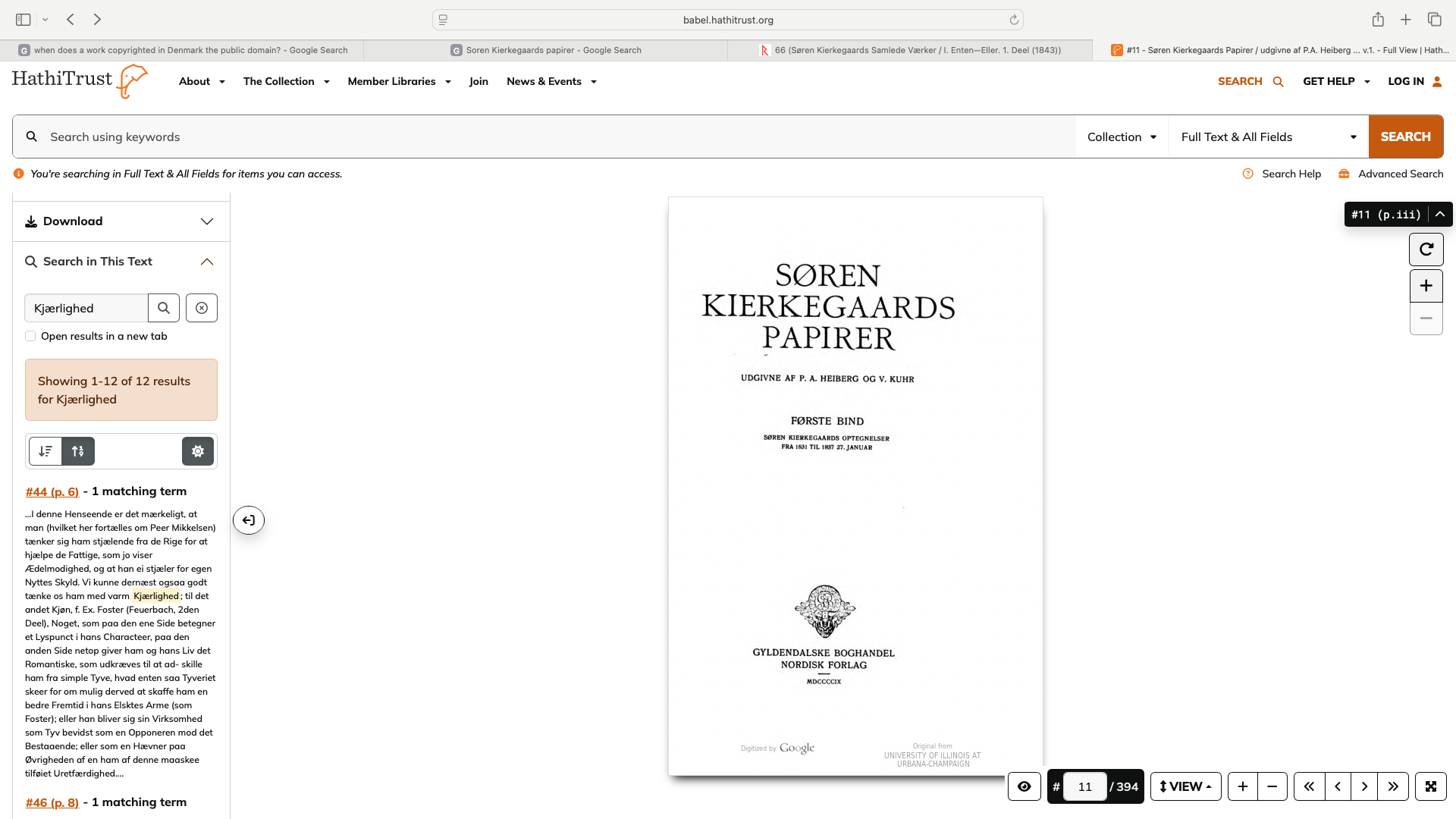
Sadly, so much time and effort went into the production of these two new editions of Kierkegaard’s works, it will be at least a generation before we can expect a genuinely complete and reliable edition of Kierkegaard’s works in either Danish or English. Happily, some, at least some of the volumes of the earlier, but also complete, collection of Kierkegaard’s unpublished works, Søren Kierkegaards Papirer are available online through the Hathi Trust website and are actually searchable via a little field to the left of the text (see illustration above). Unhappily, one can search only a single volume at a time and it appears that vols. 7 and 8 are not available in searchable editions (though one hopes perhaps they will be soon).
Happily, I have two copies of the Papirer, a nice hardcover that used to belong to the library of Franklin and Marshal College and which I bought on eBay (yes, you can occasionally get stuff like that on eBay!) and an older severely dilapidated softcover edition that I bought many years ago from Bob Perkins and Sylvia Walsh Perkins, and I have decided to tear that one apart, scan it, and throw it up online as one huge searchable file. The scanning shouldn’t actually be too complicated or take too long. What I expect will take some time is finding a suitable home for the huge file once it is ready to be uploaded to the web. I can’t house such a file here on this blog. First, I doubt I would have the space for it. Second, what would happen to it after I died? It clearly needs to be housed on some library website. I’m applying for a sabbatical for the 2027-2028 academic year and plan to use some of that sabbatical on the project of making a searchable edition of the Papirer available online.
Another bit of happy news is the fact that what is generally considered the best and most reliable edition of Kierkegaard’s published works, the second edition of Søren Kierkegaard’s Samlede Værker (Søren Kierkegaard’s Collected Works) is available online through something called Project Runeberg. This edition, despite being lauded as the best, is not popular among contemporary scholars because it was produced during a period the resurgence of Nordic nationalism and hence uses the old Fraktur, or what the Danes call Gothisk, typeface and many contemporary scholars find it difficult to read. In fact, it takes very little time to read it. Those who don’t have the patience to master it, however, will be pleased to learn that there is a Roman typeface version of each page immediately below the scanned version.
Unhappily, this version hasn’t been proofread, so it is possible there might be some errors in it. Happily, anyone who has the truly minimal amount of patience that is required to learn to read Fraktur, can get some valuable proofreading experience, or “service” credit, for helping out Project Runeberg by proofreading some, or even all, the pages of a particular volume. You wouldn’t even need to be able to read Danish to be able to do that proofreading. You’d just have to learn to read Fraktur so that you could tell in the words were rendered properly in the Roman version of the text. In fact, it might actually be a disadvantage to be able to read Danish because of the well-known capacity the brain has to “fix” spelling, etc., if it knows how the word should be spelled, without ever consciously alerting the reader to the fact that the word in the text in question was misspelled. That bane of the existence of proofreaders would not trouble a proofreader who did not know Danish!
There was a session in honor of the work of Sylvia Walsh at the years’s annual meeting of the Pacific Division of the American Philosophical Association. The presenters, Sheridan Hough, Céline Léon, and myself, focused on Walsh’s most recent book, Kierkegaard on Woman, Gender, and Love. It was a wonderful opportunity for us to express our gratitude to Walsh not just for her excellent scholarship, but for everything she had done for each of us throughout our careers. Walsh, and her husband, Robert L. Perkins, went out of their way to help and promote the work of younger scholars and those of us who benefitted from that assistance will be forever in their debt.
I’m indebted to Walsh, yet again, for helping me to appreciate what a truly egalitarian thinker Kierkegaard is on gender issues. He was way ahead of his time in his understanding of how gender stereotypes warp the development not simply of women, but also of men. I discovered this in the process of preparing my paper for the session, “Between the Lines: Reading Kierkegaard on Women (and Men).”
“That the social environment into which a woman is born plays an important role in the formation of her character,” observes Walsh in “Issues that Divide: Interpreting Kierkegaard on Women and Gender,” one of the essays in Kierkegaard on Woman, Gender, and Love, “is a viewpoint clearly voiced by Kierkegaard himself in Two Ages, a literary review of a novel by that name penned anonymously by Thomasine Gyllembourg, an accomplished female writer of the time whose works were greatly admired by Kierkegaard” (p. 4)
Unfortunately, Kierkegaard’s admiration for Fru Gyllembourg, as well as his admiration for several other prominent women of his day, has tended to be obscured by the multitude of negative references to women in his works. Some of the most notoriously sexists, even misogynistic, observations about women occur in the portion of Stages on Life’s Way, entitled “In Vino Veritas,” where various characters describe women as “incomplete form[s]” (p. 55), “display fruit[s]” (p. 77), and as lacking sufficient reflection to avoid contradicting themselves (p. 51).
One could argue that it ought to be apparent to readers, and more importantly to scholars, that the negative views of women expressed in ”In Vino Veritas” do not represent Kierkegaard’s own views for the simple reason that the views of the various speakers, about what they purport is woman’s nature, do not even cohere. Fortunately, Kierkegaard tells us himself that those views are not his own. “The purpose of the five speakers in ‘in vino veritas,’ he explains, “is to provide an illumination of woman that is essential yet false” (KJN Vol. 11, part 2, p. 24, emphasis added, the title of this section of Stages is not capitalized in KJN).
There is evidence in the authorship taken as a whole that suggests that whatever differences there might be between men and women that are rooted in their respective biologies, Kierkegaard did not view these differences as having essential significance.
So what is that evidence? The following observation, written around 1849 in one of Kierkegaard’s journals is key: “There really is something to the view that one ultimately finds a bit more self-sacrifice among women,” he observes. It’s tempting to interpret this to mean that Kierkegaard really does think that there are essential differences between men and women based on their biology. But then he goes on to say that this abundance of self-sacrifice one finds in women
is no doubt because they live quieter and more withdrawn lives and thus a little closer to ideality; they don’t as easily acquire the marketplace measures used by men, who get right to the business of life. What saves women is the distance from life that is granted them for so long …. This quieter life means that women are sometimes more loyal to themselves than men are, since men are demoralized from boyhood by the demand to be like others, and become completely demoralized as youths, not to mention as men, by being taught all about the way things are in practical life, in reality. It is this very competence that is ruinous. If girls are brought up in the same way, one can say goodnight to the whole hum. race. And women’s emancipation, which tends toward this very sort of education, is no doubt the invention of the devil. (KJN NB11:159 [1849)] emphasis added.)
To descry “women’s emancipation” would certainly appear sexist when taken out of context (as many of Kierkegaard’s remarks so often are). It’s clear from this journal entry, however, that Kierkegaard believes the problem is not with the idea of educating women, but with the specific type of education the ”emancipation” movement appeared to be advocating for women. That is, Kierkegaard believed this education had a corrupting influence on men, one from which women were at least marginally more protected. Such protection is a social phenomenon, though. It may be based, in the minds of some, on the view that women’s biology makes them less fit than men to survive without such protection. This would not appear, however, to be Kierkegaard’s view. The journal entry suggests Kierkegaard believed that if women were brought up in the same way as men, far from buckling under the weight of “the way things are,” they would become exactly like men.
But an acknowledgement that women are the equal of men in their potential to deal effectively with “the way things are in practical life,” does not necessarily translate into an acknowledgement that they are the intellectual equals of men. Did Kierkegaard believe women were essentially the intellectual equals of men? Is there any evidence to support such a view? The answer is an unequivocal yes. First there is Kierkegaard’s admiration for Fru Gyllembourg, that Walsh observed and that I have already cited. There there is Walsh’s observation that,
Woman’s reflective capacity is … recognized in a … serious and positive manner by Kierkegaard in The Crisis and a Crisis in the Life of an Actress (1848), where he compares and praises the artistic genius of two actresses of his day (Madame Heiberg and Madame Nielsen) who are able, each in a different way, to bring dialectic or reflection to bear in their theatrical interpretations of the idea of femininity (C, pp. 85-90; cf. SLW, 131n.) (Walsh, p. 10).
And indeed, Kierkegaard refers to the view that women are intellectually inferior to men as a “masculine superstition” (mandelig Overtro) (KJN Vol. 5, p. 229).
Walsh observes that Anti-Climacus, the pseudonymous author of Sickness Unto Death, defines woman’s nature as devotedness. This may sound sexist to contemporary readers. Walsh points out, however, that while man’s nature is not defined as devotedness, according to Kierkegaard,
in relation to God … the self [is] defined as devotion for both man and woman, which suggests that ultimately, the self is defined in terms of the feminine for Anti-Climacus and that a distinction must be made between the penultimate selfhood or self-identity of man and woman in terms of their sexual identities, wherein they are different, and their ultimate selfhood as human beings in relation to God, wherein they are the same and equal (Walsh, 8.)
Women thus have an advantage relative to men, according to Kierkegaard, in that the cultural conception of feminine selfhood is far closer to the true self as before God than is the cultural conception of masculine selfhood. It’s important to remember, however, that this advantage is not an essential one, but a culturally constructed one. There is little, if any evidence that Kierkegaard believed this advantage was conferred on women by their biology. Quite the contrary. Kierkegaard’s emphasis is always on the essentially human.
Each one of us is a human being and then in turn the distinctive individual [det Forskjellige] that he is in particular [han særeligen er]; but to be a human being is the fundamental qualification. No one [ingen] should become so enamored of his distinctiveness that he cravenly or presumptuously forgets that he is a human being. No one [intet Menneske] is an exception to being a human being because of his distinctiveness. He is rather a human being and then the particular person he is [det han særligen er]. (WOL, 141, emphasis added).
So much for Kierkegaard’s purported misogyny. Not only does he think that the cultural conception of feminine selfhood is closer to genuine selfhood than is the cultural conception of masculine selfhood, but he thinks women are essentially every bit as smart as men, an admirably progressive view for a man of Kierkegaard’s day. This revelation about Kierkegaard also goes a long way to explaining his popularity among female readers, as well as the fact that the women who knew him, and whose recollections are collected in Erindringer on Søren Kierkegaard (recollections of Søren Kierkegaard) (Reitzel, 1980) speak so positively of him.
Kierkegaard’s overriding concern is, of course, with the truth of Christianity and how culture can obscure it by presenting a false and distorted picture of it. Our true selves, the true human self, the true selves of both men and women, as conceived by God, according to Kierkegaard, are devotion, devotion to God. That such devotion seems more natural to women is not, according to Kierkegaard, because they are essentially different from men, but because, as Kierkegaard observes in the journal entry from which I have already quoted, they are brought up differently from men. This means that not only are the various sexist comments made by the characters in “In Vino Veritas,” but indeed all Kierkegaard’s apparently sexist remarks, whether in published works or in his journal and papers, essentially satirical barbs directed by Kierkegaard at a culture, or at worldliness more generally, that can get creation so wrong.
Two of my biggest supporters throughout my career have been the late Robert L. Perkins and Sylvia Walsh Perkins. I met them both at the very first Kierkegaard conference I attended at the College of Wooster, when I was still only a graduate student. One of my professors, George L. Kline learned I planned to attend the conference and suggested that I should try to make contact there with Bob Perkins. Perkins’ work on Kierkegaard, George explained, was very good, so it would be good for me to get to know him.
I didn’t know anyone at that conference, so I was happy to have something of an information introduction to Bob. I approached him during one of the breaks early in the conference. I liked him immediately. Despite being one of the top people in Kierkegaard studies in the world, he was very warm and modest and self effacing. When I mentioned to him how his work had been recommended to me by George Kline, he seemed pleased, but immediately changed the subject. “You should read Sylvia Walsh’s work,” he exclaimed with enthusiasm. “Now there is a scholar who is really good!”
I’m paraphrasing, of course, because that first meeting was so long ago that I don’t remember exactly what Bob said. In fact, that first meeting was so long ago that Bob and Sylvia weren’t even married yet. I followed Bob’s advice and sought out Sylvia at that same conference. I quickly became friends with both of them, and not because they were the first Kierkegaard scholars I met, but because they were both truly lovely people, passionate and gifted scholars, warm, kind, and socially conscious. Bob and Sylvia supported me throughout my career. In fact, it is no exaggeration to say that without the support of Bob, Sylvia, and C. Stephen Evans, I wouldn’t have a career.
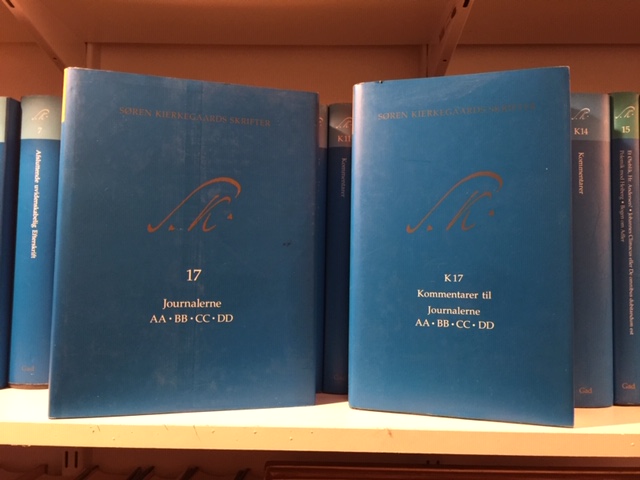
I was therefore deeply moved when Sylvia contacted me recently to ask whether I would be interested in any of the books she was planning to get rid of. She said she was winding down her scholarly activity and hence unlikely to need all the books in the large library she and Bob has amassed over the years. Among the books Sylvia offered me was a complete set of the new Søren Kierkegaards Skrifter, the most recent edition of Kierkegaard’s collected works in Danish, as well as a complete set of the new Kierkegaard’s Journals and Notebooks, the English translation of Kierkegaard’s journals and papers that is based on the new SKS.
Sylvia was also getting rid of the old Hongs’ translation of the journals and papers that they had done for Indiana University Press. I’m not a huge fan of the Hongs’ translations, as readers of this blog are likely aware. The earlier translations tend to be better than the later ones, though, and their translations of the journals and papers are very early. Also, while the new Kierkegaard’s Journals and Notebooks is far more comprehensive than the old Hongs’ translation that went under the title Kierkegaard’s Journals and Papers, the actual translations in the new edition are often no better, and sometimes even worse, than those in the older edition. The thing I like best about the Hongs’ translation of the journals and papers, though, is that it is organized thematically rather than chronologically. That makes it a pleasure simply to sit and read.
I’d wanted a set of the Hongs’ Journals and Papers for years. It is still available through Indiana, as well as Abebooks.com. It’s quite expensive, though, to get a complete set, even used. Given that I already had a complete set of the Papirer (which I had also earlier gotten from Bob and Sylvia), and given that Princeton had come out with the new Journals and Notebooks, it seemed extravagant to lay out money for the now obsolete Hongs’ translation.
But then, out of nowhere, or so it seemed, I got an email from Sylvia, whom I had come to regard as sort of my scholarly guardian angel, asking me if I wanted a collection of books that included this set. Of course the Journals and Papers are not the most important of the works Sylvia has so generously given me. They are the books, however, for which I had nurtured a secret longing. After all SKS is available online, and KJN is disappointing in some respects.
And now I have my very own set of Kierkegaard’s Journals and Papers! Thank you, Sylvia!
It seemed wrong to pick and choose books from the list Sylvia sent me, so I told her just to send them all and that I would find homes for any books I already had. Hence the title of this post. I’ve created a list of the duplicates and will send them to anyone who is willing to pay for the postage. Just write me and let me know which books you would like and why. The reason I would like you to explain why you want the book, or books, in question is in case several people write at the same time that they want the same book, or books. Basically, I will distribute the books based on a first come, first served basis, but if two or more people request the same books at the same time, an explanation of why each wants the book, or books, will help me to decide who should get them. I will let you know what it will cost to ship them and will not ship them until I hear that you are okay with that cost.
Again, I’ve attached a list of the books I am giving away. Some highlights are a complete third edition of Kierkegaard’s collected works in Danish, selected volumes of both SKS and KJN. Check out the attached list, though, for exciting finds!

 Two of my biggest supporters throughout my career have been the late Robert L. Perkins and Sylvia Walsh Perkins. I met them both at the very first Kierkegaard conference I attended at the College of Wooster, when I was still only a graduate student. One of my professors,
