Kierkegaard’s Papirer Available Online!
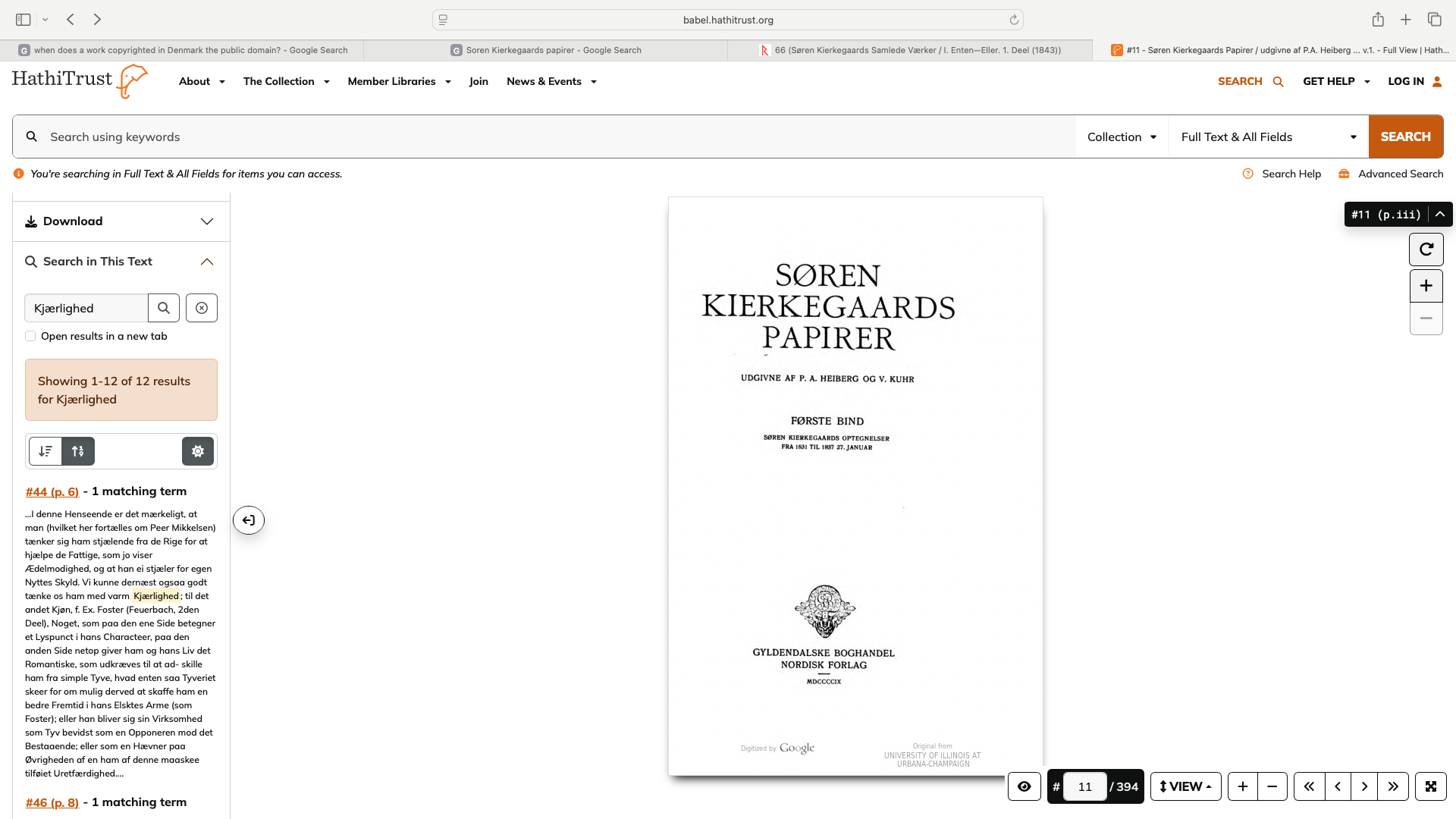
This brief post is a little holiday weekend gift to Kierkegaard scholars. As most readers of this blog will realize by now, the new 55 volume Søren Kierkegaards Skrifter, that purports to be the definitive edition of Kierkegaard’s works in Danish is deeply flawed in that it is not actually complete, but missing quite a bit of the material the editors had originally promised it would include. That is, it was supposed to include everything, but it doesn’t. And some of the stuff that it leaves out, such as Kierkegaard’s unequivocal identification of himself as a universalist, is hugely important to understanding Kierkegaard as a thinker. 

The problem of missing material unfortunately affects the new 12 volume English translation of Kierkegaard’s unpublished works, Kierkegaard’s Journals and Notebooks, as well, since this work was based on Søren Kierkegaard’s Skrifter. 

Sadly, so much time and effort went into the production of these two new editions of Kierkegaard’s works, it will be at least a generation before we can expect a genuinely complete and reliable edition of Kierkegaard’s works in either Danish or English. Happily, some, at least some of the volumes of the earlier, but also complete, collection of Kierkegaard’s unpublished works, Søren Kierkegaards Papirer are available online through the Hathi Trust website and are actually searchable via a little field to the left of the text (see illustration above). Unhappily, one can search only a single volume at a time and it appears that vols. 7 and 8 are not available in searchable editions (though one hopes perhaps they will be soon). 

Happily, I have two copies of the Papirer, a nice hardcover that used to belong to the library of Franklin and Marshal College and which I bought on eBay (yes, you can occasionally get stuff like that on eBay!) and an older severely dilapidated softcover edition that I bought many years ago from Bob Perkins and Sylvia Walsh Perkins, and I have decided to tear that one apart, scan it, and throw it up online as one huge searchable file. The scanning shouldn’t actually be too complicated or take too long. What I expect will take some time is finding a suitable home for the huge file once it is ready to be uploaded to the web. I can’t house such a file here on this blog. First, I doubt I would have the space for it. Second, what would happen to it after I died? It clearly needs to be housed on some library website. I’m applying for a sabbatical for the 2027-2028 academic year and plan to use some of that sabbatical on the project of making a searchable edition of the Papirer available online. 

Another bit of happy news is the fact that what is generally considered the best and most reliable edition of Kierkegaard’s published works, the second edition of Søren Kierkegaard’s Samlede Værker (Søren Kierkegaard’s Collected Works) is available online through something called Project Runeberg. This edition, despite being lauded as the best, is not popular among contemporary scholars because it was produced during a period the resurgence of Nordic nationalism and hence uses the old Fraktur, or what the Danes call Gothisk, typeface and many contemporary scholars find it difficult to read. In fact, it takes very little time to read it. Those who don’t have the patience to master it, however, will be pleased to learn that there is a Roman typeface version of each page immediately below the scanned version. 

Unhappily, this version hasn’t been proofread, so it is possible there might be some errors in it. Happily, anyone who has the truly minimal amount of patience that is required to learn to read Fraktur, can get some valuable proofreading experience, or “service” credit, for helping out Project Runeberg by proofreading some, or even all, the pages of a particular volume. You wouldn’t even need to be able to read Danish to be able to do that proofreading. You’d just have to learn to read Fraktur so that you could tell in the words were rendered properly in the Roman version of the text. In fact, it might actually be a disadvantage to be able to read Danish because of the well-known capacity the brain has to “fix” spelling, etc., if it knows how the word should be spelled, without ever consciously alerting the reader to the fact that the word in the text in question was misspelled. That bane of the existence of proofreaders would not trouble a proofreader who did not know Danish!

Yet Another Error in the New Kierkegaard’s Journals and Notebooks

I’ve found yet another significant error in the new Søren Kierkegaard’s Journals and Notebooks. I don’t go looking for errors, as I believe I’ve explained in earlier posts, I discover them by accident, usually when I’m updating references from the old Søren Kierkegaard’s Journals and Papers. Due to the generosity of my friend Sylvia Walsh Perkins, I have a complete set of both KJN and the earlier JP. Most of the journal references in my earlier writing, as well as the notes I’ve made over the years, are to the JP, so when I need to update those references to the new KJN, I go first to the relevant JP entry because that entry always includes a reference to the passage in Søren Kierkegaards Papirer, the only complete edition of Kierkegaard’s journals and papers in Danish. When I find the passage in the Pap. I type the Danish into the searchable edition of the new Danish Søren Kierkegaards Skrifter. That then gives me the location of the passage in SKS. The new KJN is keyed to SKS, so once I have the SKS info I can find the passage in the new KJN.

Unfortunately, I keep discovering problems with the new KJN. The problem I am going to talk about in this post concern the following passage from KJN

For a thinker there can be no worse anguish than having to live in suspense while people pile up detail upon detail; it always looks as if the idea, the conclusion, will arrive very soon. If a researcher in the natural sciences does not feel this anguish he must not be a thinker. This is the terrible tantalization of the intellectual! A thinker is, as it were, in hell as long as he has not found certainty of spirit. (KJN 4, 72.)

The Danish for this passage is:

For en Tænker kan der ikke gives nogen rædsommere Qval end at skulde leve hen i den Spænding at medens man opdynger Detail, det bestandig seer ud som kom nu Tanken næste Gang, Conclusionen. Føler Naturforskeren ikke denne Qval saa maa han ikke være Tænker. Dette det Intellectuelles rædsomme Tantalisme! En Tænker er som i Helvede saa længe han ikke har fundet Aandens Vished.

The Hongs render the Danish as:

For a thinker there is no more horrible anguish than to have to live in the tension that while one is heaping up details it continually seems as if the thought, the conclusion, is just about to appear. If the natural scientist does not feel this anguish, he must not be a thinker. This is the most dreadful tantalization of the intellectual! A thinker is literally in hell as long as he has not found certainty of spirit.

Here is how I would translate the passage: 

There is no torment more dreadful to a thinker than to have to live in the tension that while one is heaping up details it constantly seems as if the conclusion will come with the next thought. If the natural scientist [Naturforsker] does not feel this anguish, he must not be a thinker. This is the most dreadful tantalization of the intellectual! A thinker is in hell as long as he has not found certainty [Aandens Vished].

The Hongs’ translation of this passage is generally superior to the new KJN translation. There are numerous problems with the translation in KJN. First, the term translated in KJN merely as “worse” (rædsommere) is the same term that is translated later as “terrible” (rædsomme). The latter translation is more accurate in that rædssom has connotations of fear given that it is derived from ræd which Ferrall-Repp translates as “fearful, timid, afraid, frightened, timorous.” One can’t actually call the translation of rædsommere  as “worse” a error, though. It just isn’t ideal. The Hongs’ “more horrible” is actually preferable.

The same thing could be said of KJN’s tortured attempt to keep Kierkegaard’s simile “som i Helvede” a simile by translating in as “is, as it were, in hell.” The phrase sounds intolerably pedantic in English, whereas the original Danish, som i Helvede would not sound pedantic to a native Danish speaker. The tone of the original is far better preserved by rendering the simile as a metaphor. That is, som i Helvede is better translated as “is in hell,” without the Hongs’ “literally,” since if some translation of som were necessary, “figuratively” would be more appropriate, but would, again, render a passage that sounds more pedantic in English than it does in Danish.

The last annoying departure from the Hongs’ translation of the passage in question that I’m going to list in this post is the rendering of opdynger Detail  as “pile up detail upon detail.” Opdynge, according to Ferrall-Repp means  “to heap up, amass, accumulate,” so the Hongs’ “heaping up,” is arguably preferable to KJN’s “pile up,” but again, the new translation does not actually alter the sense of the passage. Even the fact that KJN renders Detail (which has no plural in Danish but which is clearly used in the plural sense in this passage) as “detail upon detail” doesn’t doesn’t actually alter the sense of the passage. 

There are lots of these unnecessary deviations from the Hongs’ translations in the new KJN translations. Rendering “Spænding” as “suspense” rather than “tension” is less desirable than the Hongs’ “tension” given that Ferrall-Repp does not list “suspense” as one of the possible English translations of Spænding. Those translations are: “1. tension; 2. estrangement; 3. excitement.” That said, “suspense” isn’t actually misleading. It’s just an unnecessary deviation from the earlier translation. One gets the sense, going through the new KJN, that many of the deviations from the Hongs’ earlier translations were made not because there was any problem with the original, but because the more changes the new translation team could come up with, the greater would be the impression that a new translation was necessary.  

No such justification for a new translation of Kierkegaard’s journals and papers was necessary, however, because the Hongs’ translation was not complete. That is, there was definitely a need for a complete English translation of Kierkegaard’s journals and papers. Sadly, KJN is not a complete translation of all of Kierkegaard’s journals and papers because is it based on SKS and SKS is not complete. That is, there’s lots of important material missing from SKS (see earlier posts on the problems with SKS).

The error in the new KJN translation of the above passage is the translation of the Danish man as “people.” Not only is this incorrect, it is seriously misleading. Man, in Danish, just like man in German, is properly translated as “one” (as indeed the Hongs did render it in their translation of this passage). That is, it isn’t other people who Kierkegaard describes as piling up “detail upon detail” (opdynger Detail), but the researcher who is the subject of the passage. 

The error in KJN actually gives the passage a different meaning. That is, it makes it look as if the thinker in question experiences rising anxiety, or whatever, as he or she watches other people’s research amass more and more material that would be relevant to some issue to which the thinker is seeking a resolution, or some question to which he or she is seeking an answer. In fact, such a view could be attributed to Kierkegaard, as I in fact did attribute it in the paper I gave at Princeton in July. That is, I pointed out in that paper that science and scholarship, according to Kierkegaard, are collective endeavors, that no individual scholar or scientist can be the sole arbiter of truth in his or her discipline. 

The new KJN translation of the passage in question from Kierkegaard’s journals would appear to support such a view and could easily be appropriated by scholars as a reference that would support such a view. The thing is, it doesn’t. It isn’t inconsistent with such a view. It just doesn’t speak to the issue of how the establishment of truth in science and scholarship is a collective endeavor. The issue of this passage is how intellectuals, or scholars and scientists, are actually unwittingly searching for a kind of certitude, or mental calm, that cannot be found in the realm of science and scholarship, or of ideas more generally, but only in the realm of spirit. 

So scholars beware. If you are not actually fluent in Danish and have your own edition of Soren Kierkegaards Papirer (or easy access to a library that has it). Then you are going to want to get ahold of a copy of the Hongs’ Søren Kierkegaard’s Journals and Papers. As hard as I sometimes am on the Hongs, I think they actually did a very nice job with the journals and papers. Sadly, as I mentioned about, their translation is only a selection, so serious Kierkegaard scholars are going to need to supplement it with references to the Papirer, and that, of course, means they are going to have to learn Danish!

Opportunity to Present Your Work!

I have been a member of the steering committee of the Kierkegaard, Religion, and Culture Group of the American Academy of Religion, on and off, for many, many years. Sylvia Walsh Perkins brought me onto the steering committee, as she did Marcia Robinson. Sylvia was always looking out for younger scholars, and especially women, because she knew from experience how inhospitable the world of scholarship could be for women. 

Continue reading → Opportunity to Present Your Work!