Page 4 of 5

Kierkegaard’s Journals and Notebooks–OH NO!

I have only the first volume of the new English translations of Kierkegaard’s Journals and Notebooks published by Princeton University Press and the reason I have that volume is that I was given a free copy by the Scottish Journal of Theology when I agreed to review it for them. The editors include some scholars, such as Alastair Hannay and Vanessa Rumble, who have an excellent command of Danish. I was suspicious, however, of the rate at which they were cranking out the translations.

Translation is hard work. Good translations take some time to produce. It was hard for me to imagine that anyone could translate all of Kierkegaard’s journals and papers in the short time Princeton had projected it would take and actually do a decent job. The first volume in the Princeton series appeared in 2007. Since then, nine of the projected 11 volumes have appeared. That’s more than a volume a year.

I’ve not made a serious study of these new translations of Kierkegaard’s journals, since I did my review of the fist volume. I generally work with the original Danish versions that are available for free in searchable editions online. I’m working on a paper on humor in Kierkegaard right now, however, and I ran across a passage from one of Kierkegaard’s journals that I wanted to use for my article. The late, and venerable George Kline taught me that even if one has an excellent command of a particular language, if there exists a definitive English translation of a work in that language from which one wishes to quote, it is incumbent upon one to use the language of the translation. It’s a courtesy to the reader. If everyone who knew German, for example, did his own translations of Kant when quoting Kant, those poor souls who did not know German would have a hard time locating the passage in question. So I figured that I should use the wording of the new Kierkegaard’s Journals and Notebooks and dutifully looked up the passage that was, fortuitously, in the one volume of KJN that I happened to own. The translation reads as follows:

Humor is irony taken to its maximum vibration. Although the Xn aspect is the real primus motor, there are still people in a Christian Europe who have not come to describe more than irony, which is why they have also been unable to practice the absolutely isolated humor that subsists in the person alone.

That sounds kind of weird, doesn’t it? What is “the absolutely isolated humor that subsists in the person alone”? That doesn’t even sound like English, does it? I worked for many years as a translator when I lived in Denmark. I also know a little bit about translation theory. If I ever teach translation, or translation theory, which I hope one day to do, I am going to drill home to my students that translations should never sound awkward unless the original is awkward.

As I said, translation can be very difficult. It took me several days to come up with my translation of the passage from Repetition that I referred to in the blog post from 5 December 2015 Since, however, a translation is going to be around for a very long time, haste in seeing it to press is unadvisable. How does that saying go: “Translate in haste, repent in leisure”?

Here is the Danish for the passage in question:

Humoren er den til sin største Vibration gjennemførte Ironie, og omendskjøndt det Χhristelige er den egl. primus motor, saa kan der desuagtet findes i et christeligt Europa Folk, som ikke er kommen til at beskrive mere end Ironien, og derfor hell. ikke have kunnet gjenemføre den absolut-isolerede, personlig-ene-bestaaende Humor, d. 4 Aug. 37.

Here is my translation:

Humor is irony taken to its maximum vibration. Even though Christianity [det Xhristelige] is the genuine primus motor [prime moving force], it is still possible to find peoples in Christian Europe who have come no further than describing irony and who are hence incapable of achieving the absolutely isolated, uniquely personal humor.

My wording of the first sentence is identical to the wording of KJN. After that, the two translations diverge. There is nothing in the Danish that corresponds to KJN’s “aspect.” That’s an attempt on the part of the translator, or translators, to make sense of Kierkegaard’s “det Xhristlige” which translates literally as “the Christian” where “Christian” functions as an adjective. The thing is, there is no noun that it qualifies, so the translator simply added “aspect” without indicating that it was added. That in itself is no great crime (though it is a crime, interpolated material should be enclosed within brackets). The problem is, that it is actually misleading rather than helpful.

All genuine humor, according to Kierkegaard, has its foundation in Christianity. I won’t try to defend that claim here, suffice it to say in this context that it does. Kierkegaard is not talking here about some aspect of humor being Christian. How could some “aspect” of irony or humor be the “prime mover” that propels irony into the territory of humor? The prime mover has to be fundamental to the thing in question, not merely an “aspect” of it.

The “a” in front of “Christian Europe” is literally correct, but it’s unnecessary. What other kind of Europe was there? Danish, like German, uses articles more often than does English so to include them all in a translation is not only unnecessary, it yields a translation that is unidiomatic.

“[D]escribing” is a toughie. The Danish term in question is “beskrive,” a cognate of “describe.” It appears, in this context, to mean “describe” in the sense of “describing an arc.” That is, it appears to mean something like “exhibiting,” or better, “performing.” In fact, I think it means something closer to “understanding,” I was, therefore, tempted to use “understanding” instead of the more literal “describing.” What decided me against that was the fact that an astute reader could figure that out by him, or herself. Generally, a translator should not interpret the text for the reader unless that is the only way of making it comprehensible. There are often instances in which that is the only way to make a text comprehensible, but this did not seem to me to be one of them.

“Folk” unequivocally refers, however, to “a people,” and not to “people.” It’s a stab at the Danish people as a group. They are the “Folk” in “Christian Europe” to which Kierkegaard is snidely referring. If he had meant “people,” he’d have written “mennesker” (or “Mennesker” given that he was writing in the nineteenth century).

The worst problem with this translation, however, is the very last part: “the absolutely isolated humor that subsists in the person alone.” Really? That’s the best this august translation team could come up with? It doesn’t even sound like English. The minimum criterion for an English translation, it seems to me, is that it should sound like English, even if the translator needs to be rather free in the translation in order to achieve that effect. What is bizarre about the KJN version of this passage is that it is not, in fact, as one might expect, a literal translation. The Danish is: “den absolut-isolerede, personlig-ene-bestaaende Humor.” That translates literally as: “the absolutely isolated, uniquely personal humor.” Really, I kid you not. “[P]ersonlig” you can probably figure out for yourself, and “ene-bestaaende” translates as “unique.” Don’t take my word for it. Type it (or the contemporary “enebestaende”) into Google translate.

My guess is that the translators elected to use “subsists in the person alone” rather than the literal “uniquely personal” because Kierkegaard’s text has “personlig-ene-bestaaende” rather than “personlig enebestaaende.” That is, Kierkegaard appears to want to highlight the root words of “enebestaaende”: “ene” (which according to Ferrall-Repp means “alone, by oneself, solely”) and “bestaaende” (which according to Ferrall-Repp means “to consist in; to consist – be composed of; to subsist, exist, continue, endure”).

This shows the limits, however, of translation because while Kierkegaard can emphasize the parts of “enebestaaende” without losing the whole, a translation cannot do this. The translators, in this instance, appear to have elected to emphasize the parts, with the effect that they have lost the whole. Not only have they lost the whole, they’ve diminished what one could call the music of the text in the process. It is the chief sin of the Hongs’ translations, I believe, that they very often lose the music of the originals. Unfortunately, this would appear to be a problem with these new translations of Kierkegaard’s journals as well.

I don’t mean to suggest here that all the text of the new KJN is as bad as this particular passage. It isn’t. It is very disappointing, however, to see stuff like this in new translations when the point of producing new translations is precisely to make improvements on earlier translations.
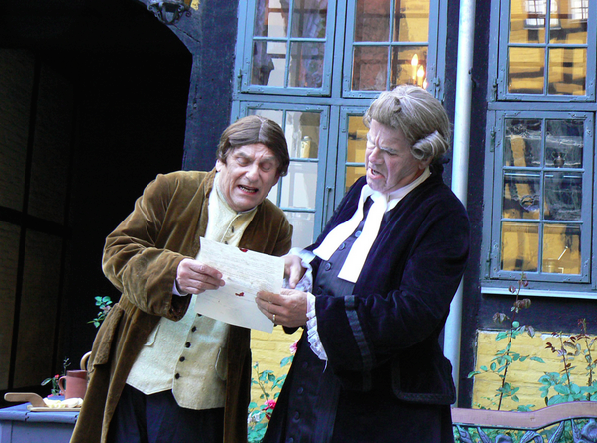
Erasmus Montanus

Untitled 2
Scene from a production of Erasmus Montanus by Bagsværd Amatørescene, Photographer: Flemming Mortensen

There are two places in Kierkegaard’s published and unpublished works where he refers to the earth being “as flat as a pancake.” The first is in his review of H.C. Andersen’s failed attempt at a novel, Kun en Spillemand, that was published under the title of From the Papers of One Still Living, and the second is in his Concluding Unscientific Postscript to the Philosophical Crumbs

The second reference will no doubt be familiar to Kierkegaard scholars. It is in that passage where Kierkegaard, or Johannes Climacus, the pseudonym under which Kierkegaard published the Postscript, illustrates his claim that the mere utterance of an objective truth is not in itself evidence that the person who utters it is sane. “Let me recount an incident,” he begins, “that without any kind of adaptation from my side, comes straight from an insane asylum.” He then tells the story of a man who escapes from this asylum and on his way into town, finds a little skittle ball lying on the ground. He absent-mindedly picks up the ball and puts it in the tail pocket of his coat. As he walks, the ball gently hits him, explains Climacus, on his “a – “ and presumably, the fact of it’s being a ball, reminds him every time it strikes him that the earth is round. Since he knows that everyone agrees that the earth is round, he decides that the best way to convince people that he is sane is to go about saying continually ”the earth is round!”

“And indeed is not the earth round?” ask Climacus. “Does the asylum crave yet another sacrifice for this opinion as when everyone believed it to be as flat as a pancake?” (Hannay, 164). This reference to the earth being “flat as a pancake” is clearly an allusion to Ludvig Holberg’s play Erasmus Montanus. I cannot remember how I learned this. I could have sworn it was in an explanatory note in either one of the English translations of the Postscript or in the text as it appears in the new Søren Kierkegaards Skrifter. But I have searched in vain for such a note, though SKS does acknowledge that the first appearance of this phrase in Kierkegaard’s works, the one in From the Papers of One Still Living is an allusion to the Holberg play.

Since there are at least two references to this play in Kierkegaard’s works, I felt that I should read it. I didn’t own a copy, however, so I did a google search, in the hope that I could find a copy online. I did. Not only did I find a copy, but I found a download able copy in English translation!

The play is hilarious. The Danes like to claim Holberg as one of their own, but in fact, he was Norwegian. The thing is, Denmark ruled Norway back then, so Norwegians were viewed, more or less, as Danes, particularly if they distinguished themselves the way Holberg did. I’m telling you this because the play is clearly set in Norway, in that it concerns a people in a little mountain village and, well, there are no mountains in Denmark. Back in the 18th century, when the play is set, residents of Norway who wanted a university education typically attended the University of Copenhagen. So Rasmus Berg, the eldest son of a prosperous farmer does just that.

I don’t know if all the instruction was in Latin back then, but at least some of it was. Students were typically taught to argue in Latin and showy Latin disputations were part and parcel of university life. Rasmus Berg returns to his little mountain village as Erasmus Montanus, determined to impress everyone with his new learning. Unfortunately for him, the local deacon succeeds in convincing the poor townsfolk, none of whom know a word of Latin, that he is beating the pants off Berg, or Montanus, in Latin disputation even though the Latin he purports to be speaking is nothing but gibberish, bits and pieces of Latin grammar, and other odd words and phrases that he strings together to form nonsensical sentences that he utters with such passionate conviction that everyone feels sorry for poor Berg, or Montanus, for being shown up that way in public.

That isn’t the worst of it, though. The townsfolk are so scandalized when Berg, or Montanus, informs them that the earth is round, that his future father-in-law withdraws his permission for Berg to marry his daughter. Berg, or Montanus, is forced, finally, to recant his statement that the earth is round in order to win the hand of his ladylove.

Interesting, eh? Not only was Kierkegaard understandably taken with the play, the whole thing is kind of a metaphor for his life. There are lines in it about how the earth must be flat because everyone but Montanus thinks it is, and that truth is in numbers. There is the general backwardness of the mountain people that mirrors what Kierkegaard thought of as the backwardness, or philistinism, of the people in the little market town of Copenhagen. And then there is the fact that Montanus had to surrender his calling as an intellectual, to betray his learning, to betray what he knew to be true, in order to enjoy the pleasures of domestic life. This, as we all know, was a sacrifice Kierkegaard could not himself make.

I have come to believe that there are likely many more allusions to this particular play in Kierkegaard’s authorship than have yet been recognized as such. If you can find one yourself, please send it along. Perhaps we can write a collective paper on the influence this play on Kierkegaard’s works, and if there are enough of us, then everyone will have to admit that our claims are correct –– right?

(Hannay, who is generally an excellent translator of Kierkegaard, has inexplicably rendered the Danish Keglekugle as “skittle bowl” instead of “skittle ball.” Perhaps this is some kind of Anglicism with which I am unfamiliar. The object in question is indisputably a skittle ball, however, as both earlier English translations of the Postscript indicate, no matter what people in the UK call it.)


Observations on the Various Editions of Kierkegaard’s Collected Works

SV 2 two pages

There are now four different Danish editions of Kierkegaard collected works. The first edition, edited by A.B. Drachman, J.L. Heiberg, and H.O. Lang was published by Gyldendal between 1901-1906 and comprised 14 volumes. The second edition, published between 1920-1936, was essentially a corrected version of the first edition with the inclusion of a very helpful fifteenth volume that contained author and subject indexes for all the individual volumes as well as a glossary of the more important terms in Kierkegaard’s authorship.

A third inexpensive popular edition of Kierkegaard’s collected works in 20 volumes was published in the 1960s. This edition was never intended for use by scholars and is marred by numerous errors that were more than likely a result of how quickly the edition was produced (one volume per month according to Tony Aalgaard Olesen).

The second edition is generally considered to be the best of the collected works as well as the most readily available. It’s still possible to find it in used bookstores in Denmark for a reasonable price. A casual web search I did just now turned up three copies at Vangsgaards Antikvariat for between 1,000DK and 1,800DK (approximately $150-$300).

The first edition is still preferred by scholars, however, because the second edition, produced as it was during a period of the resurgence of Nordic nationalism was printed in Blackletter, or Gothic type, and many contemporary scholars find that difficult to read. The English translations of Kierkegaard supervised by Howard V. Hong and Edna H. Hong and published by Princeton University Press in the ‘80s and ’90s thus have page correlation numbers to the first, rather than the second, edition of Kierkegaard’s collected works.

Unfortunately, the first edition of Kierkegaard’s collected works is increasingly difficult to find and generally very expensive. Fortunately, there is a new edition of Kierkegaard’s collected works. This new edition, produced by the Søren Kierkegaard Research Center in Copenhagen is distinguished from the earlier editions by a new title. Whereas all three earlier collected works were titled Søren Kierkegaards Samlede Værker (literally Søren Kierkegaard’s collected works, or SV), the new edition is titled Søren Kierkegaards Skrifter (Søren Kierkegaard’s writings, or SKS).

There is much to recommend the new edition. The individual volumes have been beautifully produced, at least from an aesthetic standpoint, and each is accompanied by a helpful companion volume of commentary. The edition purports to be a “critical” one, but unfortunately falls short of that ideal. It was produced too quickly to ensure the kind of quality that is requisite for a critical edition and the editorial staff was generally too inexperienced in that type of work. The 55 volumes were produced between 1997 and 2013, or 16 short years compared, for example, to the critical edition of Kant writings on which work began in 1900 and is apparently still continuing!

The haste with which this new edition was produced is likely the explanation for problems such as the one I identified in the notes to my translation of Kierkegaard’s Repetition. The fictional narrator of that work refers to the “disappearance” of the young man who was the subject of his observations. “[D]isappearance,” as I explain in a note, was originally “death.” Kierkegaard apparently changed “death” (Død) to “disappearance” (Forsvinden) after learning that his former fiancée, Regine Olsen, had become engaged. SKS has Forvinden (recovery), however, rather than Forsvinden. The original 1843 edition of Repetition, on the other hand, has Forsvinden, not Forvinden and since there is no explanation for the change in SKS, it appears it’s simply an error.

So the new edition is not perfect. The critical apparatus is extensive, but somewhat arbitrary in what it includes and does not include and the price for all 55 volumes (at approximately $100 each) is prohibitively expensive. Despite this, however, it will become the standard scholarly edition because not only can volumes be purchased individually, but the entire edition is available in searchable form online! For that reason alone, I find myself often referring to it.

In my opinion, however, the most reliable text is still that of the second edition. The type takes a little getting used to, but not so long as many people seem to fear. I’m very fortunate, actually, in that not only do I have a second edition in excellent condition, someone actually went through my edition and put page correlation numbers to the first edition in the margins. I kid you not, there are page correlation numbers on every single page of every single volume. Not only are there these numbers, whoever put them there also put a tiny mark at the point in the line of the text where the new page began.

You can see these lines, just barely, in the photo above. There’s one between “saa” and “aldeles” on the page at the left, and another after the dash and just before “Om” on the page at the right. Pretty cool, eh! My theory is that my copy of the second edition must have been used in the production of the page correlation tables in the third edition, or in Alastair McKinnon’s concordances. It’s hard to imagine someone would have undertaken the labor involved in putting in all those numbers unless he were being paid to do so. I’m grateful to whoever did it though. I can now quickly check the accuracy of the Hongs’ translations even though they include page correlation numbers only to the first edition.

This extremely rare (very likely one of a kind) copy of the second edition of Kierkegaard’s collected works is only one of the many antiquarian treasures I collected while I lived in Denmark. I plan to write about more of my treasures later.