Some Praise for the Hongs as Translators

I’ve been hard on the Hongs’ translations of Kierkegaard’s works in posts on this blog. My criticisms of the Hongs’ translations don’t stem from any personal animosity. That’s how I was trained. That is, I was taught that scholars needed to be hard on one another in order to push scholarship forward. I sincerely hope, however, that my criticisms of the Hongs’ translations have not blinded my readers to the debt everyone in the community of Kierkegaard scholars owes to them. Where would we be without their years of that selfless dedication? The Hong Kierkegaard Library at St. Olaf College has been a real force for good, and for scholarly progress in the world of Kierkegaard studies. Don’t take my work for that, though, please check out the library’s website if you are not already familiar with the many programs they offer. 

I first met Howard and Edna Hong in the summer of 1987 when I had a fellowship to study at the Kierkegaard Library. They were both lovely people and wonderful hosts to all the visiting scholars. Howard was a ubiquitous presence around the library, which at that time was housed on the very top floor of one of the classroom buildings and was outfitted with large black slate tables that must have come from some science classroom. It was cool and dark and quite, just like a library should be. It was a wonderful place to work. 

Howard had put together a collection of used books that were duplicates of some of the books in the library. He invited the visiting scholars to purchase, at very modest prices, any of these books that took their interest. My purchases from Howard’s duplicates were the beginning of my own library of works on Kierkegaard. Both he and Edna were, as I mentioned, wonderful hosts. I was only a graduate student at the time, but I felt as welcome in the community there at the library as if I had been a full-blown scholar!

I like to think that neither Howard nor Edna would be offended by my criticisms of their work, that they would accept them in the spirit of commitment to the progress of scholarship, because it is certainly from such a commitment that those criticisms spring rather than, as I mentioned above, any personal animosity. I had nothing but admiration and affection for both of the Hongs, and for everything they did to advance Kierkegaard scholarship. I’m able to engage with Kierkegaard’s texts in the manner I do, at least partly because of the work they did before me. Everyone in Kierkegaard studies is enormously indebted to the Hongs for their selfless commitment to the promotion of Kierkegaard’s thought. 

I’m, therefore, deeply honored to have been invited to be the keynote speaker at the 10th International Kierkegaard Conference at St. Olaf College this summer and thought I would use this occasion to highlight some places where one of the Hongs translations has corrected some errors in an earlier translation. 

I’ve decided to focus on Works of Love because I am currently reading through it with Mark Lama, a newcomer to Kierkegaard studies, but an enormously talented scholar with a truly enviable affinity for Kierkegaard’s thought (check out this fantastic post by Mark on a mathematical metaphor in Works of Love)! And while reading through it, I’ve discovered several places where the Hongs’ translations, both the older translation for Harper and Brothers (1962) and the new translation for Princeton (1995), correct errors in the Swensons’ translation (Princeton, 1946). I generally love the Swensons’ translations, but there is no getting around that there are actual errors in their translation of Works of Love. 

The first of the Swensons’ errors concerns the translation of Kierkegaard’s “Christenhed” as “Christianity” on page 39. The Danish for the passage is:

Det kunde rigtignok synes, at da Christenheden nu saa længe har bestaaet, maa den vel have gennemtrængt all Forhold og  — og os Alle. Men dette er et Sandsebedrag. Og fordi Christendomen har bestaaet saa længe, dermed er jo dog vel ikke sagt, at det er os, der har levet saa længe eller saa længe været Christne. (SKS 9, p. 53.)

The Swensons have:

It might certainly seem that since Christianity has now existed for so long, it must by now have penetrated every relationship—and all of us. But this is an illusion. And because Christianity has existed so long, that is certainly not saying that we have lived as long, or have so long been Christian. (p. 39.)

The Hongs’ translation from 1962 has:

It might well seem that since Christendom has existed so long now it must have penetrated all relationships—and all of us. But this is an illusion. Because Christianity has existed so long it cannot thereby be said that it is we who have lived so long or have been Christian for so long. (p. 60.)

That is, the Hongs correctly translated Kierkegaard’s “Christenhed” as “Christendom” and Kierkegaard’s “Christendom” as “Christianity.” The passage is clearly talking about two different things, the enduring nature of Christian culture, or what one might think of as the visible church, on the one hand, and the enduring nature of genuine Christian faith, or the invisible church, on the other hand. 

Unfortunately, the newer Hongs’ translation for Princeton appears to make the same mistake as the Swensons’ translation (see page 46). My own experience with the copyediting that is done by publishing houses leads me, however, to believe that this was likely not an error on the Hongs’ part but on the part of some editor at Princeton. This belief is supported by the fact that both the second edition of Kierkegaard Samlede Værker, or “collected works” (which is generally considered the best of the three editions of the Samlede Værker), and the new Søren Kierkegaards Skrifter have first “Christenhed” and then “Christendom” in the passage in question and the Hongs knew well how each of these terms should be translated.

The next error in the Swensons’ translation occurs in the context of an analogy Kierkegaard draws between learning to read by first learning the alphabet and only later learning to recognize the letters in the combinations that constitute words. No child, observes Kierkegaard, has ever deluded itself that it could read long before it could spell. “But in spiritual matters, how seductive! Does not everything here begin with the great moment of the resolution, the intention, the promise—where one can read as fluently as the most accomplished lecturer presents the most practiced reading.” The problem, Kierkegaard points out, is that one then has to go out and live according to one’s resolution. That is, one has to conform one’s will and subsequent individual mundane, or everyday, actions to one’s great resolution. But how is one to do that? “[J]ust as it is with spelling,” Kierkegaard explains, “which separates the words and takes them apart” so that the meaning of the whole is lost, the mundane actions of everyday life do not stand in an obvious relation to the meaning of one’s great resolution (Hongs’ p. 133). 

That’s a pretty straightforward, and yet hugely important, point that the Hongs get right. Unfortunately, the Swensons seem to have been confused by the presence of the definite article on the end of the Danish “Stavning,” or “spelling” (the definite article is enclitic in Danish), and hence rendered Kierkegaard’s “Stavningen” (SKS, 136) as “the spelling which tears the words apart into letters” (Swenson, 109 emphasis added) with the result that it looks like Kierkegaard is talking about a particular kind of spelling, or a particular approach to spelling, when he is simply talking about spelling in general.  

The most egregious translation error in Swenson’s translation, though (or at least the most egregious I have found so far) occurs on page 126 where the Swensons have:

[F]or this is just the mystery of love, that there is no higher certainty than the beloved’s renewed assurance; humanly understood it is unconditionally to be certain of being loved, not of loving, since it is superior to the relation between friend and friend (Swenson, 126).

Does that make sense to you? I have to confess that it does not make much sense to me. The Danish is:

[T]hi dette er just Kjærlighedens Gaade, at der ingen høiere Vished er end den Elskedes fornyede Forsikkring; menneskeligt forstaaet er det, ubetinget at være vis paa at være elsket, ikke at elske, da det er at staae over Forholdet mellem Vennen og Vennen (SKS 9, 157.)

The Swensons appear to have been confused about the function of “er det,” literally “is it” but in this instance more properly understood as “it is.” That is, it actually qualifies “ikke at elske” or “not to love,” rather than “ubetinget at være vis paa at være elsket,” or “unconditionally to be certain of being loved.”

The Hongs, thankfully, again, get it right. They have:

[T]he very enigma of love is this—that there is no higher certainty than the beloved’s renewed assurances. In the human sense, to be absolutely certain of being loved is not to love, since this means to stand above the relationship between friend and friend (Hongs, 156). 

It might be tempting to assume that Kierkegaard is contrasting erotic love here with friendship. It is precisely friendship he is referring to in this passage, however, because the passage concerns Christ’s repeated question to Peter “Simon, son of John, do you love me?” That is, Kierkegaard is talking about Christ’s very human need to be loved by his friend, Peter, and loved in what philosophers call the preferential sense, or “more than these” (John 21:15-17).

I’d like to close with reference to what it is tempting to think of as a very mundane sort of error in the Swensons’ translation. That is, the Swensons translated “Vor Pligt at elske de Mennesker, vi see” (SKS 9, 155) as “Our Duty to Love the Men We See” (Swenson, 125)! I kid you not, Swenson translates the Danish “Mennesker,” which even a beginning student of Danish knows means “human beings” not “men,” as “men,” hence lending credence to the view that Kierkegaard was sexist, or even worse, a misogynist! Fortunately, the Hongs, again, get this right!

I don’t mean to suggest that I have suddenly done an about face on my view of the Hongs’ translations. I still prefer the the Swensons’, and Swenson-Lowrie translations, as well as Alastair Hannay’s translations for Penguin, to the new Hongs’ translations for Princeton from the perspective of style. I think it’s important for me to acknowledge, however, that there are instances where the Hongs get points of translation correct, where some of the works I prefer on stylistic grounds do not. I think it’s also important to point out that I like the style of the Hongs’ translations of Kierkegaard’s Journals and Papers for Indiana University Press, better than the style of much of the new Kierkegaard’s Journals and Notebooks from Princeton. Just as is the case with the Hongs’ translations, though, style was sacrificed by the team that produced the Journals and Notebooks for what they were hoping would be increased accuracy and certainly the commitment to accuracy is a laudable one. 

My hope is that translators of Kierkegaard will one day get beyond what I believe is the false dichotomy of style vs. accuracy. We can do that, however, only by being relentlessly meticulous in both our reading of Kierkegaard and our holding one another to account in how we read him. This, I believe, is the responsibility of all scholars. At least that is what I was taught by my scholarly mentors, and I believe they were correct. We make progress by pushing one another forward, so a little rough and tumble is just as it should be. 

That said, by “rough and tumble” I mean holding one another to account for the quality of our scholarship by exposing flaws or weaknesses in it. I emphatically do not mean that it is ever acceptable to engage in ad hominem attacks of one another, or to misrepresent the substance of one another’s scholarship in an attempt to discredit it, etc., etc. There is too much of that now in the scholarly community, and not only is it contributing, I believe, to the diminishing esteem in which the humanities are held by the general public, it is antithetical to the objective of all scholarship — the search for truth. I’m sure the Hongs would agree with me there.

Kierkegaard and MacDonald on Genuine Community

I recently discovered a thinker whose views are very similar to Kierkegaard’s and that has given me an opportunity to share once again my thoughts on Kierkegaard’s views on the nature of genuine community. Kierkegaard famously disparages what he refers to as “the crowd” and its “leveling” tendencies, but that does not mean he had a negative view of all collectivities. He makes very few references to positive collectivities, but that was likely first because he felt they were exceptionally rare, and second, and more importantly, because he felt describing such collectivities wasn’t his specific life’s task. His task, as he conceived it, was to encourage people to separate from the crowd, to become individuals.

Christianity, writes Kierkegaard in Works of Love, turns our attention completely away from the external, turns it inward (WOL, 376). In the stillness of God’s house, he writes in Three Discourses on Imagined Occasions, “[t]here is no fellowship—each one is by himself; there is no call for united effort—each one is called to individual responsibility” (TDIO, p. 10). 

And yet, he continues later in the same work, “in the stillness, what beautiful harmony with everyone! Oh, in this solitude, what beautiful fellowship with everyone!” (TDIO, p. 38).

It may appear that Kierkegaard is contradicting himself here, but I don’t think he is. I think what he means is that in the stillness before God, there is no “fellowship” in the sense that there is no escaping into the crowd, no hiding behind others, no opportunity for leveling reassurances that after all, it is unreasonable to expect moral perfection. 

“God wants each individual,”writes Kierkegaard, for the sake of certainty and of equality and of responsibility, to learn for himself the Law’s requirement. When this is the case, there is durability in existence, because God has a firm hold on it. There is no vortex, because each individual begins, not with ‘the others’ and therefore not with evasions and excuses, but begins with the God-relationship and therefore stands firm (WOL, p. 118).

God is the “middle term” for Kierkegaard in any genuinely loving relationship, whether that relationship is one of preferential love or neighbor love. But when God is the middle term, then genuine community is possible. 

That brings me to my discovery. I take painting lessons. I have to drive more than an hour every Saturday to get to my painting class. I enjoy the drive because the landscape through which I drive is mostly rural. Still, the drive is nicer if I have something to listen to. Sadly, the radio in my 1999 Mazda Protegé long ago bit the dust, so I have to stream whatever I listen to on my phone with the help of a small bluetooth speaker. I like to listen to books, when possible. I found something called The Hope of the Gospels, by George MacDonald on YouTube. I’d never heard of MacDonald, but I like theological works, so I thought I would give it a try. 

It was amazing! MacDonald’s writing is every bit as beautiful and inspiring as Kierkegaard’s best edifying writing and there is an uncanny similarity of views between the two. 

“Although I say, every man stands alone in God,” writes MacDonald in Miracles of Our Lord, “I yet say two or many can meet in God as they cannot meet save in God; nay, that only in God can two or many truly meet; only as they recognize their oneness with God can they become one with each other” (The Complete Works of George MacDonald, p. 13,394)

What MacDonald is describing is precisely the “beautiful fellowship” with others that a genuine God relationship not only makes possible according to Kierkegaard, but actually necessary.

“Christianity,” according to Kierkegaard, “turns our attention completely away from the external, turns it inward, and makes every one of your relationships to other people into a God-relationship (WOL, p. 376). “God just repeats everything you say and do to other people; he repeats it with the magnification of infinity. God repeats the words of grace or of judgment that you say about another; he says the same thing word for word about you (WOL, pp. 384-385). 

But this unity of the divine and the human as exemplified in the neighbor is not merely for purposes of judgment.

“Love is a need, the deepest need, in the person in whom there is love for the neighbor,” writes Kierkegaard, “he does not need people just to have someone to love, but he needs to love people. Yet there is no pride or haughtiness in this wealth, because God is the middle term, and eternity’s shall binds and guides this great need so that it does not go astray and turn into pride. But there are no limits to the objects, because the neighbor is all human beings, unconditionally every human being” (WOL, p. 67). 

“All communities are for the divine sake of individual life,” writes MacDonald, “for the sake of the love and truth that is in each heart, and is not cumulative—cannot be in two as one result. But all that is precious in the individual heart depends for existence on the relation the individual bears to other individuals: alone—how can he love? alone—where is his truth? It is for and by the individuals that the individual lives. A community is the true development of individual relations. Its very possibility lies in the conscience of its men and women. No setting right can be done in the mass. There are no masses save in corruption. Vital organizations result alone from individualities and consequent necessities, which fitting the one into the other, and working for each other, make combination not only possible but unavoidable. Then the truth which has informed in the community reacts on the individual to perfect his individuality. In a word, the man, in virtue of standing alone in God, stands with his fellows, and receives from them divine influences without which he cannot be made perfect” ( The Complete Works of George MacDonald, p. 13,393).

Kierkegaard could not have said it better himself!

I am devouring everything MacDonald wrote, at least all the theological writings. Theological writings were not all he wrote. Kierkegaard and MadDonald have more in common than the substance of their theologies. Kierkegaard, as is widely known, loved fairy tales. MacDonald loved them as well. In fact, he actually wrote fairy tales and it appears his fantastical works were enormously influential on a number of later thinkers including J.R.R.Tolkein and C.S. Lewis.

Unfortunately, the only hard copy edition of MacDonald’s collected theological writings that I have been able to find is part of his much larger complete works that retails on Abebooks.com for $1,980.53, which is just a little more than my current book-buying budget allows. Fortunately, there is an ebook version of MacDonald’s complete works that is available through Amazon for a measly $1.99! 

It is profoundly mysterious to me that MacDonald is not better known. There is a George MacDonald Society, but I’ve never seen any sessions devoted to his works at the annual meeting of the American Academy of Religion. I’ve been attending the annual meetings of the AAR for more than twenty years and I had never run across his name before. I would’t go so far as to argue that no attention has ever been paid to MacDonald at the AAR, but if there has been any attention given to MacDonald, it has been very slight, and it appears no attention whatever has been given to the relation between MacDonald’s thought and Kierkegaards. 

That has got to change!

The Meaning of “Ethics” in Fear and Trembling

img_3925

I belong to a really wonderful philosophy of religion reading group. We’re reading Eleanor Stump’s Wandering in Darkness. We just finished the chapter that looks at the story of Abraham and Isaac. Stump contrasts her interpretation of the story with Kierkegaard’s, famously put forward in Fear and Trembling. She acknowledges that she is not a Kierkegaard scholar, and that her interpretation of Fear and Trembling is not intended as a contribution to Kierkegaard scholarship, but explains that she’s using the story to “bring out the salient features of [her] differing interpretation.” Readers, she continues “should feel free to take the section of this chapter on Kierkegaard’s reading of the story as only a Kierkegaard-like interpretation” (p. 260).

Unfortunately, Stump’s interpretation of Kierkegaard’s reading of the story of Abraham and Isaac isn’t very “Kierkegaard-like.”

“[A]s I understand him,” writes Stump,

Kierkegaard takes Abraham to be caught in a dilemma; but he thinks that that dilemma is resoluble, because he supposes that God’s command produces a “teleological suspension of the ethical” for Abraham. The ethical prohibition against the killing of an innocent child is overridden by God’s command to sacrifice Isaac. That Abraham understands and accepts this feature of his situation is part of what makes him a hero of faith for Kierkegaard (pp. 260-261).

For Stump, on the other hand, there is no dilemma. “If we read the episode of the binding of Isaac,” she argues, 

in the context of the whole narrative of Abraham’s life, in which Abraham’s double-mindedness about God’s goodness is manifest, and especially if we see that episode against the backdrop of the expulsion of Ishmael, then it is clear that God is not pitting his authority against morality in asking Abraham to sacrifice Isaac, as Kierkegaard apparently supposed. … God’s demand for Isaac and the requirements of morality are on the same side in this story (p. 303).

“The faith that makes Abraham the father of faith,” she continues, “has its root in Abraham’s acceptance of the goodness of God, Abraham’s belief that God will keep his promises, and Abraham’s willingness to stake his heart’s desire on that belief” (p. 304).

That is, Stump argues that God has repeatedly shown Abraham that he is trustworthy hence ethics requires that Abraham accept God as trustworthy. That, according to Stump, is what ethics demands. There’s no dilemma, no conflict between the requirements of ethics and God’s command. What God commands is precisely what the moral law requires. 

Stump’s interpretation of Kierkegaard is not new. Many people have interpreted Fear and Trembling in the way Stump does. It is arguably difficult not to interpret it this way, given that Kierkegaard himself coined the phrase “teleological suspension of the ethical” (teleologisk Suspension af det Ethiske). Yet, there are ample clues in the work itself that Kierkegaard does not mean to suggest that God’s commands would ever conflict with genuine moral or ethical obligation.

But if Kierkegaard is not trying to argue that God’s command can potentially be in conflict with our ethical obligations and that when it is, our duty to God supersedes those obligations, what is he doing in Fear and Trembling? 

One doesn’t have to know a lot about Kierkegaard to take issue with Stump’s reading of Fear and Trembling. In fact, one only needs to have read the introductions to Alastair Hannay’s and Sylvia Walsh’s translations of the work to get a decent idea of what sort of “dilemma” it presents. 

“The opening pages of each of the three problemata,” explains Hannay 

all follow a uniform pattern. First the ethical is defined as the universal, then a consequence drawn from this, followed by the observation that to accept this consequence is to concede that Hegel’s account of the ethical is right. Thereupon our author claims that if Hegel’s account is indeed right, then Hegelians have no right to talk of faith or to give credit to Abraham as its father, for according to each of the consequences in question Abraham must stand morally (even criminally) condemned. The three consequences of defining the ethical as ‘the universal’ are: (i) that the individual’s moral performance must be judged by its underlying social intention; (ii) that there are no duties to God other than duties that are in the first instance to the universal; and (iii) that it is a moral requirement that one not conceal one’s moral projects or the reasons one has for failing to carry them through. In each of the problemata Abraham is shown to infringe the principle of the ethical as the universal by failing to conform to the consequence, or implicated requirement, in question. Abraham acts as though there were a superior measure of moral performance that made social intentions irrelevant; he supposes himself to have an absolute duty to God that overrides the ethical defined as the universal; and he cannot reveal his intention to the parties concerned. (p. 28)

“Hegel defined ethical life (Kierkegaard uses a Danish expression, ‘det Sædelige’, which is a direct translation of Hegel’s ‘das Sittliche’),” Hannay continues, 

as the identification of the individual with the totality of his social life. The basic idea behind an ethics of Sittlichkeit is that public morality, or the principles of social and political cohesion underlying any actual society, are expressions of universal human goals. If there is a human telos (goal) at all, that is where it finds expression. Thus in order to become moral the individual should conform to, and begin to want to act in accordance with, the principles of public morality that any State must be based on. ‘The State’, says Hegel, ‘in and by itself is the ethical whole.’ This is precisely the idea of the ethical as the universal which the problemata present as a hoop that Abraham must jump through in order to prove the morality of his action. Abraham consistently fails.

It isn’t merely, or even primarily, Hegel that Kierkegaard has in mind, I would argue, when he refers to “ethics in the sense of social convention.” It’s Hans Lassen Martensen, his former teacher and eventual Bishop of Copenhagen. “De Sædelige” is the title of the first section of the first volume of Martensen’s Den christelige Ethik (Christian Ethics). Sædelighed, which according to Martensen, has its foundation in the family unit, is the foundation of Christian ethics. Den christelige Ethik was not published until after Kierkegaard’s death, but Martensen was an ardent follower of Hegel from the beginning of his philosophical career and is repeatedly and mercilessly caricatured as such by Kierkegaard.

“The general thrust of Protestant liberal thought from Kant to Hegel,” observes C. Stephen Evans in his introduction to Sylvia Walsh’s translation of Fear and Trembling (Cambridge, 2006), 

has been to understand genuine religious faith in ethical terms. Kant himself had closely linked true religious faith to the ethical life: “Apart from a good life-conduct, anything which the human being supposes that he can to do to become well-pleasing to God is mere religious delusion and counterfeit service of God.” When Kantian ethics is converted by Hegel to Sittlichkeit then the equation of faith with the ethical sets the stage for the triumph of Christendom and the identification of religious faith with social conformism. (p. xxix)

“Kierkegaard thinks that genuine faith,” continues Evans, “requires an individual relation with God that is personally transformative.” According to Kierkegaard, argues Evans, faith in God “is not reducible to fulfilling one’s social roles.” Such faith serves as the basis, he observes, however, of a renewal of the self and of social institutions. 

Only ethics in this new, specifically religious sense really counts as ethics for Kierkegaard because only through a transformation of the individual is there any hope of that individual’s conforming his or her will to the substance of the moral law. Outside of Grace, guilt is too debilitating, to corruptive of the subjective determining ground of the will. 

Hannay’s own view is that Kierkegaard “envisages some alternative” to the Hegelian principle of morality whereby there is no genuine conflict between what ethics requires and what God commands. Not only that, Hannay goes so far as to assert that Johannes de silentio, the pseudonymous author of Fear and Trembling, envisages such an alternative. 

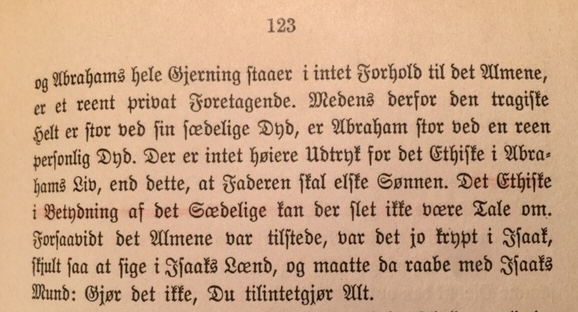
Evans doesn’t give Johannes de silentio so much credit as Hannay does, but they agree that the view of ethics that equates it with Sittlichkeit/Sædelighed was not one to which Kierkegaard himself subscribed. Such a view is amply supported by the repeated qualifications of “the ethical” in Fear and Trembling as “the universal,” and at least one completely unequivocal reference to “the ethical in the sense of social convention” (Det Ethiske i Betydning of det SædeligeSKS 4, p. 153/SV, 2nd ed. III, p. 123). Unfortunately, the allusion to Hegel is obscured in both the Hongs’ and, more surprisingly, Hannay’s own translation of the relevant passage. The Hongs have “[t]he ethical in the sense of the moral” (p. 59) and Hannay has “[t]he ethical in the sense of ethical life” (p. 88). 

That Kierkegaard envisages an alternative to the Hegelian view of ethics is widely recognized by scholars. Kierkegaard is a famous opponent of Hegel on this point, as well as on many others. Scholars are familiar with Kierkegaard’s hyphenated expression “ethical-religious.” Ethics cannot ultimately be separated from religion, according to Kierkegaard, in the manner that both Hegel and Martensen try to do. More particularly, ethics cannot be separated from Christianity, as is clear in, for example, Kierkegaard’s ethical treatise Works of Love. 

If there is a God, then there is a way that God wants his creatures to relate to him (or her or it). That is, if there is a God, then the proper relation to God is the individual’s telos and insofar as the proper relation to God is going to involve relating in a particular way to the rest of creation, then ethics is subsumed under religion which means there cannot be any conflict between ethical duty and religious duty. The two are the same. 

One doesn’t need to be a Kierkegaard scholar to appreciate this. Not only is the logic of the above identification of ethical and religious duty unassailable, Kierkegaard has left ample clues in Fear and Trembling to indicate that “the ethical” as it is presented there ought always to have quotation marks around it in that there is another higher ethics in the background, an ethics not unlike the one that Stump defends in her effort to provide an ethical justification for Abraham’s apparent willingness to sacrifice his son. 

Except that Abraham isn’t actually willing to sacrifice his son, on Stump’s reading. His faith is that God won’t actually ask him to do it in the end. 

Stump’s reading of the Abraham story has some very compelling elements, including the creative and original use she makes of Abraham’s earlier effective sacrifice of Ishmael. I would argue, however, that if Abraham’s faith was simply that God’s goodness would mean that he would not, in the end, require the sacrifice of Isaac, then Abraham comes off not as the father of faith, but merely as a really nice guy, unwilling, as Rhett Butler observes of Melanie Hamilton, to think ill of anyone she loves.