Page 2 of 2

End-of-Year Bits and Pieces

The last few months have been packed with Kierkegaard-related activities. There were not the standard two Kierkegaard sessions at the annual meeting of the American Academy of Religion in San Diego in November, but actually five! You can find a list of the sessions as well as the presenters here.

The papers were of varying quality, but none stood out as particularly bad. I realize that that observation is sort of damning with faint praise. Sadly, however, faint praise is often all that is appropriate with respect to contemporary Kierkegaard scholarship. The problem isn’t just that a decent command of Danish is all too rare among Kierkegaard scholars, it’s also that far too many are not familiar with the breadth of Kierkegaard’s writings. Many scholars continue, for example, to view Kierkegaard as sexist simply because they are unfamiliar with the material from Kierkegaard’s journals and papers that I presented in my paper “Kierkegaard on the Paradox of Feminist Progress” as part of a session of the Nineteenth Century Theology Unit and that I have presented here on this blog. 

There are several difficulties here. First, Kierkegaard’s unpublished material collected first in Søren Kierkegaard’s Journals and Papers, and then again in the new Kierkegaard’s Journals and Notebooks, while not complete is still very extensive, so it takes some time to get through it all.

Second is the fact that the short cut of searching for relevant material in the online edition of Kierkegaard’s works is unavailable for scholars who don’t have a very good knowledge of Danish. A little knowledge just isn’t enough because in many instances, there will be literally thousands of hits on a search for a particular term such as Evighed (i.e., “eternity”). There are 149 pages of hits for that term and each page has what appears to be a minimum of ten hits, but which can be greater because each hit will give a number of appearances of the term in question for a particular text. So that’s over a thousand hits for a single term, each of which must be read for its relevance to the topic being researched. One has to be able to scan these hits very quickly to see if they are indeed relevant, and most scholars simply can’t do that. 

Third, as I mentioned above, and have mentioned before, even the new Søren Kierkegaards Skrifter (and the new Kierkegaard’s Journals and Notebooks, which is based on the Skrifter) while purporting to be complete, is not actually complete. Some very important material is missing. That material can be accessed only in the old Søren Kierkegaards Papirer. Very few people have a set of the Papirer, though. I did a search just now for a set and couldn’t find a complete one, though I did find this set that has 19 volumes. The listing says that the complete set is actually 20 volumes. My own hard-cover set actually has 25 volumes, though. Three of those volumes are indexes, but that means that a complete set, sans the indexes would be 22 volumes and not 20. 

But enough of the problems with contemporary Kierkegaard scholarship. There is other news, both good and bad, to report. The good news first: The Kierkegaard Library at St. Olaf College is doing its best to improve the quality of Kierkegaard studies. First, they offer courses in Danish during the summer for visiting scholars and will be offering one on translation as well in the summer of 2026. Second, they have launched a new journal dedicated to Kierkegaard scholarship.

Finally, the bad news. Robert Alastair Hannay passed away on the eighth of December. Hannay was an outstanding Kierkegaard scholar, though perhaps not always so sensitive to the depth and influence of Kierkegaard’s religious convictions on his thought more generally. He was rare among Kierkegaard scholars in having had a rigorous analytical training in philosophy and he put that training to good use in his scholarship. He was also an outstanding translator. His translations of Kierkegaard’s works for Penguin are unsurpassed in both their accuracy and readability. Hannay will be sorely missed. 
Summer at “The Farm”

img_1074
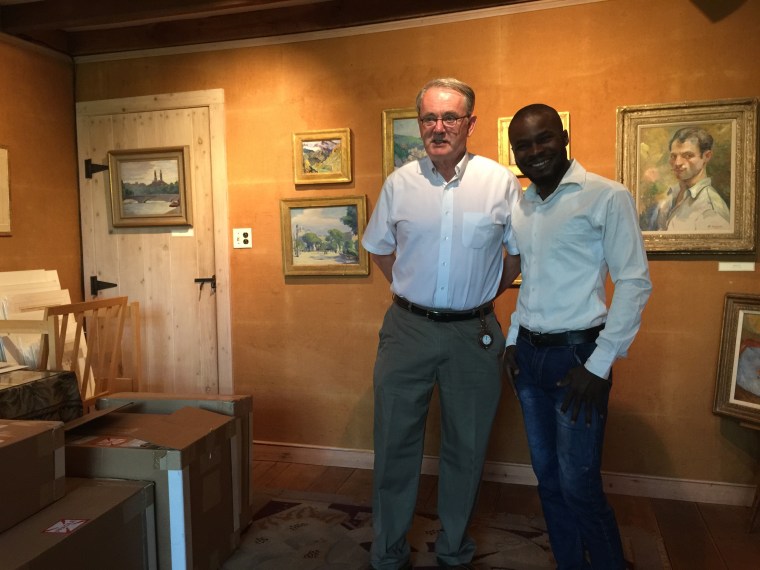
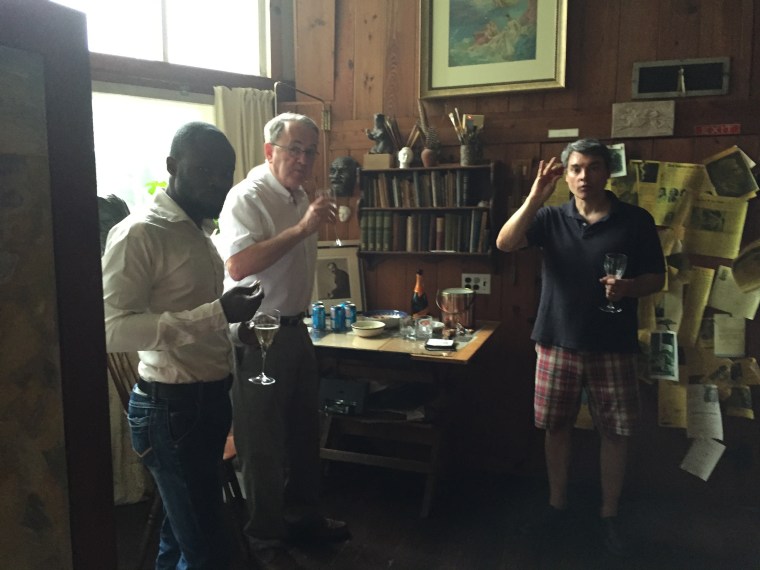
Nigerian Kierkegaard scholar Benneth Anozie, American Kierkegaard scholar Vincent A. McCarthy, and Brian J. Foley, Esq.

Bucks County has got to be one of the most beautiful places in PA, if not in the entire U.S. It has long attracted artists and was the home of the famous Bucks County impressionists. I am very fortunate to have a friend, David Leopold, who owns a large property in Bucks County that was once the home of Bucks County impressionist Ben Solowey. David, who is the archivist for both Al Hirschfeld and David Levine, as well as a freelance curator, is also the director of the Studio of Ben Solowey, a small museum and art gallery that was once Solowey’s studio. I house sit for David for several weeks every summer.

I was house sitting this summer when I received an email from Vincent A. McCarthy. McCarthy had met a Nigerian scholar, Benneth Anozie at a conference at St. Olaf College. Anozie, he explained, was eager to meet me because he was working on a dissertation on Kierkegaard’s epistemology. Would I be around to get together with Anozie, asked McCarthy? When I explained that I was not actually in Philly, but at a farm in Bucks County, McCarthy said that would not be a problem, that he and Anozie could drive up there. I was surprised at first by McCarthy’s willingness to undertake such a long drive for a short meeting. Little did I know that McCarthy is a man of extraordinarily refined tastes. He also has a property in Bucks County. “I need to mow my lawn anyway,” he explained. So I told him to come on up and we would make a day of it.

My husband, Brian, and I gave Benneth and Vincent a champagne tour of the then current exhibition Homage: Ben Solowey’s Art Inspired by his Influences. It was a wonderful visit that included a sumptuous meal with more wine. We didn’t talk too much about Kierkegaard. I did get a few minutes, however, to talk to Anozie about Kierkegaard’s epistemology and we are now connected through Linkedin. I was also very fortunate in that Vincent brought me a copy of his new book Kierkegaard as Psychologist (Northwestern, 2015). I’ve only just started it so I can’t say very much about it yet. I can say, however, that the introduction is one of the best short introductions to Kierkegaard that I have ever read. The book, explains McCarthy

is intended to highlight the incredibly rich and deep psychological dimensions of Kierkegaard’s thought, to offer an appreciation and assessment of it, and to serve somewhat as an introduction and commentary on Kierkegaard’s psychology for general readers with an interest in, but not necessarily in possession of detailed knowledge of Kierkegaard’s corpus and Kierkegaard scholarship as such.

That said, a brief survey of the table of contents, combined with an appreciation of the depth of McCarthy’s understanding of Kierkegaard as exhibited in the introduction suggests that the book will be of enormous help to dedicated Kierkegaard scholars as well. There’s a bizarre lacuna in Kierkegaard scholarship concerning Kierkegaard’s psychology. There’s Kresten Nordentoft’s eponymous book from 1972, Steve Evans’ excellent Søren Kierkegaard’s Christian Psychology: Insight for Counseling and Pastoral Care from 1990, and the essays collected in Kierkegaard’s Truth: The Disclosure of the Self, vol. 5 of a series entitled Psychiatry and the Humanities, from 1981, but that’s not very much given how important human psychology was among Kierkegaard’s interests and how profound are his insights into that psychology.

Kierkegaard’s authorship, asserts McCarthy at the end of the introduction,

stresses what he holds to be a timeless prescription as it engages in a profound analysis of forms of alienation and dis-ease with oneself. The “patients” he selects are modeled on nineteenth-century types, but he quickly penetrates beneath the nineteenth-century surface to reveal souls whose restlessness and discontent Augustine in the fourth century and we in the twenty-first have little trouble recognizing. And it is because of his penetration to a problem that transcends but is not unconnected with any particular age and society that Kierkegaard can seem very modern indeed, that he can sometimes seem a contemporary of Freud and Maslow and not just Brahms and Liszt.

I could not have said it better myself. I can’t wait to read more of this book. I’ll present more thoughts on it in later posts.

img_1073
McCarthy and Anozie with a self-portrait of Solowey behind Anozie