Kierkegaard and Current Religious Discourse

MDPI has two open-access journals that are worth a look. John Lippitt and C. Stephen Evans recently edited a special edition of the journal Religions entitled “Kierkegaard, Virtues and Vices,” and, Lee Barrett, formerly of Lancaster Theological Seminary and now of Moravian Seminary, and Dr. Andrzej Slowikowski, of Uniwersytet Warminsk-Mazurski w Olsztynie, Poland, have just come out with a special edition of Philosophies on “Kierkegaard’s Religious Thought in Relation to Current Religious Discourse.” 

My “Was Kierkegaard a Universalist” is the first one you’ll see when you go to the webpage for the special edition. There’s been a lot of discussion among theologian in the last few years about universal salvation. Universalism, as its known, is increasingly popular among these thinkers, hence it seemed relevant to address Kierkegaard’s thoughts on this issue. The paper examines evidence both for and against the view that Kierkegaard was a universalist and concludes that despite Kierkegaard’s occasional references to the importance of the idea of eternal damnation to Christianity, there is reason to believe that he may have been a universalist.

After my paper comes a paper by René Rosfort, of the Soren Kierkegaard Research Center at the University of Copenhagen. Rosfort argues in “The Humanity of Faith: Secularization of Christianity,” that “Kierkegaard’s famous existential approach to Christianity amounts to a secularization of Christianity and as such can be seen as a critical development of and not a rejection of the Enlightenment critique of religion.” 

After Rosfort there’s a paper by David J. Gouwens of Brite Divinity School, entitled “Kierkegaard’s Descriptive Philosophy of Religion: The Imagination Poised Between Possibility and Actuality.” Gouwens argues that Kierkegaard “imaginatively deploys conceptual and rhetorical strategies maieutically to both describe and elicit self-reflection aimed at transformation, thus expanding the imagination’s uses for his readers.” 

Next comes Joseph Westfall, of the University of Houston, with a paper entitled “Abraham’s Faith: Both the Aesthetic and the Ethical in Fear and Trembling.” Westfall examines Johannes de Silentio’s presentation of the faith of Abraham in Fear and Trembling, and argues that a new way of conceiving Kierkegaard’s “notion of faith as a paradoxical co-inhabiting of both the aesthetic and the ethical stages, rather than as a rejection, synthesis, or overcoming of them” can be derived from this presentation.

After Westfall’s paper there is a paper by the aforementioned Andrzej Slowikowski, entitled “Kierkegaard’s Theories of the Stages of Existence and Subjective Truth as a Model for Further Research into the Phenomenology of Religious Attitudes.” Slowikowski uses Kierkegaard’s theory of the stages of existence as a kind of template for sorting out ”the complex world of human religiousness” by reducing that world “to a few very basic existential attitudes.” 

Next comes Heiko Schulz, of Goethe-Universität, in Frankfurt a.M, with “Thankfulness: Kierkegaard’s First-Person Approach to the Problem of Evil.” Schulz argues that Kierkegaard offers promising resources for address the problem of evil. Schultz argues that “in order to make use of these resources at all, one must necessarily be willing to shift the battleground, so to speak: from a third- to a genuine first-person perspective, namely the perspective of what Climacus dubs Religiousness A. All (yet also only) those who seek deliberate self-annihilation before God—a God in relation to whom they perceive themselves always in the wrong—shall discover the ideal that an unwavering and in fact unconditional thankfulness (namely, for being forgiven) is to be considered the only appropriate attitude towards God and as such both necessary and sufficient for coming to terms with evil and suffering, at least in the life of someone making that discovery.” I’m inclined to think that Schulz is right here, though I confess I haven’t read the paper yet. 

The last piece in the special edition is by Curtis L. Thompson of Thiel College in Greenville, PA. That piece is entitled “Dancing in God in an Accelerating Secular World: Resonating with Kierkegaard’s Critical Philosophical Theology.” The intent of his paper, explains Thompson, “is to demonstrate how [Kierkegaard’s] religious thought, especially on God’s relation to the world and to the human being, can contribute to generating a cogent response to the challenges presented by our accelerating secular world.”

I haven’t read any of these papers yet, alas, because I am hard at work on a paper I’m scheduled to present at a conference in the UK in early September. The conference is entitled “The Existential Dimension of Doubt,” the launch conference of the ERC Advanced Grant Project “The Ethics of Doubt — Kierkegaard, Skepticism and Conspiracy Theory.” Once I’m back from this conference, however, I’ll check out each of these papers and let you know what I think of them.
Kierkegaard’s Early Reception in Germany

url.jsonA reader of this blog informed me that Walter Lowrie’s translation of Repetition from 1941 contained an essay at the back on all the translations of Kierkegaard into English up to that point. That was actually one of the few older translations of Kierkegaard’s works that I did not have, so I hastily hunted one down on abebooks.com. 

The essay is very interesting. There aren’t any revelations in it for people familiar with the older translations, but there is lots of other interesting information. Lowrie recounts, for example, how he was impressed by “the importance the name of Kierkegaard had acquired throughout the Continent, especially in Germany” immediately following WWI (p. 184). I was aware, of course, that the Germans learned of Kierkegaard’s work even while he was still alive, to say nothing of the period after his death. I’d assumed, however, perhaps partly as a result of Georg Brandes’ attempts in the late 1880s to introduce Kierkegaard to Nietzsche, that Kierkegaard’s work was not actually all that well known among German-speaking intellectuals. That is, I’d assumed that if Kierkegaard had become well known in Germany, that, as an intellectual, Nietzsche, would already have been aware of him. When I learned he wasn’t, I like so many other scholars, assumed that Kierkegaard was a marginal figure in German intellectual history. 

I couldn’t have been more wrong. “I could hardly pick up a serious book,” Lowrie continues, “without finding his [i.e., Kierkegaard’s] name in it. Every writer who claimed to be abreast of modern thought had something to say about him, and every reputable publisher had to bring out something. S.K. had already taken the place of Nietzsche as the literary vogue in higher circles” (p. 184). 

That was revelation to me. Kierkegaard had displaced Nietzsche in early twentieth-century German thought? Of course the popularity of Kierkegaard in Germany in the post WWI period is compatible with his relative obscurity at the end of the nineteenth century. I’m not the only scholar, however, who believed Kierkegaard was a marginal figure in German intellectual history. 

It would have been helpful if Lowrie had included some references to specific works. Unfortunately, he didn’t. Fortunately, we have Heiko Schulz’s excellent essay on Kierkegaard’s early reception in the German-speaking world in Kierkegaard’s International Reception, Tome I: Northern and Western Europe. The essay is entitled “Germany and Austria: A Modest Head Start: The German Reception of Kierkegaard.” Schulz appears to have tracked down every reference to Kierkegaard in the last part of the nineteenth century, to say nothing of the early part of the twentieth century, and includes references to specific article titles as well as helpful summaries of their contents. Most of the early German references to Kierkegaard appeared, predictably, in theological journals. 

There were early translations as well, Schulz explains however, including Einladung und Ärgernis. Biblische Darstellung und christliche Begriffsbestimmung von Søren Kierkegaard [Invitation and offense. Kierkegaard’s presentation of the Bible and Christian concepts], trans. and ed. by Albert Bärthold, manuscript (Halberstadt, 1872); Sören Kierkegaard. Eine Verfasser-Existenz eigner Art. Aus seinen Mittheilungen zusammengestellt [Søren Kierkegaard. A unique authorial existence. Compiled from his own communications] trans. and ed. by Albert Bärthold (Halberstadt: Frantz, 1873); Aus und über Søren Kierkegaard. Früchte und Blätter [From and about Søren Kierkegaard. Fruits and leaves], trans. and ed. by Albert Bärthold (Halberstadt: Frantz’sche Buchhandlung, 1874); Zwölf Reden [Twelve discourses], trans. and ed. by Albert Bärthold (Halle: J. Fricke, 1875); Von den Lilien auf dem Felde und den Vögeln unter dem Himmel. Drei Reden Søren Kierkegaards [The lilies of the field and the birds of the air. Three discourses of Søren Kierkegaard], trans. and ed. by Albert Bärthold (Halberstadt: H. Meyer, 1876) ; Lessing und die objective Wahrheit. Aus Søren Kierkegaards Schriften [Lessing and objective truth. From Søren Kierkegaard’s writings], trans. and ed. by Albert Bärthold (Halle: J. Fricke, 1877); Die Lilien auf dem Felde und die Vögel unter dem Himmel. Drei fromme Reden.—Hoherpriester—Zöllner—Sünderin. Drei Beichtreden von Søren Kierkegaard [The lilies of the field and the birds of the air. Three religious  discourses—The high priest—The tax collector—The woman who was a sinner], trans. and ed. by Albert Bärthold (Halle: J. Fricke, 1877); Søren Kierkegaard. Ausgewählt und bevorwortet [Søren Kierkegaard. A selection with prefaces], trans. and ed. by Albert Bärthold (Hamburg: Agentur des rauhen Hauses, 1906) (These references are all taken from p. 387 ofSchulz’s essay, though the English translations of the titles are my own).

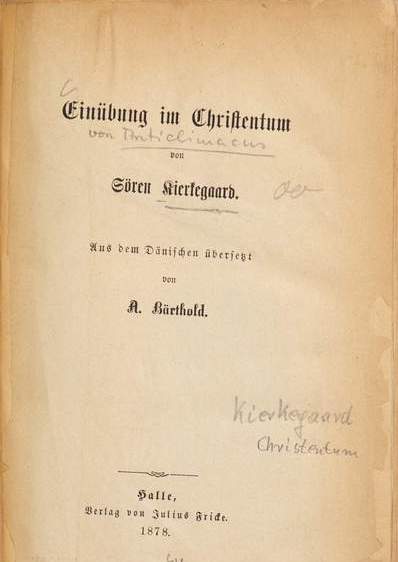
“In addition,” Schulz continues, “Bärthold translated three complete pseudonymous works: Einübung im Christentum [Practice in Christianity], trans. and ed. by Albert Bärthold (Halle: J. Fricke, 1878); Die Krankheit zum Tode. Eine christliche psychologische Entwicklung zur Erbauung und Erweckung [The sickness unto death. A Christian psychological exposition for edification and awakening], trans. and ed. by Albert Bärthold (Halle: J. Fricke, 1881); Stadien auf dem Lebenswege. Studien von Verschiedenen. Zusammengebracht, zum Druck befördert und hrsg. von Hilarius Buchbinder [Stages on life’s way. Collected, presented to the press, and published by Hilarious Bookbinder]; trans. and ed. by Albert Bärthold (Leipzig: J. Lehmann, 1886) (These references, like those above, are all taken from p. 387 of Schulz’s essay, with the English translations supplied by me).

I’ve always been interested in Kierkegaard’s early reception in Germany because I believe that reception had a strong influence on his reception in the rest of the world. I’ve become more interested in it recently, however, as a result of my interest in George MacDonald. MacDonald’s thought is remarkably similar to Kierkegaard’s. I can find no evidence, however, that MacDonald could read Danish and the earliest English translations of Kierkegaard did not appear until after MacDonald’s death. MacDonald appears to have had an excellent command of German, however, as did most English-speaking intellectuals around the end of the nineteenth and the beginning of the twentieth century, and it seems likely that at least some of his reading would have included German theological journals and possibly even early German translations of Kierkegaard. I haven’t had any time yet to research this. That would require tracking down both what books he personally owned, what books and periodicals would have been available to him in the libraries he used, and going through all his correspondence in search of any mention of Kierkegaard’s name.

That said, MacDonald is himself a profoundly original thinker and if his view of human existence and Christianity is remarkably similar to Kierkegaard’s it is not necessarily because he was influenced by Kierkegaard but very possibly because he and Kierkegaard were similar in other ways, and that they understood easily things that the rest of us have to struggle to understand.