Kierkegaard on “Reasoning”
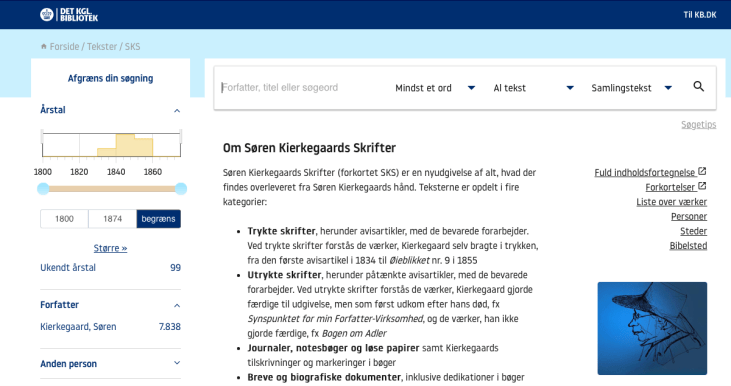
 I don’t go looking for problems in translations. I find them, usually by accident. My research generally begins with word searches on the online edition of Søren Kierkegaards Skrifter. Though it is increasingly clear that SKS is not complete, it’s the most complete searchable version of Kierkeaard’s works and hence is enormously helpful. There are links in the hits on word searches that will take me directly to the text in question from which I can then cut and paste into a document of my own the text I want to use. This text is, of course, always in Danish. I could translate it myself into English, but as I’ve written before, I was taught that doing one’s own translation is acceptable only in instances where the text in question does not exist in a translation that has been accepted by scholars. So the next step, after I’ve found the passage I want in the original Danish, is to find it in one of the newer translations of Kierkegaard. I go to the Hongs’ translations first because these are the ones that are generally used by scholars. Most of the time, the Hongs’ translations are fine. They aren’t always fine, though, as I have documented in earlier posts. Sometimes the problems are relatively minor and sometimes they’re quite significant. I ran across a passage with some problems of the latter sort recently. Not only is the translation problematic, but the problem in question illustrates the danger of over-translation that sometimes happens when translators take themselves, or their responsibility to properly represent the thought of the original author, too seriously.
The passage in question appears in Two Ages. “What does it mean,” asks Kierkegaard there,
to be loquacious [at raisonere]? It is the annulled passionate disjunction between subjectivity and objectivity. As abstract thought, loquacity [Raisonnement] is not sufficiently profound dialectically; as conception [Mening] and conviction, it lacks full-blooded individuality. But in extensity loquacity [Raisonnerende] has the apparent advantage: a thinker can comprehend his branch of knowledge, a person can have a concept [Mening] of what is related to a particular subject, can have a conviction based on a specific view of life, but the loquacious man [den Raisonnerende] chatters [raisonnerer] about anything and everything (TA, 103.)
The Danish text reads:
Hvad er det at raisonere? Det er den ophævede lidenskabelige Disjunktion mellem Subjektivitet og Objektivitet. Som abstrakt Tænkning er Raisonnementet ikke dialektisk dybt nok, som Mening og Overbeviisning er det uden Individualitets Fuldblodighed. Men extensivt gaaer den Raisonnerende af med Skin-Fordelen; thi en Tænker kan omfatte sin Videnskab, en Mand kan have en Mening om hvad der hører til et bestemt Fag, kan have en Overbeviisning i Kraft af en bestemt Livs-Anskuelse, men den Raisonnerende raisonnerer om alt Muligt.
There are several problems here. The first, and to me, entirely inexplicable one, is that the Hongs have translated Mening as “conception” and “concept” rather than “opinion.” Danish has a term for “concept,” it’s Begreb, a cognate of the German Begriff and Kierkegaard makes frequent us of it. Mening, on the other hand, means opinion, as any Danish-English dictionary makes clear.
“[A]nulled” should also, arguably be “sublated,” since the Danish term in the original is ophævede, which is a cognate of the German aufgehoben, which scholars will immediately recognize as a Hegelian term. This term generally appears in English translations of Hegel as “sublated,” hence ophævede, when it appears in Kierkegaard’s works is probably also best translated that way.
The biggest problem with the Hongs’ translation of this passage, however, is with the translation of Raisonnement as “loquacity.” The Hongs acknowledge themselves in a note that such a translation at least appears problematic in that Raisonnement is a cognate of “reasoning” and, in fact, was translated as “reasoning” in a translation that appeared from Oxford in 1940. “[A]t raisonere,” the note continues
does mean to reason. But it also means the dissipation of reason in verbosity, loquacity, garrulity, and therefore in Danish Raisonneur means “one who uses his mouth” (Ludvig Meyer, Fremmedordbog, 1844; ASKB 1034). On p. 97, at raisonere was changed in the final draft to at snakke. In the draft of p. 97 at snakke and at raisonere are used as synonyms” (TA, 173).
At snakke and at raisonere are not used as synonyms, however, in the final version of the book and this suggests that while Kierkegaard considered them related, he did not consider them to be synonyms.
Raisonneur, or “one who uses his mouth,” does not appear in the passage in question. What the Hongs translate as “the loquacious man” is not den Raisonneur, but den Raisonnerende, which suggests he does not mean to refer to a loquacious man as such, but to someone who is overly fond of reasoning. Ferrall-Repp lists the meaning of Raisonnere as “to reason, argue” and Raisonnement as “reasoning” (the foreign words are at the back of the book). It’s thus likely by den Raisonnerende, Kierkegaard has in mind someone who is overly fond of argument, or publicly debating with others. This, in any case, appears to be the sense in which Kant used räsonniert in What is Enlightenment. Kierkegaard was well aware of Kant’s use of räsonniert because he comments on it in his journals (see NB16:50). That is, den Raisonnerende is not someone who is simply fond of the sound of his own voice, but someone who is fond of rational disputation. The qualification “rational” is important, because otherwise Kierkegaard’s qualification of at raisonere as “abstract thought” does’t make much sense.
I have an ebook version of the Hongs’ Two Ages, so after I discovered this problem with at raisonere, I did a word search on “loquacious” to see if it occurred elsewhere in the translation, and discovered that the only other place it appears is on page 22 (or thereabouts, ebook pagination is not always exact) where there is a reference to “every loquacious barber.” When I checked the original Danish, though, I discovered that the term there is snaksom, not raisonnerende.
Snaksom ought properly to be translated as “talkative,” or “chatty,” rather than “loquacious” because the use of “loquacious” is an affectation and affectation was something Kierkegaard abhorred. That’s less important, however, than the fact that using a single English term, “loquacious” to translate what are clearly two quite distinct concepts in the context of the work in question conflates these two concepts for the reader. There’s a big difference between a barber who blathers on mindlessly about “anything and everything,” and someone who endlessly disputes about anything and everything.
Finally, The Hongs have also inexplicably translated en Mand as “a person.” We might all wish that Kierkegaard had written et Menneske, i.e., “a person,” but he didn’t. He wrote “a man.”. In fact, its not impossible that Kierkegaard thought the problem of excessive cerebration, or the tendency to rationally dispute about anything and everything, was specifically masculine.
I believe, and will argue in a paper I’m giving in a conference at Princeton next week, that what Kierkegaard says in this passage about what it means to raisonere gives us an important insight into his view of the relation between subjectivity and objectivity. That is, Kierkegaard claims here that reasoning, in the sense in which Kant uses it, brings the two together. It simply does this in a way that for Kierkegaard is imperfect in that it lacks “full-blooded individuality.” There are times, however, such as when one is engaged in the study of nature or history, when “full-blooded individually” is arguably inappropriate. What the scholar and scientist want is objective truth, and that is entirely appropriate for them as scholars and scientists. It’s only when the “reasoning” in question is about what Kierkegaard identifies as as “subjective truth” that reasoning’s lack of “full-blooded individuality” would appear to be problematic.
I know I am occasionally hard on the Hongs. It’s the job of scholars, however, to be meticulous in their treatment of their sources. That I’m often critical of the Hongs does not mean that I’m unaware that I owe them an enormous debt, as does everyone who works on Kierkegaard in English. They were the first people to do an extensive translation of Kierkegaard’s Journals and Papers, and I have to say that I prefer the language of that translation to the language of the new Kierkegaard’s Journals and Notebooks. I still depend on that translation to correct the wording of passages in the latter when it seems to me to have gone terribly wrong.
The Hongs’ contribution to Kierkegaard scholarship is not restricted, however, to their translations of Kierkegaard. They founded the Kierkegaard library at St. Olaf College and that library, and the fellowships it offers, has done incalculable good for scholars over the years. I had one of those fellowships myself, back when Howard was still alive and a constant presence there. He had a little of the vanity that I think nearly every scholar has, but he had a generous heart as well and helped me many times in my stay there at the library. I remember him, and Edna, very fondly.
 I’m on sabbatical now. My plan had been to use this time to finish Fear and Dissembling, the book I have been working on for many years. I’d conceived that plan, however, before my father died, and since his death I’ve found it hard to get back to that project. I’ve actually found it hard to do anything constructive. I need to do something, though, to occupy my time until my powers of concentration have returned, something worthwhile, so I have hit upon a project that I have so far found very therapeutic. I am translating the chapter from
  Piety on Kierkegaard