Page 3 of 4

Erasmus Montanus

Untitled 2
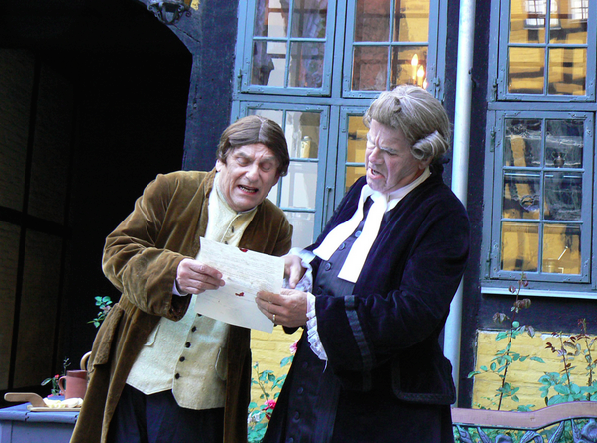
Scene from a production of Erasmus Montanus by Bagsværd Amatørescene, Photographer: Flemming Mortensen

There are two places in Kierkegaard’s published and unpublished works where he refers to the earth being “as flat as a pancake.” The first is in his review of H.C. Andersen’s failed attempt at a novel, Kun en Spillemand, that was published under the title of From the Papers of One Still Living, and the second is in his Concluding Unscientific Postscript to the Philosophical Crumbs

The second reference will no doubt be familiar to Kierkegaard scholars. It is in that passage where Kierkegaard, or Johannes Climacus, the pseudonym under which Kierkegaard published the Postscript, illustrates his claim that the mere utterance of an objective truth is not in itself evidence that the person who utters it is sane. “Let me recount an incident,” he begins, “that without any kind of adaptation from my side, comes straight from an insane asylum.” He then tells the story of a man who escapes from this asylum and on his way into town, finds a little skittle ball lying on the ground. He absent-mindedly picks up the ball and puts it in the tail pocket of his coat. As he walks, the ball gently hits him, explains Climacus, on his “a – “ and presumably, the fact of it’s being a ball, reminds him every time it strikes him that the earth is round. Since he knows that everyone agrees that the earth is round, he decides that the best way to convince people that he is sane is to go about saying continually ”the earth is round!”

“And indeed is not the earth round?” ask Climacus. “Does the asylum crave yet another sacrifice for this opinion as when everyone believed it to be as flat as a pancake?” (Hannay, 164). This reference to the earth being “flat as a pancake” is clearly an allusion to Ludvig Holberg’s play Erasmus Montanus. I cannot remember how I learned this. I could have sworn it was in an explanatory note in either one of the English translations of the Postscript or in the text as it appears in the new Søren Kierkegaards Skrifter. But I have searched in vain for such a note, though SKS does acknowledge that the first appearance of this phrase in Kierkegaard’s works, the one in From the Papers of One Still Living is an allusion to the Holberg play.

Since there are at least two references to this play in Kierkegaard’s works, I felt that I should read it. I didn’t own a copy, however, so I did a google search, in the hope that I could find a copy online. I did. Not only did I find a copy, but I found a download able copy in English translation!

The play is hilarious. The Danes like to claim Holberg as one of their own, but in fact, he was Norwegian. The thing is, Denmark ruled Norway back then, so Norwegians were viewed, more or less, as Danes, particularly if they distinguished themselves the way Holberg did. I’m telling you this because the play is clearly set in Norway, in that it concerns a people in a little mountain village and, well, there are no mountains in Denmark. Back in the 18th century, when the play is set, residents of Norway who wanted a university education typically attended the University of Copenhagen. So Rasmus Berg, the eldest son of a prosperous farmer does just that.

I don’t know if all the instruction was in Latin back then, but at least some of it was. Students were typically taught to argue in Latin and showy Latin disputations were part and parcel of university life. Rasmus Berg returns to his little mountain village as Erasmus Montanus, determined to impress everyone with his new learning. Unfortunately for him, the local deacon succeeds in convincing the poor townsfolk, none of whom know a word of Latin, that he is beating the pants off Berg, or Montanus, in Latin disputation even though the Latin he purports to be speaking is nothing but gibberish, bits and pieces of Latin grammar, and other odd words and phrases that he strings together to form nonsensical sentences that he utters with such passionate conviction that everyone feels sorry for poor Berg, or Montanus, for being shown up that way in public.

That isn’t the worst of it, though. The townsfolk are so scandalized when Berg, or Montanus, informs them that the earth is round, that his future father-in-law withdraws his permission for Berg to marry his daughter. Berg, or Montanus, is forced, finally, to recant his statement that the earth is round in order to win the hand of his ladylove.

Interesting, eh? Not only was Kierkegaard understandably taken with the play, the whole thing is kind of a metaphor for his life. There are lines in it about how the earth must be flat because everyone but Montanus thinks it is, and that truth is in numbers. There is the general backwardness of the mountain people that mirrors what Kierkegaard thought of as the backwardness, or philistinism, of the people in the little market town of Copenhagen. And then there is the fact that Montanus had to surrender his calling as an intellectual, to betray his learning, to betray what he knew to be true, in order to enjoy the pleasures of domestic life. This, as we all know, was a sacrifice Kierkegaard could not himself make.

I have come to believe that there are likely many more allusions to this particular play in Kierkegaard’s authorship than have yet been recognized as such. If you can find one yourself, please send it along. Perhaps we can write a collective paper on the influence this play on Kierkegaard’s works, and if there are enough of us, then everyone will have to admit that our claims are correct –– right?

(Hannay, who is generally an excellent translator of Kierkegaard, has inexplicably rendered the Danish Keglekugle as “skittle bowl” instead of “skittle ball.” Perhaps this is some kind of Anglicism with which I am unfamiliar. The object in question is indisputably a skittle ball, however, as both earlier English translations of the Postscript indicate, no matter what people in the UK call it.)


Kierkegaard on “Dialectic”

A reader wrote recently to inquire about what Kierkegaard meant by “dialectic.” That’s a good question because whatever he means, it is clearly not the same thing that Hegel famously means by this term. First, I have to say that like so many of Kierkegaard’s favorite terms, it does not appear to have a single meaning.

“Dialectic,” or more correctly, Dialektik, comes originally from the Greek διαλεκτική, dialektikē, so you won’t find it in Christian Molbech’s Dansk Ordbog, the standard Danish dictionary from Kierkegaard’s time, but must turn to Ludvig Meyer’s Fremmedordbog (dictionary of foreign words) from 1853. Meyer defines Dialektik as “samtalekunst” (i.e., the art of conversation), as well as “Fornuftlære,” “Tankelære,” “Logik” (the first two translate literally as, ”teachings of reason,” and ”teachings of thought, ” but are probably best translated as ”informal logic,” while Logik is best translated as “formal logic”). In Plato, continues Meyer, Dialektik refers to “higher speculative philosophy,” whereas in Aristotle and more recent thinkers it refers to “probability theory” as well as “eristic,” “sophistry” and “casuistry.”

Interestingly, Kierkegaard never seems to use Dialektik in the last two pejorative senses. My guess is that that is not because a dialectical contemplation of something could never lead one way from the truth, but because of the high esteem in which he appears to have held ancient skepticism. That is, a dialectical contemplation of any question that does not admit of a clear and uncontroversial answer, will ultimately bring the individual back to him or herself and in that way accentuate the role of decision and the will.

There is an extremely helpful Terminologisk Register, or glossary, by Jens Himmelstrup in the second half of volume 15 of the second edition of Kierkegaard’s Samlede Værker. The glossary contains a long entry on Dialektik. Himmelstrup explains here that the term comes originally from the Greek διαλέγομαι, dialegomai, meaning “to carry on a conversation with someone.” “The term,” he continues, “became associated with Socrates, in that he employed the art of conversation, or dialogue, in his activity as a philosopher which was generally aimed at achieving clarity concerning the precise meaning of individual terms and concepts.”

Himmelstrup then proceeds to give a brief history of the meaning of the term in philosophy. What is important for our purposes here, however, is what he says concerning its meaning for Kierkegaard. Sometimes, he explains, “dialectic” refers to “purely logical determinations” (I presume that by this he means it refers to formal opposites such as a and ~a). Other examples he gives of Kierkegaard’s use of the term suggest it means something more like “dynamic,” as when Kierkegaard writes in the first volume of Either-Or: “Love from the soul has, secondly, yet another dialectic, for it differs in relation to every single individual who is the object of love” (This reference is from Alastair Hannay’s translation for Penguin. Even though the ebook version provides only a location number [1587-1588] rather than a page number, the Hongs’ translation of this passage is so tortured that I could not bring myself to use it. This is probably also a good place to point out that neither the Hongs’ “psychical love” nor Hannay’s “love from the soul” is a particularly felicitous translation of Kierkegaard’s “sjælelig Elskov.” That expression is probably best translated simply as “romantic love”).

Suffice it to say in answer to the question of what Kierkegaard means by the term “dialectic,” that the meaning appears to be as protean as is the meaning of the term “knowledge.” That’s not to say that Kierkegaard equivocates on its meaning, but simply, as I explain in Ways of Knowing, that Kierkegaard was extremely sensitive to how fluid are the meanings of most terms in everyday speech and that he abhorred the tendency of academics to artificially fix meanings.

Stay tuned for my next blog post “Those Crazy Hongs!” an examination of how the Hongs (or more likely Howard Hong) could conceivably have rendered “Sandselig Genialitet, bestemmet som Forførelse” as “The Elementary Originality of the Sensuous Qualified as Seduction.”

Great Publishing News!

Old books (cropped)Alastair Hannay has produced a new translation of Kierkegaard’s Concept of Anxiety! This is great news for Kierkegaard scholars, and perhaps even better news for people who are not actually scholars but simply fans of Kierkegaard, because Hannay’s translations are markedly superior to the Princeton translations. Hannay’s new translation was not actually the occasion for this post, however. I’ll have a review of the translation later. The reason for this post is that I was delighted to discover that the translation is available in an ebook edition! Not only that, in preparation for my review, I thought I would see if Princeton had issued an ebook of Reidar Thomte’s translation of Anxiety, and sure enough, they have come around as well!

I know there are still a few people out there who are still resisting the transition to ebooks, so I thought I would take the opportunity once again to try to convince them that ebooks are fantastic! I have lots of beautiful old volumes of late 18th and early 19th-century philosophy and theology that I collected in Denmark and I doubt there are many people who appreciate a beautiful book more than I do. I have to tell you, though, that I am absolutely crazy about ebooks. I was excited about the idea of them when I first heard about them for the simple reason that they are searchable. Once I got a Kindle, however, I discovered that there are lots more wonderful things about ebooks:

1. They take no space. This is very important for me because even with two residences and an office at school, I have no more space for books.

2. You can carry thousands of books with you in your pocket everywhere you go so that never again will you be stuck anywhere without something to read. In fact, if you have a smart phone, you can read your books on your phone in the unfortunate event that you have failed to bring your ebook reader along with you. I know that sounds kind of crazy. I never thought I would want to read a book on my phone. It’s surprisingly pleasant though. I think the fact that the phone has backlighting makes it easier to read the small characters so that they don’t actually seem all that small.

3, You can secure a new book instantly, INSTANTLY! Once I was watching a program on mysticism and the narrator referred to a scholar of mysticism, Evelyn Underhill, who sounded very interesting. I was able to download a copy of one of her books before the program I was watching had even finished! This, to me, is just a huge advantage to ebooks. It has been enormously stimulating to my thought processes that I can get books immediately (not to mention that I can search them).

4. It is easy to move back and forth between notes and text. You just click on the note number and you are taken to the note. Click on the back button and you are back to the point in the text where the note appears. This isn’t easier than checking footnotes, of course, but it is much easier than checking endnotes. I hate endnotes, but everyone seems to be doing them now instead of footnotes.

5. I can cut and paste text to my lecture notes for class or for articles I’m working on–and the reference is inserted automatically!

6. You can download free samples of books you are not sure you want to buy and these samples are pretty substantial chunks of text, usually at least a whole chapter.

7. Ebooks are cheaper than regular books, so if you buy as many books as I do, you save A LOT of money buying ebooks.

8. Not only are ebooks cheaper than conventional books, lots and lots of them are actually free! That’s right, lots of books that have gone into the public domain (including lots of older translations of Plato and other philosophers) are available free of charge in the Kindle bookstore (I’m sure Barnes and Noble has something similar for their Nook).

9. Ebooks are easier to read in bed because they are lighter than most regular books and you don’t have to manage the two halves. I used to get very uncomfortable because I sleep on my side so, if I were reading a really thick book either my arm would get tired holding up the thick side or I would have to turn over on my other side every time I finished reading a page.

Ebooks are the wave of the future. Not only are they better in all the ways listed above than conventional books for readers, they make it much easier for people to get into print (meaning e-ink print, of course). The ebook revolution is going to be as big a thing, I think, as was the invention of the printing press. There were books before the printing press, but books (not to mention democracy) really took off after the invention of the printing press. I think ebooks are going to have just as revolutionary an effect on humanity as did the printing press.

Okay, there are some disadvantages with them. Unless you have an iPad, or other tablet computer, you won’t get the full experience of color illustrations. That isn’t such a huge problem for philosophers and theologians, though, because most of our books don’t have big color illustrations. Of course, you need to charge an e-reader whereas you don’t need to charge a book. E-readers actually hold a charge for a long time, however. My Kindle Paperwhite holds a charge for weeks even though it is backlighted. Finally, t is difficult to “page through” an e-reader (you are better off doing a search on a key word).

The advantages of e-books clearly FAR outweigh their disadvantages. Sorry to go on like this but I am so crazy about ebooks. I do this to everyone who tells me he doesn’t like e-books, that to me is like saying you don’t like to read. If you like to read, you will LOVE e-books. Mark my words!