Page 28 of 52

On Being Human

MLN Kierkegaard cover.128.5_frontVolume 128 no. 5 of MLN (originally Modern Language Notes) includes a collection of papers from the conference on Kierkegaard that was hosted by Johns Hopkins last September. Leonardo Lisi very kindly sent me a copy as a thank you for my having chaired a session at the conference. I went immediately to the paper by Jonathan Lear because it had been one of my favorites from the conference. The paper, “The Ironic Creativity of Socratic Doubt” (MLN 1001-1018) takes its point of departure in a passage from Kierkegaard’s journals that reads:

Socrates doubted that one was a human being by birth; to become human, or to learn what it means to be human does not come that easily–what occupied Socrates, what he sought, was the ideality of being human (Journals 278).

Lear says he’s going to pursue the suggestion that “we should read the or as exegetical” in the sense that “what follows the ‘or’ explicates what precedes it” (MLN 1004). That is, Lear argues that learning what it means to be human is precisely to “become human.” Learning what it means to be human, Lear asserts, is not “tantamount to acquiring a practical skill” (MLN 1005) because if it were, then it would seem easy enough to do, yet Socrates had difficulty with it and Kierkegaard seems to accept this difficulty as natural for anyone who is sufficiently reflective.

Lear’s essay is extraordinarily rich and I cannot hence to justice to it here. I want here only sketch Lear’s thesis and point out what I believe is problematic about it. That is, I’m going to argue that while Lear presents a beautifully persuasive reading of Plato’s Symposium, this reading cannot unproblematically be attributed to Kierkegaard.

Lear uses Diotima’s discussion of “pregnancy” from Plato’s Symposium to gain insight into what might be the difficulty involved in learning what it means to be human. This is indeed, I would argue, a fruitful approach to the problem because though Kierkegaard skips over this part of Diotima’s speech in The Concept of Irony, the metaphor of pregnancy becomes very important to Kierkegaard.

Diotima’s speech is about love. “[L]ove,” she asserts, “is wanting to possess the good forever” (206a; Lear’s emphasis). But the only way we are going to be able to do that, observes Lear, is if “we create it ourselves.” “The ‘real purpose of love,’ Diotima say, ‘is giving birth in beauty whether in body or in soul’” (206b; Lear’s emphasis) (MLN 1010)

“What we lack and seek,” asserts Lear, “is not the missing good object… Rather what we lack and seek is the beautiful environment–the beautiful other–in which we can then give forth something from deep within ourselves” (MLN 1010). Lear acknowledges that ordinarily we associate the erotic in Plato with a kind of lack and that. “No doubt,” he observes, “there are passages that support that though. But here in the heart of the Platonic Socrates’ discourse on eros, he says that the erotic encounter is the occasion to experience ourselves as full. Since Socrates says he is persuaded by Diotima’s teaching (212b),” continues Lear, “he cannot here be thinking of himself as empty” (MLN 1011).

It is not necessarily the case, however, that the “lack” traditionally associated with erotic love in Plato is equivalent to “emptiness.” That is, the “lack” that the lover seeks to fill through the possession of the beloved in not incompatible with his experiencing himself as full in some other respect. A lover may be filled, for example, with a wonder at creation and yet lack a beloved to share it with. Alternatively, the fullness the lover experiences may simply replace the lack that served as the impetus to love. That is, the traditional Platonic conception of erotic love as related to a kind of lack in the lover is not necessarily incompatible, in the manner Lear suggests with Diotima’s view of love as a kind of fullness that issues in birth.

This point is not essential, however, to Lear’s thesis. His thesis is actually that human life has a “characteristic activity.” This activity, he explains is “pregnancy and giving birth in the beautiful. That is, it is the creativity in the presence of –or in the presence of a memory of–a beautiful other person who stimulates and inspires us. Try to imagine,” Lear continues, “a human being who has no pregnancy in them whatsoever: no ability to reproduce biologically nor even a spark of creative impulse. If one can imagine this at all, one is imagining someone at the far end of an autistic spectrum. This is not just another instance of a human being, but an impaired one” (MLN 1014).

“We see from the inside,” continues Lear, “that human being is characterized by creativity stimulated by our encounter with others–and that a biological instance of the kind that lacked that creativity would be a problematic instance. This,” asserts Lear, “is not an arbitrarily high standard; it is a constitutional condition” (MLN 1015). I like this definition of what it means to be human, but I’m not entirely convinced that this is what Kierkegaard had in mind. Lear asserts that “giving birth in the beautiful is our characteristic practical activity” and that “[l]earning what it means to give birth in the beautiful just is the self-conscious understanding that we acquire in giving birth in the beautiful” (MLN 1015). But if a human being who is unable to do this and hence to gain an understanding of it is, as Lear asserts, someone “at the far end of an autistic spectrum,” then it is difficult to understand why Kierkegaard would believe that “to learn what it means to be human does not come that easily.” That is, if Lear is correct in his claim that “giving birth in the beautiful is our characteristic practical activity,” then learning what it means to give birth is this way would be something that everyone did as a matter of course.

One might be tempted to argue, that when Kierkegaard says “learning what it means to become human does not come that easily,” what he means is more that it is painful rather than that it is rare. Perhaps, after all, that is what Lear means. Lear is a practicing Freudian analyst, so it’s unlikely that he would want to exclude from the category “human” the vast number of individuals Kierkegaard’s gloss on Plato’s text suggests would be excluded. This can’t be what Kierkegaard means, however, because he clearly does, ironically, want to exclude vast numbers of human beings from the category “human.” We are supposed to be “human,” according to Kierkegaard, in the manner Lear describes, but in fact, most of us are not. [T]he ideality of human being” that Socrates sought is impossibly high according to Kierkegaard, in that it is not something we can achieve without God’s help. That’s the irony. We cannot become who we are, according to Kierkegaard, in the beautiful environment of human love, but only in the beautiful environment of divine love.

New Book on Kierkegaard and Rationality

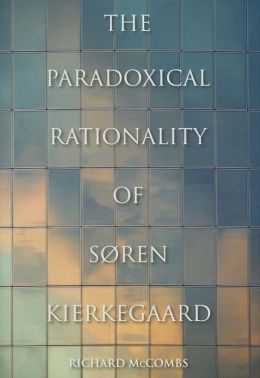
Paradoxical Rationality of Kierkegaard (cover) I received a review a couple of days ago of a new book entitled The Paradoxical Rationality of Søren Kierkegaard. The book is by Richard McCombs. The review, by Antony Aumann, appeared in Notre Dame Philosophical Reviews. I haven’t read the book yet, so I won’t say much about it here. I will share only a few comments on the review. First, Aumann takes McCombs to task for neglecting the secondary literature. I have to say, however, that on my view, that is a fairly minor flaw in a book on this topic. There is some good work on Kierkegaard and rationality (particularly in the volume Kierkegaard after MacIntyre), but there isn’t much that is addressed specifically to this topic. A great deal of what C. Stephen Evans writes touches on the topic of Kierkegaard and rationality, but strangely, Aumann does not fault McCombs for neglecting Evans’ work, but for neglecting, among others, the work of Louis Pojman.

What I would like to see referenced in scholarly treatments of the topic of Kierkegaard and rationality is some German language work. There is simply nothing comparable in comprehensiveness and theoretical rigor to Anton Hügli’s Die Erkenntnis der Subjektivität und die Objektivität des Erkennens bei Søren Kierkegaard (Editio Academica, 1973) and Das Problem des Interesses und die Philosophie Sören Kierkegaards (Karl Alber, 1983). Both these works should be required reading for anyone interested in either Kierkegaard’s epistemology or his position on the nature of human rationality. I quote liberally from both works in Ways of Knowing: Kierkegaard’s Pluralist Epistemology, so you can get some idea of the content of each there. Hopefully, those little tastes will whet your appetite to the extent that you will be willing to struggle through the originals.

Neither, alas, is available as an ebook. Fortunately, McCombs book is available as an ebook. I’ve already downloaded it because I learned from Aumann’s review that the book contains an entire chapter on Kierkegaard’s epistemology. I’m going to get started on the book right away and will post my thoughts on it as soon as I am able to give them coherent form.

In other publishing news, Oxford has come out with a new volume entitled The Oxford Handbook of Kierkegaard. I presume, from the mixed bag of contributors, that it is intended primarily for non-specialists. In typical Oxford fashion, however, at $112 it is priced beyond the means of its intended audience. Scholars will occasionally pay approximately $100 for a book, but non-specialists rarely will. I fear this volume is destined to languish unread on library shelves. That need not have been the case in that Oxford has thoughtfully made it available in a Kindle edition. Unfortunately, they have thoughtlessly priced even that edition out of the reach of nearly everyone but libraries. Most ebooks are substantially cheaper than their physical counterparts for obvious reasons. The Kindle edition of this book, however, is $85. One can only hope Oxford will soon see the error of its ways and reduce that price.

Speaking of how much scholars will pay for books, I have a funny story to relate. I used to order books occasionally from the German book import store in Copenhagen when I lived there. I had heard the theologian Joachim Ringleben speak at some conference or other and had been very impressed by him, so I ordered his book Aneignung: Die Spekulativ Theologie Sören Kierkegaards. When I went to pick up the book, however, the man to whom I was to give my money, opened the inside cover to learn the price and simply burst out laughing. He laughed so hard it was some time before he could calm down sufficiently to process the sale. Even then he kept shaking his head and smiling.

Fortunately, the Kindle version of McCombs book is only $24.49. Thank you Indiana University Press!

Danish Art

140-2  A kind reader wrote to me yesterday to inquire why I had not posted anything to this blog in January. He said he enjoyed the blog and that he hoped I was not ill, or anything. I’ve not been ill (well, okay, I have been ill, for only for about a week). I’ve just been very busy. I’m teaching online this term and that actually takes more time than conventional teaching. I’ve also been finishing a book. It’s not a book on Kierkegaard. It’s a book on figure skating entitled Sequins and Scandals: Reflections on Figure Skating, Culture, and the Philosophy of Sport. So it is a philosophy of sport book, sort of. It’s actually a collection of many different pieces that I had published on skating over the years, as well as a few new pieces. It was mostly written already, but it did take some time to put together.

I am also finishing an article on Kierkegaard for a volume Oxford is doing on “theological epistemology” and I am editing the bibliography and writing an introduction to the forthcoming English translation of Martin Slotty’s book on Kierkegaard’s epistemology. Yes, I have been very busy. In between these projects, however, I have been doing a little Ebay shopping.

One of the things that was hardest for me about leaving Denmark was that it meant I could no longer spend my spare time haunting Danish junk stores looking for fine old paintings. That was how I used to relax when I lived in Copenhagen. Sometimes, when I had been working for many days without leaving the apartment (I can actually go a long time without seeing other people because I am kind of a recluse), I would just head out to one of the local junk stores. What most people outside Denmark don’t realize is that Danes suffer from an inferiority complex relative to the rest of Europe. Den danske mindreværdskompleks it’s called (literally “the Danish less-worth complex”). Legions of Danes appear to have taken up a serious study of painting since the turn of the century, but since relatively few of them became internationally famous, no one wants their paintings. Danes buy up these domestically produced works of art when the artists are young in the hope that these artists will become famous. But of course most of them never do, so when older Danes die, their heirs generally do not want these paintings, so they end up being carted off by the local junk dealer. Every junk store in Copenhagen is filthy with them, floor to ceiling. When I lived there I could often pick up a beautiful old painting from the first half of the century in a heavy guilt frame for under $100.

Over time, I gradually accumulated about fifty such paintings. Unfortunately, I could not take them all with me when I left Copenhagen. I still have plenty of paintings, so you should not feel sorry for me. I miss the trips to the junk stores though. Or did, until a couple of weeks ago when I discovered that there are some very nice Danish paintings available on Ebay! Yes, that’s right–Ebay. Unfortunately, I haven’t found any for under $100, but I’ve found some really beautiful ones in an Ebay store called Art-Gate from between $200-$500, which is really very good for an original oil painting in a beautiful old frame. 140-5

None of these paintings date from Kierkegaard’s time. They are mostly from the first half of the twentieth century. Many are stereotypical Danish landscapes, though, that will mean a lot to scholars who have spent time studying in Denmark. There are some nice interiors and still lifes as well, and all at very reasonable prices. In fact, Art-Gate invites people to make offers for the paintings, so you could easily end up paying even less than the official asking price. It’s not quite so much fun as combing through the junk stores yourself, but at least you won’t have to do the packing and shipping!

I’ll be back soon with more news!