Page 28 of 51

Danish Art

140-2  A kind reader wrote to me yesterday to inquire why I had not posted anything to this blog in January. He said he enjoyed the blog and that he hoped I was not ill, or anything. I’ve not been ill (well, okay, I have been ill, for only for about a week). I’ve just been very busy. I’m teaching online this term and that actually takes more time than conventional teaching. I’ve also been finishing a book. It’s not a book on Kierkegaard. It’s a book on figure skating entitled Sequins and Scandals: Reflections on Figure Skating, Culture, and the Philosophy of Sport. So it is a philosophy of sport book, sort of. It’s actually a collection of many different pieces that I had published on skating over the years, as well as a few new pieces. It was mostly written already, but it did take some time to put together.

I am also finishing an article on Kierkegaard for a volume Oxford is doing on “theological epistemology” and I am editing the bibliography and writing an introduction to the forthcoming English translation of Martin Slotty’s book on Kierkegaard’s epistemology. Yes, I have been very busy. In between these projects, however, I have been doing a little Ebay shopping.

One of the things that was hardest for me about leaving Denmark was that it meant I could no longer spend my spare time haunting Danish junk stores looking for fine old paintings. That was how I used to relax when I lived in Copenhagen. Sometimes, when I had been working for many days without leaving the apartment (I can actually go a long time without seeing other people because I am kind of a recluse), I would just head out to one of the local junk stores. What most people outside Denmark don’t realize is that Danes suffer from an inferiority complex relative to the rest of Europe. Den danske mindreværdskompleks it’s called (literally “the Danish less-worth complex”). Legions of Danes appear to have taken up a serious study of painting since the turn of the century, but since relatively few of them became internationally famous, no one wants their paintings. Danes buy up these domestically produced works of art when the artists are young in the hope that these artists will become famous. But of course most of them never do, so when older Danes die, their heirs generally do not want these paintings, so they end up being carted off by the local junk dealer. Every junk store in Copenhagen is filthy with them, floor to ceiling. When I lived there I could often pick up a beautiful old painting from the first half of the century in a heavy guilt frame for under $100.

Over time, I gradually accumulated about fifty such paintings. Unfortunately, I could not take them all with me when I left Copenhagen. I still have plenty of paintings, so you should not feel sorry for me. I miss the trips to the junk stores though. Or did, until a couple of weeks ago when I discovered that there are some very nice Danish paintings available on Ebay! Yes, that’s right–Ebay. Unfortunately, I haven’t found any for under $100, but I’ve found some really beautiful ones in an Ebay store called Art-Gate from between $200-$500, which is really very good for an original oil painting in a beautiful old frame. 140-5
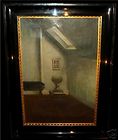
None of these paintings date from Kierkegaard’s time. They are mostly from the first half of the twentieth century. Many are stereotypical Danish landscapes, though, that will mean a lot to scholars who have spent time studying in Denmark. There are some nice interiors and still lifes as well, and all at very reasonable prices. In fact, Art-Gate invites people to make offers for the paintings, so you could easily end up paying even less than the official asking price. It’s not quite so much fun as combing through the junk stores yourself, but at least you won’t have to do the packing and shipping!

I’ll be back soon with more news!

2013 in review

The WordPress.com stats helper monkeys prepared a 2013 annual report for this blog.

Here’s an excerpt:

The concert hall at the Sydney Opera House holds 2,700 people. This blog was viewed about 11,000 times in 2013. If it were a concert at Sydney Opera House, it would take about 4 sold-out performances for that many people to see it.

Click here to see the complete report.

Kierkegaard’s Christian Epistemology

I said in my last post that I would write more about the Kierkegaard conference at Baylor last month. It was an extraordinarily rich conference in terms of  the breadth of topics covered and it was unusual in that there were several papers devoted to aspects of Kierkegaard’s epistemology. Indeed, there was an entire session entitled “Kierkegaardian Challenges to Epistemology.” This is testament to an increasing appreciation of the importance of epistemological concerns to Kierkegaard’s thought.

C. Stephen Evans gave an excellent presentation entitled “Kierkegaard the Natural Theologian? Kierkegaard on Natural Religious Knowledge,” in which he argued (as I argue in Ways of Knowing) that Kierkegaard assumes people have a natural knowledge of God, and that “[t]his natural religious knowledge is not without value” in that “it is part of what prepares a person to encounter the Christian Gospel”  (Evans’ handout).

Of course this natural knowledge of God, explained Evans, is distinguished from faith in Christ, or any knowledge that might come as a product of this faith. The latter sort of knowledge and how faith makes it possible was the subject of my own presentation “Encountering the Truth: Kierkegaard’s Existential Mysticism as a Corrective for the New Atheism.”  My argument was that according to Kierkegaard, an encounter with what he refers to in Philosophical Crumbs as “the god in time” (173) amounts to acquaintance knowledge of God (i.e., in the person of Christ) and that this acquaintance knowledge serves as the foundation for specifically Christian propositional knowledge that looks very unlike the sorts of views the “new atheists” routinely attribute to Christians.

That what Kierkegaard calls an encounter with the god in time can lead to specifically Christian propositional knowledge is a topic I cover in great detail in Ways of Knowing. What was new in the presentation was making clear the implications of Kierkegaard’s position for the kinds of criticisms of religion advanced by the new atheists.

Unfortunately, there are still people out there making arguments about Kierkegaard’s epistemology without really knowing very much about it. Aaron Fehir, for example, whose paper “Subjectivity and Conscience: A Kierkegaardian Resolution to the Problem of the Criterion” was part of the session entitled “Kierkegaardian Challenges to Epistemology,” had read neither Ways of Knowing, nor Anton Hügli’s excellent Die Erkenntnis der Subjektivität und die Objektivität des Erkennens bei Søren Kierkegaard (Basel, Switzerland: Editio Academica, 1973) nor Martin Slotty’s Die Erkenntnis Lehre S.A. Kierkegaards (Diss. Friedrich-Alexanders-Universität, 1915), with the result that in effect there was no Kierkegaardian solution, on his view, to the skeptical “problem of the criterion.”  Both the historical contemporary of Christ and someone who came later were equally poorly situated, argued Fehir during the question period, relative to the “unrecognizable” “god in time.”

You don’t actually have to have read anything on Kierkegaard’s epistemology, however, to appreciate that Kierkegaard’s point in Crumbs is not that both the contemporary and someone who comes later are equally poorly situated relative to “the god in time.” It’s pretty clear, I would argue, to anyone who is sufficiently attentive to the text, that Kierkegaard’s point is that both the contemporary and someone who comes later are equally well situated relative to the god in time. That’s the specific technical sense in which Kierkegaard uses the expression “contemporaneousness.” Anyone, according to Kierkegaard can be “contemporaneous” with the god in time, but (and this is an important qualification) that, for Kierkegaard, is the only way one can achieve a proper understanding of religious truth.

Fehir is a religious pluralist. Kierkegaard was not a religious pluralist. There is certainly room, I would argue, in Kierkegaard’s thought for the view that non-Christian religious traditions could embody elements of religious truth, could be on the right track, so to speak. It’s even possible to argue, based on Kierkegaard’s discussion in the Concluding Unscientific Postscript about the “how” that brings the “what” along with it, that the “pagan” who prays passionately enough encounters Christ (i.e., the god in time, or God in the person of Christ) in his prayers, but it’s Christ, for Kierkegaard that one would have to say he encounters, Christ with whom (through his passion) he achieves “contemporaneousness,” not God unmediated by Christ (remember, the Postscript is the postscript to the Crumbs).

Kierkegaard was no religious pluralist. He was, as I argue in an essay in the forthcoming Oxford Handbook of the Epistemology of Theology, a Christian mystic. That is, Kierkegaard believed in the possibility of a mystical communion with God in the person of Christ which he refers to as “contemporaneousness.” Both Hügli and Slotty agree that this encounter with the god in time provides a point of departure, according to Kierkegaard, for a new type of religious knowledge. The “criterion” of truth about which the skeptics were so concerned is what Kierkegaard refers to as “the certainty of faith.” That is, Kierkegaard does have a criterion of truth. It’s just that it is not one that religious pluralists are going to like.

Postscript

Daniel Mendelsohn said in a recent interview in the Prospect that he came from “a scholarly background.” He’d done a graduate degree in Classics, he explained, before he became a writer; “and in that world, the rule is that you can’t write anything until you’ve read everything.” That’s how I was trained as well. We could use a little more of that mentality in Kierkegaard studies.