Page 22 of 52

Kierkegaard’s Journals and Notebooks–OH NO!

I have only the first volume of the new English translations of Kierkegaard’s Journals and Notebooks published by Princeton University Press and the reason I have that volume is that I was given a free copy by the Scottish Journal of Theology when I agreed to review it for them. The editors include some scholars, such as Alastair Hannay and Vanessa Rumble, who have an excellent command of Danish. I was suspicious, however, of the rate at which they were cranking out the translations.

Translation is hard work. Good translations take some time to produce. It was hard for me to imagine that anyone could translate all of Kierkegaard’s journals and papers in the short time Princeton had projected it would take and actually do a decent job. The first volume in the Princeton series appeared in 2007. Since then, nine of the projected 11 volumes have appeared. That’s more than a volume a year.

I’ve not made a serious study of these new translations of Kierkegaard’s journals, since I did my review of the fist volume. I generally work with the original Danish versions that are available for free in searchable editions online. I’m working on a paper on humor in Kierkegaard right now, however, and I ran across a passage from one of Kierkegaard’s journals that I wanted to use for my article. The late, and venerable George Kline taught me that even if one has an excellent command of a particular language, if there exists a definitive English translation of a work in that language from which one wishes to quote, it is incumbent upon one to use the language of the translation. It’s a courtesy to the reader. If everyone who knew German, for example, did his own translations of Kant when quoting Kant, those poor souls who did not know German would have a hard time locating the passage in question. So I figured that I should use the wording of the new Kierkegaard’s Journals and Notebooks and dutifully looked up the passage that was, fortuitously, in the one volume of KJN that I happened to own. The translation reads as follows:

Humor is irony taken to its maximum vibration. Although the Xn aspect is the real primus motor, there are still people in a Christian Europe who have not come to describe more than irony, which is why they have also been unable to practice the absolutely isolated humor that subsists in the person alone.

That sounds kind of weird, doesn’t it? What is “the absolutely isolated humor that subsists in the person alone”? That doesn’t even sound like English, does it? I worked for many years as a translator when I lived in Denmark. I also know a little bit about translation theory. If I ever teach translation, or translation theory, which I hope one day to do, I am going to drill home to my students that translations should never sound awkward unless the original is awkward.

As I said, translation can be very difficult. It took me several days to come up with my translation of the passage from Repetition that I referred to in the blog post from 5 December 2015 Since, however, a translation is going to be around for a very long time, haste in seeing it to press is unadvisable. How does that saying go: “Translate in haste, repent in leisure”?

Here is the Danish for the passage in question:

Humoren er den til sin største Vibration gjennemførte Ironie, og omendskjøndt det Χhristelige er den egl. primus motor, saa kan der desuagtet findes i et christeligt Europa Folk, som ikke er kommen til at beskrive mere end Ironien, og derfor hell. ikke have kunnet gjenemføre den absolut-isolerede, personlig-ene-bestaaende Humor, d. 4 Aug. 37.

Here is my translation:

Humor is irony taken to its maximum vibration. Even though Christianity [det Xhristelige] is the genuine primus motor [prime moving force], it is still possible to find peoples in Christian Europe who have come no further than describing irony and who are hence incapable of achieving the absolutely isolated, uniquely personal humor.

My wording of the first sentence is identical to the wording of KJN. After that, the two translations diverge. There is nothing in the Danish that corresponds to KJN’s “aspect.” That’s an attempt on the part of the translator, or translators, to make sense of Kierkegaard’s “det Xhristlige” which translates literally as “the Christian” where “Christian” functions as an adjective. The thing is, there is no noun that it qualifies, so the translator simply added “aspect” without indicating that it was added. That in itself is no great crime (though it is a crime, interpolated material should be enclosed within brackets). The problem is, that it is actually misleading rather than helpful.

All genuine humor, according to Kierkegaard, has its foundation in Christianity. I won’t try to defend that claim here, suffice it to say in this context that it does. Kierkegaard is not talking here about some aspect of humor being Christian. How could some “aspect” of irony or humor be the “prime mover” that propels irony into the territory of humor? The prime mover has to be fundamental to the thing in question, not merely an “aspect” of it.

The “a” in front of “Christian Europe” is literally correct, but it’s unnecessary. What other kind of Europe was there? Danish, like German, uses articles more often than does English so to include them all in a translation is not only unnecessary, it yields a translation that is unidiomatic.

“[D]escribing” is a toughie. The Danish term in question is “beskrive,” a cognate of “describe.” It appears, in this context, to mean “describe” in the sense of “describing an arc.” That is, it appears to mean something like “exhibiting,” or better, “performing.” In fact, I think it means something closer to “understanding,” I was, therefore, tempted to use “understanding” instead of the more literal “describing.” What decided me against that was the fact that an astute reader could figure that out by him, or herself. Generally, a translator should not interpret the text for the reader unless that is the only way of making it comprehensible. There are often instances in which that is the only way to make a text comprehensible, but this did not seem to me to be one of them.

“Folk” unequivocally refers, however, to “a people,” and not to “people.” It’s a stab at the Danish people as a group. They are the “Folk” in “Christian Europe” to which Kierkegaard is snidely referring. If he had meant “people,” he’d have written “mennesker” (or “Mennesker” given that he was writing in the nineteenth century).

The worst problem with this translation, however, is the very last part: “the absolutely isolated humor that subsists in the person alone.” Really? That’s the best this august translation team could come up with? It doesn’t even sound like English. The minimum criterion for an English translation, it seems to me, is that it should sound like English, even if the translator needs to be rather free in the translation in order to achieve that effect. What is bizarre about the KJN version of this passage is that it is not, in fact, as one might expect, a literal translation. The Danish is: “den absolut-isolerede, personlig-ene-bestaaende Humor.” That translates literally as: “the absolutely isolated, uniquely personal humor.” Really, I kid you not. “[P]ersonlig” you can probably figure out for yourself, and “ene-bestaaende” translates as “unique.” Don’t take my word for it. Type it (or the contemporary “enebestaende”) into Google translate.

My guess is that the translators elected to use “subsists in the person alone” rather than the literal “uniquely personal” because Kierkegaard’s text has “personlig-ene-bestaaende” rather than “personlig enebestaaende.” That is, Kierkegaard appears to want to highlight the root words of “enebestaaende”: “ene” (which according to Ferrall-Repp means “alone, by oneself, solely”) and “bestaaende” (which according to Ferrall-Repp means “to consist in; to consist – be composed of; to subsist, exist, continue, endure”).

This shows the limits, however, of translation because while Kierkegaard can emphasize the parts of “enebestaaende” without losing the whole, a translation cannot do this. The translators, in this instance, appear to have elected to emphasize the parts, with the effect that they have lost the whole. Not only have they lost the whole, they’ve diminished what one could call the music of the text in the process. It is the chief sin of the Hongs’ translations, I believe, that they very often lose the music of the originals. Unfortunately, this would appear to be a problem with these new translations of Kierkegaard’s journals as well.

I don’t mean to suggest here that all the text of the new KJN is as bad as this particular passage. It isn’t. It is very disappointing, however, to see stuff like this in new translations when the point of producing new translations is precisely to make improvements on earlier translations.

Some Reflections on an Auspicious Occasion

IMG_0886
McGill Cap

I’ve been promoted to full “Professor.” I am no longer “Associate Professor M.G. Piety.” I am now, or will be as of 1 September, “Professor M.G. Piety.” According to my colleague Jacques Catudal, I am the first person to make full “Professor” in philosophy at Drexel in more than 18 years.

It has been a long journey, as they say. I decided to study philosophy when I was an undergraduate at Earlham College, a small Quaker college in Richmond, Indiana. I became hooked on philosophy as a result of taking a course on rationalism and empiricism with Len Clark. I didn’t particularly enjoy reading philosophy, and I hated writing philosophy papers. I loved talking about it, though. Talking about it was endlessly fascinating to me, so I switched my major from English to philosophy. I became hooked on Kierkegaard after taking a Kierkegaard seminar with Bob Horn. “Bob,” my friends at Earlham explained, “was God.” He was preternaturally wise and kind and a brilliant teacher who could draw the best out of his students while hardly seeming to do anything himself. I don’t actually remember Bob ever talking in any of the seminars I took with him, and yet he must have talked, of course.

I spent nearly every afternoon of my senior year at Earlham in Bob’s office talking to him about ideas. I worried sometimes that perhaps I should not be taking up so much of his time. He always seemed glad to see me, though, and never became impatient, even as the light began to fade and late afternoon gave way to early evening. I don’t remember him encouraging me to go to graduate school in philosophy (my guess is that he would have considered that unethical, given the state of the job market in philosophy). I do remember, however, that he was pleased when I announced that I had decided to do that.

Graduate school was enormously stimulating, but also exhausting and, for a woman, occasionally demoralizing. There has been much in the news in the last few years about how sexist is the academic discipline of philosophy. Well, it was at least as bad back then when I entered graduate school as it is now, and possibly even worse. Still, I persevered. I began publishing while still a student and was very fortunate to gain the support and mentorship of some important people in the area of Kierkegaard scholarship, including C. Stephen Evans, Robert Perkins and Sylvia Walsh Perkins, and Bruce H. Kirmmse, who was one of my references for a Fulbright scholarship I was awarded in 1990 to complete the work on my dissertation on Kierkegaard’s epistemology.

I lived in Denmark from 1990 until 1998. I received my Ph.D. from McGill University in 1995 but remained in Denmark to teach in Denmark’s International Study Program, then a division of the University of Copenhagen. I wasn’t even able to go back for my graduation, so I learned only a couple of years ago, when my husband bought me my own regalia as a gift, how gorgeous the McGill regalia are (see photo below).

I came to Drexel from Denmark in 1998 as a visiting professor. I liked Drexel. It was overshadowed by its neighbor, the University of Pennsylvania, but that seemed to me almost an advantage back then. That is, Drexel had carved out a unique niche for itself as a technical university, somewhat like MIT but smaller, that provided a first-class education in somewhat smaller range of degree programs than were offered by larger, more traditional institutions. The College of Arts and Sciences seemed to me, at that time, and to a certain extent, still today, as a real jewel, as Drexel’s “secret weapon,” so to speak, because while most large universities had class sizes ranging anywhere from 40 to several hundred students, most of the courses in the humanities at Drexel were capped at 25 students. Drexel also boasted some first-class scholars who were as committed to teaching as to scholarship. Drexel was providing its students with what was effectively the same quality of education in the humanities as is provided at small liberal-arts colleges, while at the same time giving them invaluable hands-on work experience through its co-op programs that few liberal-arts colleges could provide.

Drexel asked me to stay on for a second and then a third year, despite the fact that my beginning was less than auspicious in that at the end of that first fall term, I had mistakenly conflated the times of what should have been two separate exams and hence left my students sitting in a room waiting patiently for almost an hour for me to materialize and administer the exam. It was too late, of course, to do anything by the time I learned, via a phone call from one of the secretaries in the department, of the mistake. I was relieved when not only was the then chair of the department, Ray Brebach, not only not angry with me, but eager to see if I would be willing to stay on for another year. Ray has been one of my favorite colleagues ever since.

I received my tenure-track appointment in the spring of 2001. I liked my department. It was originally the Department of Humanities and Communications and included the disciplines of English, philosophy and communications. It was enormously stimulating to be in such a cross-disciplinary department. There were poets and novelists, as well as traditional literary scholars. I particularly liked being around the communications people, however, because many were engaged in politically significant media studies and that sort of work was reminiscent of the dinner-table discussions I remembered from childhood when my father was an editorial writer for one of the two newspapers in the town where I grew up. My association with the communications people led to the publication of an article I wrote together with my husband on the behavior of the mainstream media in the U.S. leading up to the second Iraq war.

Eventually, however, the communications people left our department and formed a new department together with the anthropologists and sociologists called the Department of Culture and Communications. So then we became the Department of English and Philosophy. I was sad to see the communications people go, but there were still plenty of creative writing people in the department who helped to make it a more stimulating environment than it would have been had it been comprised exclusively of traditional scholars. These people, including Miriam Kotzin and Don Riggs, both brilliantly talented poets, are some of my closest friends. Miriam has encouraged me to write for her outstanding online journal Per Contra, and Don, a talented caricaturist as well as poet, drew the picture of me that I occasionally use for my other blog.

It was an ordeal, however, to go up for tenure. Our department has a tradition of requiring monstrously comprehensive tenure and promotion binders into which must go almost everything one has done on the road to tenure or promotion. I think each one of my tenure binders was around 500 pages in length. It took me the entire summer of 2006 to put them together, a summer when I could have been writing material for publication. To add possible injury to the insult of having to devote so much time to the compilation of these binders was my fear that some of the reports of my “external reviewers” might not be so positive as they would haven been had I not become involved in a scandal in Denmark surrounding a controversial Danish biography of Kierkegaard. I lost several friends, including the aforementioned Bruce Kirmmse, as a result of my role in that controversy, friends whom I feared might well have been recruited to serve as external reviewers.

To this day I don’t know who all the reviewers were. Two were selected from a list I had provided my tenure committee, but the rest were selected by the committee itself. Whatever the reviewers said, however, it was not so negative as to override what subsequently became apparent was the high esteem in which my colleagues held me and my work. I was granted tenure in the spring of 2007 and I have fond memories to this day of the little reception provided by the dean for all faculty who where granted tenure that year. There was champagne and there were toasts and I was very, very happy.

I’d always been happy at Drexel, so I was surprised by the change that took place in me upon my becoming tenured. I felt, suddenly, that I had a home. I felt that people both liked and respected me. More even than that, however, I felt that I had found a community of high-minded people. People committed to principles of justice and fairness. I felt I had found a small community of the sort that Alasdair MacIntyre argues in After Virtue we must find if we are to live happy and fulfilling lives, the kind of community that is increasingly rare in contemporary society.

That all seems long ago now. Drexel has grown and changed. I am still fortunate, however, to have many brilliant, talented, and fair-minded colleagues. Thanks must go to my colleague Abioseh Porter, who chaired the department for most of the time I have been at Drexel and who was a staunch supporter of my development as “public intellectual” long before “public philosophy” enjoyed the vogue it does today. Thanks must also go to the members of my promotion committee, but especially to my colleague Richard Astro, who chaired the committee. I know from merely serving on tenure-review committees that no matter how uncontroversial the final decision is anticipated to be, there is an enormous amount of work required of the committee members, simply because of the level of detail required in the final report.

Thanks must also go to everyone who has supported me throughout my career. I set out, actually, to list each person individually, but then I realized that there are many, many more people than I would ever be able to list. I have been very fortunate.

Thank you everyone. Thank you for everything.

Cap and Gown


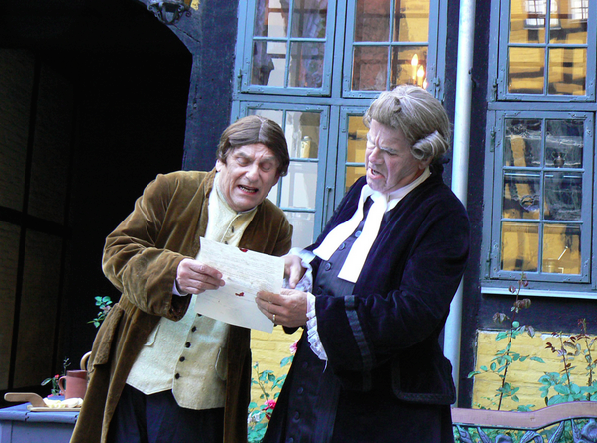
Erasmus Montanus

Untitled 2
Scene from a production of Erasmus Montanus by Bagsværd Amatørescene, Photographer: Flemming Mortensen

There are two places in Kierkegaard’s published and unpublished works where he refers to the earth being “as flat as a pancake.” The first is in his review of H.C. Andersen’s failed attempt at a novel, Kun en Spillemand, that was published under the title of From the Papers of One Still Living, and the second is in his Concluding Unscientific Postscript to the Philosophical Crumbs

The second reference will no doubt be familiar to Kierkegaard scholars. It is in that passage where Kierkegaard, or Johannes Climacus, the pseudonym under which Kierkegaard published the Postscript, illustrates his claim that the mere utterance of an objective truth is not in itself evidence that the person who utters it is sane. “Let me recount an incident,” he begins, “that without any kind of adaptation from my side, comes straight from an insane asylum.” He then tells the story of a man who escapes from this asylum and on his way into town, finds a little skittle ball lying on the ground. He absent-mindedly picks up the ball and puts it in the tail pocket of his coat. As he walks, the ball gently hits him, explains Climacus, on his “a – “ and presumably, the fact of it’s being a ball, reminds him every time it strikes him that the earth is round. Since he knows that everyone agrees that the earth is round, he decides that the best way to convince people that he is sane is to go about saying continually ”the earth is round!”

“And indeed is not the earth round?” ask Climacus. “Does the asylum crave yet another sacrifice for this opinion as when everyone believed it to be as flat as a pancake?” (Hannay, 164). This reference to the earth being “flat as a pancake” is clearly an allusion to Ludvig Holberg’s play Erasmus Montanus. I cannot remember how I learned this. I could have sworn it was in an explanatory note in either one of the English translations of the Postscript or in the text as it appears in the new Søren Kierkegaards Skrifter. But I have searched in vain for such a note, though SKS does acknowledge that the first appearance of this phrase in Kierkegaard’s works, the one in From the Papers of One Still Living is an allusion to the Holberg play.

Since there are at least two references to this play in Kierkegaard’s works, I felt that I should read it. I didn’t own a copy, however, so I did a google search, in the hope that I could find a copy online. I did. Not only did I find a copy, but I found a download able copy in English translation!

The play is hilarious. The Danes like to claim Holberg as one of their own, but in fact, he was Norwegian. The thing is, Denmark ruled Norway back then, so Norwegians were viewed, more or less, as Danes, particularly if they distinguished themselves the way Holberg did. I’m telling you this because the play is clearly set in Norway, in that it concerns a people in a little mountain village and, well, there are no mountains in Denmark. Back in the 18th century, when the play is set, residents of Norway who wanted a university education typically attended the University of Copenhagen. So Rasmus Berg, the eldest son of a prosperous farmer does just that.

I don’t know if all the instruction was in Latin back then, but at least some of it was. Students were typically taught to argue in Latin and showy Latin disputations were part and parcel of university life. Rasmus Berg returns to his little mountain village as Erasmus Montanus, determined to impress everyone with his new learning. Unfortunately for him, the local deacon succeeds in convincing the poor townsfolk, none of whom know a word of Latin, that he is beating the pants off Berg, or Montanus, in Latin disputation even though the Latin he purports to be speaking is nothing but gibberish, bits and pieces of Latin grammar, and other odd words and phrases that he strings together to form nonsensical sentences that he utters with such passionate conviction that everyone feels sorry for poor Berg, or Montanus, for being shown up that way in public.

That isn’t the worst of it, though. The townsfolk are so scandalized when Berg, or Montanus, informs them that the earth is round, that his future father-in-law withdraws his permission for Berg to marry his daughter. Berg, or Montanus, is forced, finally, to recant his statement that the earth is round in order to win the hand of his ladylove.

Interesting, eh? Not only was Kierkegaard understandably taken with the play, the whole thing is kind of a metaphor for his life. There are lines in it about how the earth must be flat because everyone but Montanus thinks it is, and that truth is in numbers. There is the general backwardness of the mountain people that mirrors what Kierkegaard thought of as the backwardness, or philistinism, of the people in the little market town of Copenhagen. And then there is the fact that Montanus had to surrender his calling as an intellectual, to betray his learning, to betray what he knew to be true, in order to enjoy the pleasures of domestic life. This, as we all know, was a sacrifice Kierkegaard could not himself make.

I have come to believe that there are likely many more allusions to this particular play in Kierkegaard’s authorship than have yet been recognized as such. If you can find one yourself, please send it along. Perhaps we can write a collective paper on the influence this play on Kierkegaard’s works, and if there are enough of us, then everyone will have to admit that our claims are correct –– right?

(Hannay, who is generally an excellent translator of Kierkegaard, has inexplicably rendered the Danish Keglekugle as “skittle bowl” instead of “skittle ball.” Perhaps this is some kind of Anglicism with which I am unfamiliar. The object in question is indisputably a skittle ball, however, as both earlier English translations of the Postscript indicate, no matter what people in the UK call it.)