Page 17 of 24

The Lily of the Field and the Snake in the Grass

Arts and Letters is a great website that publishes blurbs about interesting articles that are available online and posts links to those articles at the end of the blurb. I have made it the homepage of my browser so that I can stay up to date concerning what is being published in the humanities. I haven’t been keeping up with it recently, however, because I’ve had so much work to do. I’m home sick today, though, and when I opened my browser to get to Blackboard (the online learning platform Drexel uses) to email my students that I was cancelling class, I was surprised to see a blurb about an article on Kierkegaard.

As it turns out, the article is a review in the Times Literary Supplement of two new books on Kierkegaard, and a new translation of some of his religious discourses. The books are Mark Bernier’s The Task of Hope in Kierkegaard (Oxford, 2015) and Sheridan Hough’s Kierkegaard’s Dancing Tax Collector (Oxford, 2015). The translation is of the discourses published under the title The Lily of the Field and the Bird of the Air (Princeton, 2016). It isn’t a particularly good review. The titles of the books are intriguing, but there is little indication of their content in the review. In fact, the “review” is basically a very short summary of Kierkegaard’s life and works that isn’t always even correct. Will Rees, the author of the review, identifies Either-Or as Kierkegaard’s “first book.” Either-Or was preceded, however, by first Af en endu Levendes Papirer (From the Papers of One Still Living) (1838), and Om Begrebet Ironi (On the Concept of Irony) (1841).

As a child, observes Rees,

Kierkegaard was sensitive, sulky, ironical and precocious. In other words, he had precisely that youthful temperament which, while not a sufficient condition, is nonetheless a necessary condition for the later burgeoning of genius.

Really, I’m not kidding you. He actually says that. He says that all geniuses are necessarily “sensitive, sulky, ironical, and precocious” as children. It may well be that such traits are more pervasive among people who later prove to be “geniuses” (whatever it is, exactly, that that means). It strains credulity, however, to assert without qualification that all geniuses have such traits as children.

Rees also repeats the trope that Kierkegaard renounced the joys of “earthly life” in order to pursue his vocation as an author. Kierkegaard does occasionally speak this way himself. It is clear, however, that what Kierkegaard actually renounced was the not the joys of “earthly” life, but of a conventional life. That is, he renounced the joys of marriage and a family for those of a literary life. Kierkegaard was no ascetic. He ate well and dressed well. He relied on the services of a personal secretary and lived in relative luxury. In fact, he occasionally justified the expenditures associated with this lifestyle as necessary to sustain his creative productivity.

Rees explains that Kierkegaard’s assertion that “truth is subjectivity” is often misunderstood, yet his own explanation of the meaning of this assertion is confusing. It doesn’t mean, he explains, that “something becomes true by virtue of my saying or believing it to be true.” What it means, he continues, is that “beliefs acquire truth only in relation to the individual’s lived orientation toward them.” What’s the difference? Isn’t my believing something to be true more or less equivalent to my having a “lived orientation” toward it? I suppose that depends, at least in part, on what one means by “belief” and “lived orientation.” What is missing from Rees’ explanation is the very thing the omission of which has led to the pervasive erroneous understanding of this statement. Only what Kierkegaard refers to as “subjective truth” requires an individual’s lived orientation toward it. There’s a whole host of objective truths, according to Kierkegaard, as I explain in my book Ways of Knowing: Kierkegaard’s Pluralist Epistemology, that require no such orientation.

The strangest part of Rees’ review, however, is that it fails to indicate the translator of the one translation included in the books being reviewed. Rees mentions the translation is “new,” but not who did it. This is a clear departure from the normal editorial practice of the TLS (see, for example, “They do the war in different voices,” “Storm and stress,” and “Orphaned solemnity,” September 30, 2016). That omission was less puzzling to me after I looked up the book on PUP’s website. The translator is none other than Bruce H. Kirmmse.

Princeton’s website describes Kirmmse as “one of the world’s leading Kierkegaard translators and scholars.” If Kirmmse is “one of the world’s leading Kierkegaard translators,” it’s odd that a review of a translation by him would fail to mention that he was the translator. Could it be that the TLS actually wanted to avoid calling attention to the identity of the translator? Readers of this blog are likely aware that there would be a good reason for this. Kirmmse effectively bought the title of “one of the world’s leading Kierkegaard translators and scholars” with the currency of his ethics.

Kirmmse didn’t become “one of the world’s leading Kierkegaard translators and scholars” until after he translated a controversial Danish biography of Kierkegaard into English. As I explained in an article in Counterpunch back in 2005, there is reason to believe that Kirmmse deliberately tried to obscure that the author of that biography had plagiarized some of the book from earlier biographies. If he didn’t do this, then the anomalies described in the Counterpunch piece in Kirmmse’s translation suggest he’s not a particularly good translator.

Let’s assume, for the sake of argument, that Kirmmse didn’t try to cover up the plagiarism in the biography. Let’s assume he just isn’t all that good a translator. Being a mediocre translator isn’t a crime. But even if we assume Kirmmse didn’t try to cover up the plagiarism in the biography, he’s still guilty of failing to support the scholar who exposed the plagiarisms in the Danish media.

Of course failing to act in a way one ought to have done is not so bad as actually doing something one ought not to do. Unfortunately, Kirmmse is guilty of the latter as well as the former crime. He defamed me in an article entitled “M.G. Pietys skam” (M.G. Piety’s shame) in the Danish newspaper Weekendavisen, when I discovered that the plagiarized passages remained in his English translation of the Kierkegaard biography Kirmmse had translated and began to write about this. The article is a straightforward piece of character assassination designed to divert the attention of Danish readers from the issue of the problems with the biography and the promise of the author to fix those problems before the work was translated. The piece appeared only in Danish, for reasons that will be apparent to anyone who reads my English translation of the article in an earlier post to this blog entitled “Bruce Kirmmse’s Shame.”

I don’t know whether Princeton knew of the controversy surrounding the book in Denmark when they agreed to publish an English translation of it. They should have, of course, but that doesn’t mean they did. They had learned of the problems with the book, however, by 2006 because Peter Dougherty, the head of PUP sent me a letter in which he explained that the then forthcoming paperback included “some 58 pages of corrections.” That’s a lot of “corrections.” You will search in vain, however, for any indication that the paperback is actually a new, or “corrected,” edition.

So there you have it. There’s good reason why the TLS might prefer that the name of the translator not be mentioned in the review of the translation. Perhaps Kirmmse ought to take a leaf from Kierkegaard’s book and start using a pseudonym.
Summer at “The Farm”

img_1074
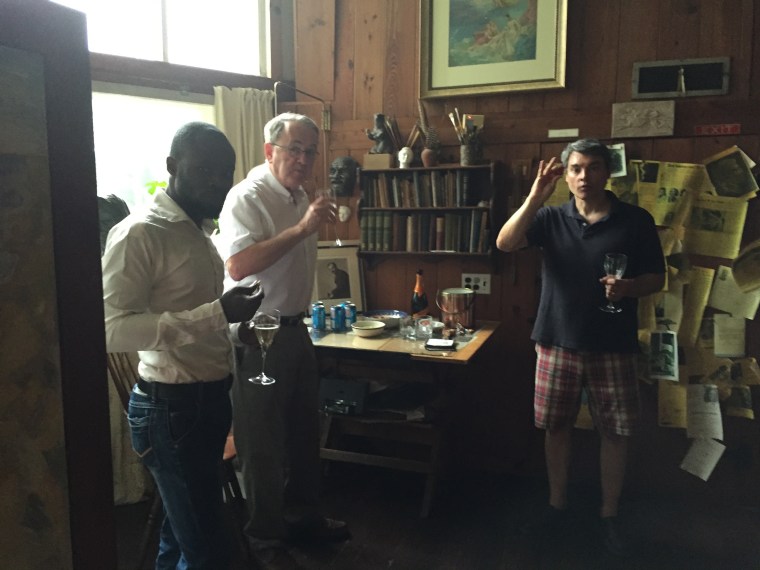
Nigerian Kierkegaard scholar Benneth Anozie, American Kierkegaard scholar Vincent A. McCarthy, and Brian J. Foley, Esq.

Bucks County has got to be one of the most beautiful places in PA, if not in the entire U.S. It has long attracted artists and was the home of the famous Bucks County impressionists. I am very fortunate to have a friend, David Leopold, who owns a large property in Bucks County that was once the home of Bucks County impressionist Ben Solowey. David, who is the archivist for both Al Hirschfeld and David Levine, as well as a freelance curator, is also the director of the Studio of Ben Solowey, a small museum and art gallery that was once Solowey’s studio. I house sit for David for several weeks every summer.

I was house sitting this summer when I received an email from Vincent A. McCarthy. McCarthy had met a Nigerian scholar, Benneth Anozie at a conference at St. Olaf College. Anozie, he explained, was eager to meet me because he was working on a dissertation on Kierkegaard’s epistemology. Would I be around to get together with Anozie, asked McCarthy? When I explained that I was not actually in Philly, but at a farm in Bucks County, McCarthy said that would not be a problem, that he and Anozie could drive up there. I was surprised at first by McCarthy’s willingness to undertake such a long drive for a short meeting. Little did I know that McCarthy is a man of extraordinarily refined tastes. He also has a property in Bucks County. “I need to mow my lawn anyway,” he explained. So I told him to come on up and we would make a day of it.

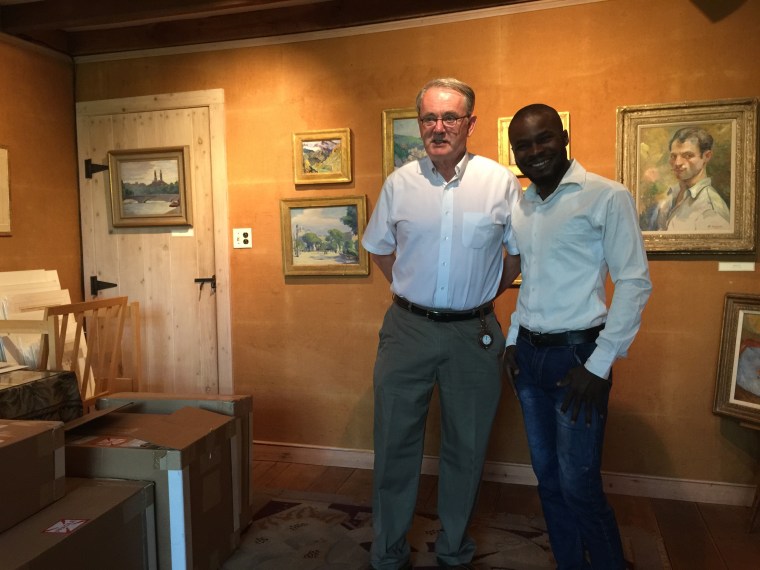
My husband, Brian, and I gave Benneth and Vincent a champagne tour of the then current exhibition Homage: Ben Solowey’s Art Inspired by his Influences. It was a wonderful visit that included a sumptuous meal with more wine. We didn’t talk too much about Kierkegaard. I did get a few minutes, however, to talk to Anozie about Kierkegaard’s epistemology and we are now connected through Linkedin. I was also very fortunate in that Vincent brought me a copy of his new book Kierkegaard as Psychologist (Northwestern, 2015). I’ve only just started it so I can’t say very much about it yet. I can say, however, that the introduction is one of the best short introductions to Kierkegaard that I have ever read. The book, explains McCarthy

is intended to highlight the incredibly rich and deep psychological dimensions of Kierkegaard’s thought, to offer an appreciation and assessment of it, and to serve somewhat as an introduction and commentary on Kierkegaard’s psychology for general readers with an interest in, but not necessarily in possession of detailed knowledge of Kierkegaard’s corpus and Kierkegaard scholarship as such.

That said, a brief survey of the table of contents, combined with an appreciation of the depth of McCarthy’s understanding of Kierkegaard as exhibited in the introduction suggests that the book will be of enormous help to dedicated Kierkegaard scholars as well. There’s a bizarre lacuna in Kierkegaard scholarship concerning Kierkegaard’s psychology. There’s Kresten Nordentoft’s eponymous book from 1972, Steve Evans’ excellent Søren Kierkegaard’s Christian Psychology: Insight for Counseling and Pastoral Care from 1990, and the essays collected in Kierkegaard’s Truth: The Disclosure of the Self, vol. 5 of a series entitled Psychiatry and the Humanities, from 1981, but that’s not very much given how important human psychology was among Kierkegaard’s interests and how profound are his insights into that psychology.

Kierkegaard’s authorship, asserts McCarthy at the end of the introduction,

stresses what he holds to be a timeless prescription as it engages in a profound analysis of forms of alienation and dis-ease with oneself. The “patients” he selects are modeled on nineteenth-century types, but he quickly penetrates beneath the nineteenth-century surface to reveal souls whose restlessness and discontent Augustine in the fourth century and we in the twenty-first have little trouble recognizing. And it is because of his penetration to a problem that transcends but is not unconnected with any particular age and society that Kierkegaard can seem very modern indeed, that he can sometimes seem a contemporary of Freud and Maslow and not just Brahms and Liszt.

I could not have said it better myself. I can’t wait to read more of this book. I’ll present more thoughts on it in later posts.

img_1073
McCarthy and Anozie with a self-portrait of Solowey behind Anozie

Irenaeus and Kierkegaard on Christian Knowledge

Keynote panel
Jonathan Lear, Tanya Luhrmann, Elaine Pagels, and Jeffry Kripal

I presented a paper at a conference entitled The Psychology of Religion/The Religion of Psycholgy at the University of Chicago in March of 2015. I meant to post my thoughts on that conference immediately after its conclusion, but a number of other commitments kept me from being able to do that. The conference, sponsored by the Martin Marty Center for the Advanced Study of Religion, was extraordinarily stimulating. The keynote speakers were Jeffry Kripal, J. Newton Rayzor Chair in Philosophy and Religious Studies, Rice University, Jonathan Lear, John U. Nef Distinguished Service Professor at the Committee on Social Thought, University of Chicago, Tanya Marie Luhrmann, Watkins University Professor in the Department of Anthropology (and Psychology, by courtesy), Stanford University, and Elaine Pagels, Harrington Spear Paine Foundation Professor of Religion, Princeton University.

I was excited to be on the same program with Jonathan Lear and Elaine Pagels. I am a huge admirer of both scholars. Lear is an extraordinarily talented scholar who has done some wonderful work on Kierkegaard as well as on classical philosophy and psychoanalysis and although Pagels has not, to my knowledge, written on Kierkegaard, her books on the history of Christianity in general, and Gnosticism in particular have been very helpful to me.

It was Pagels’ presentation, “’Making a Difference’: How Promoting Exploration of Human Experience Became Heresy,” that prompted this post. Much of that presentation was directed against Irenaeus and his attacks on the Gnostics. Pagels argued that Irenaeus was dismissive of human experience and antagonistic to the idea, so central to Gnosticism, that human beings could achieve knowledge of the divine. In fact, she attributed this antagonism, as the title of her presentation suggests, not merely to Irenaeus, but to orthodox Christianity more generally.

Irenaeus
Slide of Irenaeus from Pagels’ presentation

As I said, I am a huge admirer of Pagels, but that account of Irenaeus, and the Christian tradition more generally struck me as simply false and I said as much during the question period. Knowledge of the divine is clearly possible according to Kierkegaard, as I argue in my book Ways Of Knowing: Kierkegaard’s Pluralist Epistemology (Baylor, 2010). God, observes Kierkegaard in Philosophical Crumbs, did not take on human form “to ridicule human beings. His intention cannot thus be to go through the world in such a way that not a single person ever came to know [vide] it. He does indeed want something of himself to be understood [forstaae]” (Crumbs, 126).

The claim that knowledge of God is possible through an encounter with Christ may seem heretical to those who view Christianity as a religion based on faith. This passage from Crumbs is strikingly similar, however, to Irenaeus’ claim in The Scandal of the Incarnation: Irenaeus Against the Heresies (Ignatius Press, 1990) that “the Lord did not say that the Father and the Son could not be known at all [μη γινωσκεσθαι] for in that case his coming would have been pointless” (Against the Heresies, p. 45).

Irenaeus is specifically concerned in Against the Heresies to reject the claim of the Gnostic Valentinus that the message of the incarnation was God’s inaccessibility to human knowledge. “What the Lord really taught,” asserts Irenaeus, “is this: no one can know God unless God teaches him; in other words, without God, God cannot be known [ανευ Θεου μη γινωσκεσθαι τον Θεον]. What is more,” continues Irenaeus, “it is the Father’s will that God be known [αυτο δε το γινωσκεσθαι αυτον θλημα ειναι του Πατρος]” (Against the Heresies, 45).

Man’s imperfection, or sin, is for Irenaeus, the obstacle to his attaining specifically Christian knowledge. Thus Irenaeus observes that “the Word of the Father [i.e., Christ] and the Spirit of God [i.e., faith in Christ], united to the ancient substance of Adam’s formation [i.e., man], made man living and perfect capable of knowing the perfect Father” (Against the Heresies, p. 57). But sinful man is no longer perfect and hence is incapable of knowing God without the intermediacy of Christ. Thus Irenaeus asserts that “no one can know God unless God teaches him.”

Can “the truth be taught?” asks Kierkegaard in Crumbs (88). His answer, of course, is yes–if God himself teaches it. In other words, Kierkegaard’s claim in Crumbs that union with God is necessary in order for specifically Christian knowledge to be possible echoes exactly Irenaeus’ claim in Against the Heresies that “no one can know God unless God teaches him.”

I presented a paper concerning the similarity of Kierkegaard’s view on the possibility of religious knowledge with those of both Irenaeus and Clement of Alexandria at the annual meeting of the American Academy of Religion in 2011 and was figuratively besieged by admiring Patristics scholars throughout the rest of the conference.

I’m not in a position, of course, to comment upon Pagels’ more general claim that Irenaeus, and the later Christian tradition, was dismissive of human experience. She is certainly correct to the extent that Christianity assumes human experience, characterized as it is by sin, is profoundly problematic as a means for coming to understand the truth. The picture of Irenaeus’ objection to Gnosticism that one gets from Against the Heresies relates, however, to the Gnostics’ condemnation of physical reality, as well as to their elitism, or their view that only a tiny select group of human beings, the πνευματικοι, could know God.

I was very fortunate to share drinks with both Pagels and Luhrmann just before the conference dinner and Pagels assured me then that there were other works by Irenaeus that would support her view that he was dismissive of human experience. She neglected to mention what works those were. But it is not inconceivable that other writings by Irenaeus might display a certain ambivalence about what one could call the “authority” of human experience, since the Christian tradition more generally is ambivalent about this “authority.” Human experience certainly has a kind of authority, however, for Irenaeus. It just isn’t the same kind of authority it has for the Gnostics.

It is clear, however, both that Irenaeus believed human beings could achieve knowledge of the divine and that this view is an important part of the Christian tradition.