Page 18 of 25

Summer at “The Farm”

img_1074
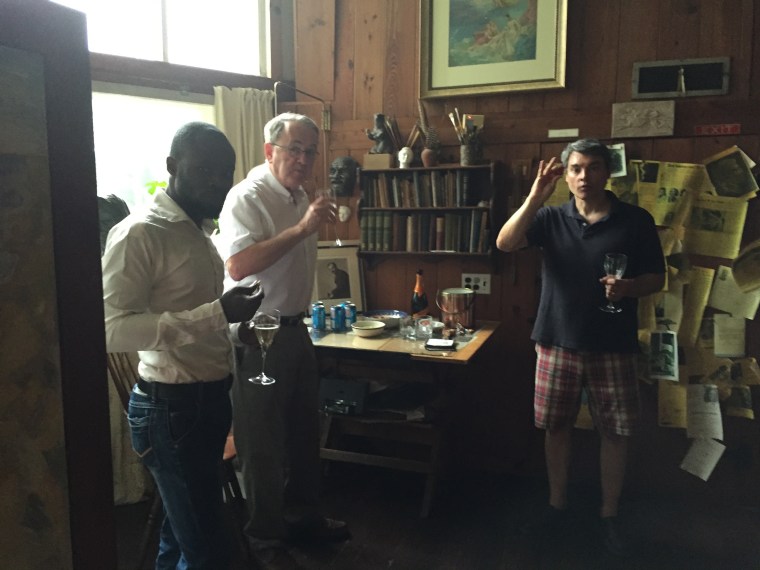
Nigerian Kierkegaard scholar Benneth Anozie, American Kierkegaard scholar Vincent A. McCarthy, and Brian J. Foley, Esq.

Bucks County has got to be one of the most beautiful places in PA, if not in the entire U.S. It has long attracted artists and was the home of the famous Bucks County impressionists. I am very fortunate to have a friend, David Leopold, who owns a large property in Bucks County that was once the home of Bucks County impressionist Ben Solowey. David, who is the archivist for both Al Hirschfeld and David Levine, as well as a freelance curator, is also the director of the Studio of Ben Solowey, a small museum and art gallery that was once Solowey’s studio. I house sit for David for several weeks every summer.

I was house sitting this summer when I received an email from Vincent A. McCarthy. McCarthy had met a Nigerian scholar, Benneth Anozie at a conference at St. Olaf College. Anozie, he explained, was eager to meet me because he was working on a dissertation on Kierkegaard’s epistemology. Would I be around to get together with Anozie, asked McCarthy? When I explained that I was not actually in Philly, but at a farm in Bucks County, McCarthy said that would not be a problem, that he and Anozie could drive up there. I was surprised at first by McCarthy’s willingness to undertake such a long drive for a short meeting. Little did I know that McCarthy is a man of extraordinarily refined tastes. He also has a property in Bucks County. “I need to mow my lawn anyway,” he explained. So I told him to come on up and we would make a day of it.

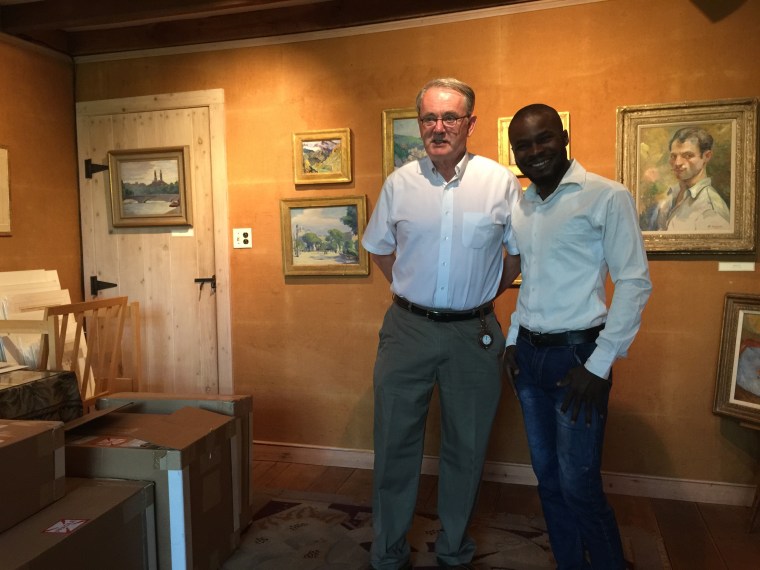
My husband, Brian, and I gave Benneth and Vincent a champagne tour of the then current exhibition Homage: Ben Solowey’s Art Inspired by his Influences. It was a wonderful visit that included a sumptuous meal with more wine. We didn’t talk too much about Kierkegaard. I did get a few minutes, however, to talk to Anozie about Kierkegaard’s epistemology and we are now connected through Linkedin. I was also very fortunate in that Vincent brought me a copy of his new book Kierkegaard as Psychologist (Northwestern, 2015). I’ve only just started it so I can’t say very much about it yet. I can say, however, that the introduction is one of the best short introductions to Kierkegaard that I have ever read. The book, explains McCarthy

is intended to highlight the incredibly rich and deep psychological dimensions of Kierkegaard’s thought, to offer an appreciation and assessment of it, and to serve somewhat as an introduction and commentary on Kierkegaard’s psychology for general readers with an interest in, but not necessarily in possession of detailed knowledge of Kierkegaard’s corpus and Kierkegaard scholarship as such.

That said, a brief survey of the table of contents, combined with an appreciation of the depth of McCarthy’s understanding of Kierkegaard as exhibited in the introduction suggests that the book will be of enormous help to dedicated Kierkegaard scholars as well. There’s a bizarre lacuna in Kierkegaard scholarship concerning Kierkegaard’s psychology. There’s Kresten Nordentoft’s eponymous book from 1972, Steve Evans’ excellent Søren Kierkegaard’s Christian Psychology: Insight for Counseling and Pastoral Care from 1990, and the essays collected in Kierkegaard’s Truth: The Disclosure of the Self, vol. 5 of a series entitled Psychiatry and the Humanities, from 1981, but that’s not very much given how important human psychology was among Kierkegaard’s interests and how profound are his insights into that psychology.

Kierkegaard’s authorship, asserts McCarthy at the end of the introduction,

stresses what he holds to be a timeless prescription as it engages in a profound analysis of forms of alienation and dis-ease with oneself. The “patients” he selects are modeled on nineteenth-century types, but he quickly penetrates beneath the nineteenth-century surface to reveal souls whose restlessness and discontent Augustine in the fourth century and we in the twenty-first have little trouble recognizing. And it is because of his penetration to a problem that transcends but is not unconnected with any particular age and society that Kierkegaard can seem very modern indeed, that he can sometimes seem a contemporary of Freud and Maslow and not just Brahms and Liszt.

I could not have said it better myself. I can’t wait to read more of this book. I’ll present more thoughts on it in later posts.

img_1073
McCarthy and Anozie with a self-portrait of Solowey behind Anozie

Irenaeus and Kierkegaard on Christian Knowledge

Keynote panel
Jonathan Lear, Tanya Luhrmann, Elaine Pagels, and Jeffry Kripal

I presented a paper at a conference entitled The Psychology of Religion/The Religion of Psycholgy at the University of Chicago in March of 2015. I meant to post my thoughts on that conference immediately after its conclusion, but a number of other commitments kept me from being able to do that. The conference, sponsored by the Martin Marty Center for the Advanced Study of Religion, was extraordinarily stimulating. The keynote speakers were Jeffry Kripal, J. Newton Rayzor Chair in Philosophy and Religious Studies, Rice University, Jonathan Lear, John U. Nef Distinguished Service Professor at the Committee on Social Thought, University of Chicago, Tanya Marie Luhrmann, Watkins University Professor in the Department of Anthropology (and Psychology, by courtesy), Stanford University, and Elaine Pagels, Harrington Spear Paine Foundation Professor of Religion, Princeton University.

I was excited to be on the same program with Jonathan Lear and Elaine Pagels. I am a huge admirer of both scholars. Lear is an extraordinarily talented scholar who has done some wonderful work on Kierkegaard as well as on classical philosophy and psychoanalysis and although Pagels has not, to my knowledge, written on Kierkegaard, her books on the history of Christianity in general, and Gnosticism in particular have been very helpful to me.

It was Pagels’ presentation, “’Making a Difference’: How Promoting Exploration of Human Experience Became Heresy,” that prompted this post. Much of that presentation was directed against Irenaeus and his attacks on the Gnostics. Pagels argued that Irenaeus was dismissive of human experience and antagonistic to the idea, so central to Gnosticism, that human beings could achieve knowledge of the divine. In fact, she attributed this antagonism, as the title of her presentation suggests, not merely to Irenaeus, but to orthodox Christianity more generally.

Irenaeus
Slide of Irenaeus from Pagels’ presentation

As I said, I am a huge admirer of Pagels, but that account of Irenaeus, and the Christian tradition more generally struck me as simply false and I said as much during the question period. Knowledge of the divine is clearly possible according to Kierkegaard, as I argue in my book Ways Of Knowing: Kierkegaard’s Pluralist Epistemology (Baylor, 2010). God, observes Kierkegaard in Philosophical Crumbs, did not take on human form “to ridicule human beings. His intention cannot thus be to go through the world in such a way that not a single person ever came to know [vide] it. He does indeed want something of himself to be understood [forstaae]” (Crumbs, 126).

The claim that knowledge of God is possible through an encounter with Christ may seem heretical to those who view Christianity as a religion based on faith. This passage from Crumbs is strikingly similar, however, to Irenaeus’ claim in The Scandal of the Incarnation: Irenaeus Against the Heresies (Ignatius Press, 1990) that “the Lord did not say that the Father and the Son could not be known at all [μη γινωσκεσθαι] for in that case his coming would have been pointless” (Against the Heresies, p. 45).

Irenaeus is specifically concerned in Against the Heresies to reject the claim of the Gnostic Valentinus that the message of the incarnation was God’s inaccessibility to human knowledge. “What the Lord really taught,” asserts Irenaeus, “is this: no one can know God unless God teaches him; in other words, without God, God cannot be known [ανευ Θεου μη γινωσκεσθαι τον Θεον]. What is more,” continues Irenaeus, “it is the Father’s will that God be known [αυτο δε το γινωσκεσθαι αυτον θλημα ειναι του Πατρος]” (Against the Heresies, 45).

Man’s imperfection, or sin, is for Irenaeus, the obstacle to his attaining specifically Christian knowledge. Thus Irenaeus observes that “the Word of the Father [i.e., Christ] and the Spirit of God [i.e., faith in Christ], united to the ancient substance of Adam’s formation [i.e., man], made man living and perfect capable of knowing the perfect Father” (Against the Heresies, p. 57). But sinful man is no longer perfect and hence is incapable of knowing God without the intermediacy of Christ. Thus Irenaeus asserts that “no one can know God unless God teaches him.”

Can “the truth be taught?” asks Kierkegaard in Crumbs (88). His answer, of course, is yes–if God himself teaches it. In other words, Kierkegaard’s claim in Crumbs that union with God is necessary in order for specifically Christian knowledge to be possible echoes exactly Irenaeus’ claim in Against the Heresies that “no one can know God unless God teaches him.”

I presented a paper concerning the similarity of Kierkegaard’s view on the possibility of religious knowledge with those of both Irenaeus and Clement of Alexandria at the annual meeting of the American Academy of Religion in 2011 and was figuratively besieged by admiring Patristics scholars throughout the rest of the conference.

I’m not in a position, of course, to comment upon Pagels’ more general claim that Irenaeus, and the later Christian tradition, was dismissive of human experience. She is certainly correct to the extent that Christianity assumes human experience, characterized as it is by sin, is profoundly problematic as a means for coming to understand the truth. The picture of Irenaeus’ objection to Gnosticism that one gets from Against the Heresies relates, however, to the Gnostics’ condemnation of physical reality, as well as to their elitism, or their view that only a tiny select group of human beings, the πνευματικοι, could know God.

I was very fortunate to share drinks with both Pagels and Luhrmann just before the conference dinner and Pagels assured me then that there were other works by Irenaeus that would support her view that he was dismissive of human experience. She neglected to mention what works those were. But it is not inconceivable that other writings by Irenaeus might display a certain ambivalence about what one could call the “authority” of human experience, since the Christian tradition more generally is ambivalent about this “authority.” Human experience certainly has a kind of authority, however, for Irenaeus. It just isn’t the same kind of authority it has for the Gnostics.

It is clear, however, both that Irenaeus believed human beings could achieve knowledge of the divine and that this view is an important part of the Christian tradition.


Some Reflections on an Auspicious Occasion

IMG_0886
McGill Cap

I’ve been promoted to full “Professor.” I am no longer “Associate Professor M.G. Piety.” I am now, or will be as of 1 September, “Professor M.G. Piety.” According to my colleague Jacques Catudal, I am the first person to make full “Professor” in philosophy at Drexel in more than 18 years.

It has been a long journey, as they say. I decided to study philosophy when I was an undergraduate at Earlham College, a small Quaker college in Richmond, Indiana. I became hooked on philosophy as a result of taking a course on rationalism and empiricism with Len Clark. I didn’t particularly enjoy reading philosophy, and I hated writing philosophy papers. I loved talking about it, though. Talking about it was endlessly fascinating to me, so I switched my major from English to philosophy. I became hooked on Kierkegaard after taking a Kierkegaard seminar with Bob Horn. “Bob,” my friends at Earlham explained, “was God.” He was preternaturally wise and kind and a brilliant teacher who could draw the best out of his students while hardly seeming to do anything himself. I don’t actually remember Bob ever talking in any of the seminars I took with him, and yet he must have talked, of course.

I spent nearly every afternoon of my senior year at Earlham in Bob’s office talking to him about ideas. I worried sometimes that perhaps I should not be taking up so much of his time. He always seemed glad to see me, though, and never became impatient, even as the light began to fade and late afternoon gave way to early evening. I don’t remember him encouraging me to go to graduate school in philosophy (my guess is that he would have considered that unethical, given the state of the job market in philosophy). I do remember, however, that he was pleased when I announced that I had decided to do that.

Graduate school was enormously stimulating, but also exhausting and, for a woman, occasionally demoralizing. There has been much in the news in the last few years about how sexist is the academic discipline of philosophy. Well, it was at least as bad back then when I entered graduate school as it is now, and possibly even worse. Still, I persevered. I began publishing while still a student and was very fortunate to gain the support and mentorship of some important people in the area of Kierkegaard scholarship, including C. Stephen Evans, Robert Perkins and Sylvia Walsh Perkins, and Bruce H. Kirmmse, who was one of my references for a Fulbright scholarship I was awarded in 1990 to complete the work on my dissertation on Kierkegaard’s epistemology.

I lived in Denmark from 1990 until 1998. I received my Ph.D. from McGill University in 1995 but remained in Denmark to teach in Denmark’s International Study Program, then a division of the University of Copenhagen. I wasn’t even able to go back for my graduation, so I learned only a couple of years ago, when my husband bought me my own regalia as a gift, how gorgeous the McGill regalia are (see photo below).

I came to Drexel from Denmark in 1998 as a visiting professor. I liked Drexel. It was overshadowed by its neighbor, the University of Pennsylvania, but that seemed to me almost an advantage back then. That is, Drexel had carved out a unique niche for itself as a technical university, somewhat like MIT but smaller, that provided a first-class education in somewhat smaller range of degree programs than were offered by larger, more traditional institutions. The College of Arts and Sciences seemed to me, at that time, and to a certain extent, still today, as a real jewel, as Drexel’s “secret weapon,” so to speak, because while most large universities had class sizes ranging anywhere from 40 to several hundred students, most of the courses in the humanities at Drexel were capped at 25 students. Drexel also boasted some first-class scholars who were as committed to teaching as to scholarship. Drexel was providing its students with what was effectively the same quality of education in the humanities as is provided at small liberal-arts colleges, while at the same time giving them invaluable hands-on work experience through its co-op programs that few liberal-arts colleges could provide.

Drexel asked me to stay on for a second and then a third year, despite the fact that my beginning was less than auspicious in that at the end of that first fall term, I had mistakenly conflated the times of what should have been two separate exams and hence left my students sitting in a room waiting patiently for almost an hour for me to materialize and administer the exam. It was too late, of course, to do anything by the time I learned, via a phone call from one of the secretaries in the department, of the mistake. I was relieved when not only was the then chair of the department, Ray Brebach, not only not angry with me, but eager to see if I would be willing to stay on for another year. Ray has been one of my favorite colleagues ever since.

I received my tenure-track appointment in the spring of 2001. I liked my department. It was originally the Department of Humanities and Communications and included the disciplines of English, philosophy and communications. It was enormously stimulating to be in such a cross-disciplinary department. There were poets and novelists, as well as traditional literary scholars. I particularly liked being around the communications people, however, because many were engaged in politically significant media studies and that sort of work was reminiscent of the dinner-table discussions I remembered from childhood when my father was an editorial writer for one of the two newspapers in the town where I grew up. My association with the communications people led to the publication of an article I wrote together with my husband on the behavior of the mainstream media in the U.S. leading up to the second Iraq war.

Eventually, however, the communications people left our department and formed a new department together with the anthropologists and sociologists called the Department of Culture and Communications. So then we became the Department of English and Philosophy. I was sad to see the communications people go, but there were still plenty of creative writing people in the department who helped to make it a more stimulating environment than it would have been had it been comprised exclusively of traditional scholars. These people, including Miriam Kotzin and Don Riggs, both brilliantly talented poets, are some of my closest friends. Miriam has encouraged me to write for her outstanding online journal Per Contra, and Don, a talented caricaturist as well as poet, drew the picture of me that I occasionally use for my other blog.

It was an ordeal, however, to go up for tenure. Our department has a tradition of requiring monstrously comprehensive tenure and promotion binders into which must go almost everything one has done on the road to tenure or promotion. I think each one of my tenure binders was around 500 pages in length. It took me the entire summer of 2006 to put them together, a summer when I could have been writing material for publication. To add possible injury to the insult of having to devote so much time to the compilation of these binders was my fear that some of the reports of my “external reviewers” might not be so positive as they would haven been had I not become involved in a scandal in Denmark surrounding a controversial Danish biography of Kierkegaard. I lost several friends, including the aforementioned Bruce Kirmmse, as a result of my role in that controversy, friends whom I feared might well have been recruited to serve as external reviewers.

To this day I don’t know who all the reviewers were. Two were selected from a list I had provided my tenure committee, but the rest were selected by the committee itself. Whatever the reviewers said, however, it was not so negative as to override what subsequently became apparent was the high esteem in which my colleagues held me and my work. I was granted tenure in the spring of 2007 and I have fond memories to this day of the little reception provided by the dean for all faculty who where granted tenure that year. There was champagne and there were toasts and I was very, very happy.

I’d always been happy at Drexel, so I was surprised by the change that took place in me upon my becoming tenured. I felt, suddenly, that I had a home. I felt that people both liked and respected me. More even than that, however, I felt that I had found a community of high-minded people. People committed to principles of justice and fairness. I felt I had found a small community of the sort that Alasdair MacIntyre argues in After Virtue we must find if we are to live happy and fulfilling lives, the kind of community that is increasingly rare in contemporary society.

That all seems long ago now. Drexel has grown and changed. I am still fortunate, however, to have many brilliant, talented, and fair-minded colleagues. Thanks must go to my colleague Abioseh Porter, who chaired the department for most of the time I have been at Drexel and who was a staunch supporter of my development as “public intellectual” long before “public philosophy” enjoyed the vogue it does today. Thanks must also go to the members of my promotion committee, but especially to my colleague Richard Astro, who chaired the committee. I know from merely serving on tenure-review committees that no matter how uncontroversial the final decision is anticipated to be, there is an enormous amount of work required of the committee members, simply because of the level of detail required in the final report.

Thanks must also go to everyone who has supported me throughout my career. I set out, actually, to list each person individually, but then I realized that there are many, many more people than I would ever be able to list. I have been very fortunate.

Thank you everyone. Thank you for everything.

Cap and Gown