Page 10 of 11

Ibsen (and Kierkegaard) at Temple

Henrik ibsen
Henrik ibsen

One of the nice things about living in Philadelphia is the Greater Philadelphia Philosophy Consortium. The consortium is made up of the philosophy departments of local colleges and universities (including The University of Delaware). The member institutions share information about events of interest to philosophers. Given the number of institutions in the consortium, there’s nearly always something good going on.

On Friday, May 2, I attended a symposium at Temple. Sponsored by Temple’s Department of Philosophy, the Center for Ibsen Studies of the University of Oslo, and The Center for the Humanities at Temple, the two-day symposium was entitled “Staging Skepticism: Ibsen and the Drama of Modernity.” Kristin Boyce and Susan Feagin presented papers on Thursday morning entitled, respectively, “The Method of Doubt and the Willing Suspension of (Dis)belief in Little Eyolf” and “Are Play Scripts Literature?” Frode Helland and Kristin Gjesdal presented papers in the afternoon entitled “The Use and Abuse of Truth: Skeptics and Skepticism in Ibsen,” and “Doubting the Past: Tragedy, Tradition, and Modernism in Ibsen’s Ghosts.”

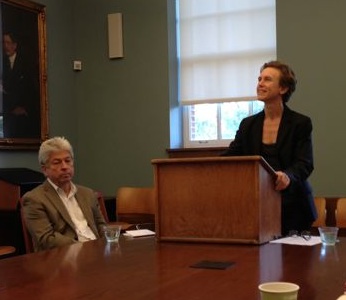
Unfortunately, I was not able to make the event on Thursday. Fortunately, I was able to make it on Friday and was treated to two very stimulating presentations. The first, by the dashing and handsome Leonardo Lisi, was entitled “Ibsen and the Metaphysics of Doubt,” and the second, by the lovely and sophisticated Toril Moi, was entitled “Hedda’s Silences: Reading, Philosophy, Theater.”

It’s easy for those of us in the fields of philosophy and theology delude ourselves that we have a monopoly on scholarly work on Kierkegaard. This symposium demonstrated clearly, however, that Kierkegaard is of great interest to people in the field of literary theory. I don’t know to what extent Kierkegaard’s thought figured into the presentations the first day, but references to Kierkegaard were much in evidence on day two.

Lisi, whose first book was entitled Marginal Modernity: The The Aesthetics of Dependency from Kierkegaard to Joyce (Fordham, 2012) is hard at work on two new book projects, both of which involve Kierkegaard.

There was a stimulating discussion after Moi’s paper. It ranged far and wide, but the part that I thought would be of particular interest to readers of this blog concerned a problem of translation. Danish has two words that can be translated as “silent”: “stille” and “tavs.” The former is used to refer both to nature and to people. That is, one speaks in Danish of a wood (i.e., forest) being “stille,” just as one could in English refer to it as “still.” But “stille” can also be used to describe people. The expression “ti stille” means “be quiet,” or “be still,” as we also often say in English.

Tavs,” on the other hand is never used to refer to nature alone. There is, as Moi explained, an “element of agency” to it. People, not nature, are “tavs.” The Ferrall-Repp dictionary defines “tavs” as “silent, hushed, discreet,” and the expression “ubrødelig taushed” as “inviolable secrecy.”

This is important because during the discussion after Moi’s paper, one of the participants in the seminar pointed out that while Moi had referred repeatedly in her paper to Hedda’s “silences” in Ibsen’s play Hedda Gabler, Hedda is not really silent at all but speaks throughout, and at least occasionally on precisely the topics on which Moi had described her as “silent.” Moi conceded the point but then explained that although Hedda speaks throughout the play, her speech fails to reveal important truths that are relevant to the plot.

To my mind, Moi didn’t need to concede anything to her critic. Hedda is “silent” in the sense in which we often use the expression in English. That is, she is not forthcoming with information that is important to the circumstances of the play. The Oxford English Dictionary offers the following as the second definition of “silent”: “Omitting mention of or reference to, passing over or disregarding, something in narration; containing no account or record.” “Unmentioned, unrecorded; marked by the absence of any record” is also given as a definition.

Another point that may interest readers of this blog. One of the participants mentioned to me during the break between Lisi’s and Moi’s papers that she was curious concerning whether Ibsen’s plays would have been performed in Norwegian in Norway. Many people don’t realize, I suspect, that though Ibsen was Norwegian, he wrote in Danish. Even fewer people realize, however, that all Norwegians at that time wrote in Danish. Danish was simply the written language of Norway. That’s why modern Norwegian (in contrast to “new Norwegian”) is known in Norway as “bokmål.” Modern Norwegian, which is effectively Danish with a few spelling changes, is the language of books (bøker). There were a few spelling differences even in Ibsen’s day, but so few that one could get all the way through a book from that period without realizing that it was actually Norwegian and not Danish. (New Norwegian, or nynorsk, is an attempt to reconstruct a common Norwegian language from the many dialects that were spoken in Norway before the Danes took over there in the sixteenth century.)

So yes, Ibsen wrote in Danish, but that’s basically the same thing as saying he wrote. Even today Danes and Norwegians rarely bother to try to speak one another’s language. Modern Norwegian, though it sounds very different from Danish, is more like a dialect of Danish than a different language.

Finally, I may have said this before, but it bears repeating. One of the benefits of learning Danish is that when you get very good at it, you’ll be able to read Norwegian. I keep forgetting that. I had such a good time at the symposium, though, that I’ve decided to read some Ibsen!

Kierkegaard and Traditionalism

As I write this scholars of religion are milling about the book exhibit at the annual meeting at the American Academy of Religion in Chicago. The AAR meeting is one of my favorite academic conferences. There’s something for everyone there. From Wiccans to the Eastern Orthodox. I decided not to attend this year’s meeting, however, because I’m not on the program and that means I’d have to foot the bill myself. There are always a multitude of interesting papers, more than I would ever be able to get to even if none of them ran concurrently. I think what I miss most of all though is the book exhibit.

The book exhibit is wonderful. Every major academic and scholarly publisher is represented, including many foreign and esoteric presses. I’ve taken, in recent years, to carrying my Kindle with me through the rows of exhibitors. If I see a book I like, I quickly check to see if it is available on Kindle. Not only are Kindle versions often cheaper than the regular or hardcover editions (even with the substantial conference discount), but they do not add to the bulk of the luggage I have to tote back home.

Some books though, are simply not the same on a Kindle, or other electronic reading device because they’re not just text, but aesthetic objects. Such a book is The Christian Spirit from World Wisdom publishers. It’s sort of a modern version of an illuminated manuscript. No one has more (both in quantity and in quality) beautiful books than World Wisdom publishers. And no press has a more congenial staff. The year I bought The Christian Spirit I struck up a conversation with the people who were staffing the World Wisdom booth and the longer I stood there and talked, the more books they gave me. Yes, they gave me books. I can’t remember how many books I bought, somewhere around a half a dozen, I think, but they gave me at least that many for free. The conversation would turn in the direction of a subject covered in a book I had not bought, and no sooner than I would shake my head in disappointment that I really could not afford to buy yet another book, would I find it thrust into my hands for free if I would simply promise to read it.

I love the people at World Wisdom. When I arrived home and began to peruse some of my new treasures, I kept coming upon the terms “traditionalism,” and “perennialism.” The two terms are used more or less interchangeably to refer to the same movement. The movement was founded by René Guénon, Frithjof Schuon, and Ananda Coomaraswamy. It’s a religious, or spiritual, movement that is at once pluralistic and conservative. Traditionalists believe that all religions have their origin in the same transcendent source–God, but that each must be respected for its own inherent integrity. It has unfortunately been associated with rightwing movements in Europe, which is probably part of the reason it is not better known in the U.S. It’s far from clear, however, that the core beliefs and values of traditionalism cohere with such movements.

What is clear, however, is that traditionalism is in at least some vague sense politically conservative. Seyyed Hossein Nasr, one of the leading proponents of contemporary traditionalism quotes Schuon as asserting that the worst king is better than the best president. That remark gave me pause, not simply because one doesn’t expect to hear such an assertion from a contemporary Western scholar, but because it sounded so remarkably like Kierkegaard.

“A mediocre ruler,” asserts Kierkegaard, “is a much better constitution than the abstraction of 100,000 growling non-human beings” (“En maadelig Regent er en | meget bedre Forfatning end dette Abstractum, 100,000 brummende U-Msker.”  [NB4 :114 1848, SKS 20, 339]). “Every movement that really wants to be progressive,” he asserts, “must have its origin in one thing–it must be clear that God is involved, that the whole thing really issues from him” (Enhver Bevægelse, der virkelig skal være et Fremskridt, maa udgaae fra Een – at det kan være tydeligt, at Gud er med i Spillet, saa det Hele egl. udgaaer fra ham [NB4 :114 1848, SKS 20, 339]).

“Nasr had cited Kierkegaard, at the beginning of a talk he gave at a conference entitled “Tradition in the Modern World, as one of the bad guys, one of the modernist thinkers (which means “bad guy” to traditionalists).

It’s not surprising Nasr would put Kierkegaard in the class of modernist thinkers. Most people who don’t know much about Kierkegaard probably think about him that way. Even Alasdair MacIntyre presents Kierkegaard that way in his otherwise excellent book After Virtue. Most serious Kierkegaard scholars know, however, that such a view of Kierkegaard is mistaken (cf., e.g., Kierkegaard After MacIntyre). Kierkegaard’s political conservatism is, in fact, the source of a great deal of embarrassment among Kierkegaard scholars who think of themselves as politically progressive.

It’s time such scholars (and I place myself among them) acknowledged, however, that despite what we like to see as the potential of Kierkegaard’s thought to contribute to a progressive political ideology, it is unlikely that Kierkegaard would have approved of such a project himself. No “progress” is possible for Kierkegaard without God and fitting God into any organized movement, political or otherwise, is a project that Kierkegaard all too often speaks as if he believes is doomed to failure.

A monarch is a better regent, for Kierkegaard, than a mob because a monarch can, as an individual, have a personal relation to God, while a mob cannot. It’s not clear, however, whether all collectives can be fairly characterized, from Kierkegaard’s perspective, as “mobs.” Despite his bitter disappointment with “Christendom,” he seems to hold out some hope that there could be such a thing as a community of believers.

What would such a community look like? Is it something the traditionalists would recognize? Is that what they also are trying to effect in the modern world? The traditionalists’ rejection of modern secularism and their call to return to an explicit acknowledgment of what they view as man’s spiritual essence certainly coheres with the substance of Kierkegaard’s thought. It ought to be attractive as well to progressives in its pluralism. There is, I would argue, the potential for a great deal of fruitful scholarship on the relation between Kierkegaard’s political views and the contemporary traditionalist movement.

Bruce Kirmmse’s Shame

Bruce Kirmmse was a key player in the controversy over Joakim Garff’s book SAK (Søren Kierkegaard: A Biography). Kirmmse did the English translation, which inexplicably included many of the errors that Peter Tudvad had already exposed in the original and indeed appeared calculated to cover up some of the apparent plagiarism in the original.  (See previous blog post, as well as, “Rot in the Ivory Tower.”)

Kirmmse also played attack dog, authoring some articles defending the book in the Danish media.  One of them was a scurrilous, defamatory hit piece against me, “M.G. Piety’s Shame,” published in the September 23-29, 2005 Weekendavisen.  I don’t use those labels lightly; when I saw the article, I consulted with a well-known defamation attorney in Philadelphia, who concluded that the article was defamatory. I didn’t pursue litigation because of a lack of funds (the lawyer didn’t want to take the case on a contingency fee, because he didn’t foresee big damages).

The article has never appeared in English.  I present it below.

I’ve decided to republish the piece here because Kirmmse was recently selected as the keynote speaker at the Seventh International Kierkegaard Conference, sponsored by the Hong Kierkegaard Library at St. Olaf’s College this coming June. I believe Kirmmse’s scurrilous role in the controversy over Garff’s book makes him unfit to be honored in this way.

Two preliminary points: (1) An astonishing aspect of Kirmmse’s piece is that Kirmmse never reveals anywhere in it that I entered the controversy as a result of the fact that the errors and plagiarisms Tudvad had exposed in the Danish edition of Garff’s book appeared uncorrected in his English translation that was published a year later.  Instead, he accuses me of ”resurrecting” Tudvad’s attack, as if out of thin air and out of spite.  That’s deliberately misleading. I knew about the controversy from the beginning but chose to write about it only after it became relevant to people who were forced to rely on Kirmmse’s translation.

(2) Kirmmse also never revealed in the piece his own self-interest. Not only did he do the translation of SAK, he was being considered to head up the new translation of Kierkegaard’s journals, a project that had been conceived by Niels Jørgen Cappelørn, one of Garff’s staunchest defenders, and over which he, Cappelørn, had control in that he could restrict access to the new Danish editions of the journals on which the translation would be based.  Many Weekendavisen readers were likely deceived into thinking that Kirmmse was a disinterested American scholar commenting on the controversy.  Instead, Kirmmse was most likely seeking to deflect attention from Tudvad’s well-documented criticisms of Garff’s book – that is, to deceive and deflect attention from his own complicity and duplicity in his translation of SAK. (See the details in “Rot in the Ivory Tower”) as well as to curry favor with Cappelørn, who had come under heavy criticism for his own role in the SAK controversy.

I realize that I could be accused of not being disinterested in how I’ve translated Kirmmse’s article. So I asked Kirmmse via an email dated 8/22/2012 for the English version of his piece (he didn’t write the article in Danish originally – it was translated by someone else for Weekendavisen).  Kirmmse never replied to my email.  So I emailed him again on 8/29/2012. This time I sent him my version and asked if he had any issues as to its accuracy. Again, he failed to reply. So on September 4, I tried to call him. The only number I had for him was the general number for the History Department at Connecticut College, where he is now emeritus.  The secretary there said she didn’t have a number for him, not even his home number.  She informed me that because he traveled a lot, email was the best way to contact him and reassured me that the email address I had for him was correct and that he was good about responding to email.   Apparently, he doesn’t want to respond.  In any event, I’m confident that I’ve translated this piece accurately.  

M.G. Piety’s Shame

by Bruce Kirmmse

Peter Tudvad expresses surprise, in an article entitled, “SAK Redux” that I, despite my generally positive review of his Kierkegaards København (Books, 2 September 2005) have also been critical of his work. I won’t repeat my review here, but merely point out that anyone who read my article in this paper as well as my longer review in Kierkegaardina 23 (Copenhagen, 2004), will quickly see that in both cases I expressed both genuine praise and serious criticism.

My praise concerns Tudvad’s industry and rigor with respect to uncovering some concrete details that were unknown to earlier scholars. My criticisms were directed at his methodology. His belief in 19th century positivism causes him to believe that one can “discover” the historical truth, and that this exists eternally uninfluenced by “interpretation.” As an historical scholar, I find Tudvad’s methodological assumptions untenable and unsuited to both historical scholarship in general as well as to its sub discipline of biography in particular. Tudvad’s unreflective positivism has, to put it bluntly, caused him to make a category mistake, with the result that he misunderstands the character of biography and it was on the basis of this misconception of the work of biographical authors that he initiated his attack on Garff’s biography of Kierkegaard.

A result of this category mistake was that Tudvad was not entirely clear about what he was doing when he initiated his attack on Garff’s biography. The same, unfortunately, cannot be said about Marilyn Piety, who decided over the course of the summer to resurrect Tudvad’s year-old attack. Piety knows exactly what she’s doing. She’s an assistant professor of philosophy at a technically oriented educational institution in Philadelphia, has a good knowledge of Danish and had published some articles on Kierkegaard. Her real specialty, however, is the writing of polemical exposés of what she believes is “nepotism” and “corruption” in the academic world, in particular in connection with Danish universities.

It’s clear from her article in The Philosophers’ Magazine (nr. 31, 2005) as well as from her subsequent pieces in the Danish press and her contributions to the public debate on the internet, that she doesn’t have anything new to say. It’s clear that when she ventures out on thin moral ice with, for example, her repetition of Tudvad’s claim of academic misconduct or plagiarism, she attempts to protect herself by asserting that the accusation of academic misconduct “was not my accusation,” that she is “only repeating” Tudvad’s accusations. This morally questionable mode of attack makes it possible for her to do damage while at the same time distancing herself from it. It is worth noting that she earlier conducted herself in precisely the same manner.

In the beginning of the 1990s, when Marilyn Piety lived in Copenhagen and was working on her dissertation at the University of Copenhagen, the rector of the university, the neurologist Kjeld Møllgård, was accused of scientific misconduct in connection with a twenty-year old study. The charge was taken seriously and brought before the Board of Ethics (etisk råd) the body that has jurisdiction over such cases in the Danish academic world. They transferred the case to the Committee on Scientific Misconduct [Udvalget Vedrørende Videnskabelig Uredelighed] who thoroughly investigated it and concluded that all charges against Møllgård proved “groundless.”

Even though Piety lived in Copenhagen in 1994 and thus must have been aware of all the facts surrounding the case–i.e., both the charges against Møllgård and the fact that Denmark’s highest authority for academic ethics had found all the charges “groundless”–she nevertheless publicized them in a full-page article in 1997 (15 August 1997) entitled “Nordic nadir for nepotism” in the Times Higher Education Supplement. She mentioned the charges against Møllgård to support her own charge of pervasive corruption in the Danish academic world, but failed to mention that he had earlier been cleared of all charges. She formulated, in fact, her presentation of the case in such a way that the reader got the impression that the question of Møllgård’s guilt was still an open one. Piety’s behavior in this case was so extreme that the Committee on Scientific Misconduct wrote to the  Times and demanded they print a retraction which was then printed in the paper on the 17th of October 1997.

So far as anyone knows, Piety has never herself issued a retraction or made any public apology for having spread false accusations of scientific misconduct on the part of Rector Møllgård, even though she knew he had been cleared of these charges three years earlier. And even though the charges of academic misconduct that have been advanced against Garff have never reached the stage of a formal investigation (there was no reason for such an investigation), two prominent Danish academics, Thomas Bredsdorff and the director of the Center for Søren Kierkegaard Research, Niels Jørgen Cappelørn, investigated Garff’s work in the ligt of Tudvad’s charges and declared publicly that the charges were groundless.

Garff has, in addition, publicly reacted to some of Tudvad’s criticisms, refuted some and promised to take others into account, particularly those concerning concrete historical facts, when the book appears in a new edition. Piety must have known about Garff’s public reaction (both his disagreement with elements of Tudvad’s critique and his willingness to correct some of the errors in a new edition of the work), and she undoubtedly was aware of Professor Bredsdorff’s and Centerleader Cappelørn’s public refutation of Tudvad’s complaint [of academic misconduct]–just as she knew when she wrote her article in 1997 that Møllgård had been cleared of all charges in 1994.

But just as she failed to issue either a public retraction or an apology for her backstabbing of Møllgård in 1997, so is it unlikely that she will do so in connection with her backstabbing of Garff in 2005. As she puts it herself “they are not my accusations,” “I’m merely restating” what others have said. This is a clear pattern in Piety’s behavior. Her method of backstabbing others through insinuation is morally condemnable and should not be taken seriously. Has she no shame at all?

After having unapologetically smeared Møllgård eight years ago by simply “repeating” charges made against him by others, she is now attempting to do the same thing to Garff in an effort to support her claim that there is “something rotten in Denmark” especially in the Danish academic world. Danes have long been sensitive to these words of Shakespeare’s and this is perhaps the reason that the Danish media were willing to publicize Piety’s views without checking her sources. The best way to react to such behavior is perhaps to answer with another quotation from Shakespeare: “Oh shame, where is thy blush” [Hamlet, III iv].

Some additional points:

–At the end of his article, Kirmmse argues that the entire Danish media somehow failed to spot my alleged errors. They didn’t spot them, I submit, because there weren’t any as the Danish media well knew because they had been covering the controversy over the biography for approximately a year by the time my first piece on it appeared.

–Kirmmse never disputes the correctness of any of the points I made in the material I published on Garff’s biography of Kierkegaard. It’s curious as well, that he attempted to discredit my efforts to inform readers of the problems with the English translation of the  book by charging that my points were not “new.” As I explained above, I decided to “resurrect Tudvad’s year-old attack” when the English translation of Garff’s book came out a year after the original Danish edition and I discovered that the problems Tudvad had identified in that edition were in the English edition as well. Kirmmse’s charge that my claims were not “new” was simply an attempt to deflect attention from that fact by invoking a well-known and widely discredited rhetorical technique frequently invoked by the public relations industry and discussed, for example, in Rampton and Stauber’s excellent Trust Us, We’re Experts (pp. 68-69). It is never an indictment of a claim, or argument, to point out that it is not “new.” Many excellent arguments (e.g., those in favor of freedom of expression and equal protection under the law) are not new, but they are excellent arguments nonetheless and bear repeating despite their lack of novelty.

–Kirmmse criticizes me for my pointing out that the charges against Garff’s book were Tudvad’s, not mine. It would have been inaccurate, however, if I had said they were mine. In fact, it would have been plagiarism if I’d repeated Tudvad’s points in print claiming that they were my own. Far from being “morally questionable,” as Kirmmse charges, my identification of the points as having come from Tudvad was morally obligatory. Tudvad was the one who deserved credit for identifying the problems with Garff’s book and I endeavored to be conscientious in making that clear.

–Kirmmse is correct when he claims that I never issued “either a public retraction or an apology” for my purported “backstabbing” of Møllgård in my 1997 article. The Times pressured me repeatedly to do this, but I stood my ground. I wasn’t mistaken in my presentation of the Møllgård case and I wasn’t sorry I had presented it.

–As for checking facts, neither Kirmmse nor Weekendavisen can have checked the facts in the Møllgård case, because if they had, they’d have discovered that the charges of scientific misconduct had been brought against Møllgård, not twenty years after the fact as Kirmmse suggests, but while Møllgård was working as a post doc at the University of California at Berkeley. The investigation had been inconclusive.

–Yes, the Danish Committee on Scientific Misconduct “cleared” Møllgård of all charges relating to the case. I didn’t know about this, however, because it was not widely publicized. Had it been, someone might well have pointed out that a Danish committee did not have the authority to clear someone of charges that had been brought by a U.S. committee.

–It’s unlikely Kirmmse even read my article “Nordic nadir for nepotism.” If he’d had he’d have seen that it was not an attack on Møllgård. Møllgård receives only passing mention in the piece. The subject of the article was, as the title indicates, nepotism in higher education in Denmark, and the point of the mention of Møllgård was that it would be difficult for him to do anything about this problem because an unresolved case of purported scientific misconduct in his past would make him vulnerable to blackmail. In fact, the reason I was aware of the case, which was twenty years old, as Kirmmse rightly pointed out, by the time it made the Danish newspapers, is that someone had apparently dredged it up in an effort to sabotage Møllgård’s candidacy for the position of rector of Copenhagen University. Hence my speculation that the scientific misconduct case would make it difficult for Møllgård to take a hard line on corruption within the university, was well supported.

–Compare the tone of my article “Nordic nadir for nepotism” to the tone of Kirmmse’s “M.G. Piety’s Shame” and ask yourselves which article is more properly described as a piece of character assassination. Kirmmse so misrepresented the content of my article that either he condemned me for writing an article that he had not in fact read and in this way violated academic and scholarly ethics, or he had read the article but deliberately misrepresented its content and in this way violated pretty much every code of ethics.

So anyway, there you have it. Not Kirmmse’s most distinguished work, but perhaps more relevant than some of his other pieces to the issue of whether he’s an appropriate keynote speaker for an international conference on the centennial of Kierkegaard’s birth. It’s a shame the library didn’t pick someone more appropriate, someone such Edward Mooney, the current president of the Søren Kierkegaard Society, or Robert Perkins or Sylvia Walsh Perkins, both of whom have devoted their lives to Kierkegaard scholarship and produced outstanding work, or C. Stephen Evans who’s work on Kierkegaard is unsurpassed, or Alastair Hannay whose Kierkegaard translations for Penguin are some of the best that have ever been done, or, finally, Peter Tudvad, who in a very Kierkegaardian way, has endured a great deal of personal abuse and repeated ad hominem attacks in the service of the truth.