Page 3 of 4

Kierkegaard on “Dialectic”

A reader wrote recently to inquire about what Kierkegaard meant by “dialectic.” That’s a good question because whatever he means, it is clearly not the same thing that Hegel famously means by this term. First, I have to say that like so many of Kierkegaard’s favorite terms, it does not appear to have a single meaning.

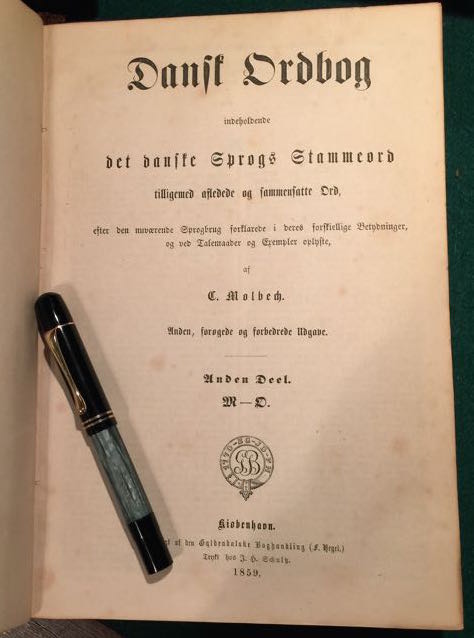
“Dialectic,” or more correctly, Dialektik, comes originally from the Greek διαλεκτική, dialektikē, so you won’t find it in Christian Molbech’s Dansk Ordbog, the standard Danish dictionary from Kierkegaard’s time, but must turn to Ludvig Meyer’s Fremmedordbog (dictionary of foreign words) from 1853. Meyer defines Dialektik as “samtalekunst” (i.e., the art of conversation), as well as “Fornuftlære,” “Tankelære,” “Logik” (the first two translate literally as, ”teachings of reason,” and ”teachings of thought, ” but are probably best translated as ”informal logic,” while Logik is best translated as “formal logic”). In Plato, continues Meyer, Dialektik refers to “higher speculative philosophy,” whereas in Aristotle and more recent thinkers it refers to “probability theory” as well as “eristic,” “sophistry” and “casuistry.”

Interestingly, Kierkegaard never seems to use Dialektik in the last two pejorative senses. My guess is that that is not because a dialectical contemplation of something could never lead one way from the truth, but because of the high esteem in which he appears to have held ancient skepticism. That is, a dialectical contemplation of any question that does not admit of a clear and uncontroversial answer, will ultimately bring the individual back to him or herself and in that way accentuate the role of decision and the will.

There is an extremely helpful Terminologisk Register, or glossary, by Jens Himmelstrup in the second half of volume 15 of the second edition of Kierkegaard’s Samlede Værker. The glossary contains a long entry on Dialektik. Himmelstrup explains here that the term comes originally from the Greek διαλέγομαι, dialegomai, meaning “to carry on a conversation with someone.” “The term,” he continues, “became associated with Socrates, in that he employed the art of conversation, or dialogue, in his activity as a philosopher which was generally aimed at achieving clarity concerning the precise meaning of individual terms and concepts.”

Himmelstrup then proceeds to give a brief history of the meaning of the term in philosophy. What is important for our purposes here, however, is what he says concerning its meaning for Kierkegaard. Sometimes, he explains, “dialectic” refers to “purely logical determinations” (I presume that by this he means it refers to formal opposites such as a and ~a). Other examples he gives of Kierkegaard’s use of the term suggest it means something more like “dynamic,” as when Kierkegaard writes in the first volume of Either-Or: “Love from the soul has, secondly, yet another dialectic, for it differs in relation to every single individual who is the object of love” (This reference is from Alastair Hannay’s translation for Penguin. Even though the ebook version provides only a location number [1587-1588] rather than a page number, the Hongs’ translation of this passage is so tortured that I could not bring myself to use it. This is probably also a good place to point out that neither the Hongs’ “psychical love” nor Hannay’s “love from the soul” is a particularly felicitous translation of Kierkegaard’s “sjælelig Elskov.” That expression is probably best translated simply as “romantic love”).

Suffice it to say in answer to the question of what Kierkegaard means by the term “dialectic,” that the meaning appears to be as protean as is the meaning of the term “knowledge.” That’s not to say that Kierkegaard equivocates on its meaning, but simply, as I explain in Ways of Knowing, that Kierkegaard was extremely sensitive to how fluid are the meanings of most terms in everyday speech and that he abhorred the tendency of academics to artificially fix meanings.

Stay tuned for my next blog post “Those Crazy Hongs!” an examination of how the Hongs (or more likely Howard Hong) could conceivably have rendered “Sandselig Genialitet, bestemmet som Forførelse” as “The Elementary Originality of the Sensuous Qualified as Seduction.”
Mistake in Hongs’ Translation

MolbechIs it possible, according to Kierkegaard, for a person to appreciate, on his own, that he is outside the truth, or in error? It would appear that Kierkegaard’s answer in Philosophical Crumbs is both yes and no. That is, on the one hand he says that since this is actually our situation, “the Socratic applies,” which is to say that we can “recollect” it, or come to appreciate it on our own. On the other hand, it looks like we can’t, at least according to the Hongs’ translation of Philosophiske Smuler.

The Hongs translate the following passage:

Dersom et Menneske oprindeligen er i Besiddelse af Betingelsen for at forstaae Sandheden, da tænker han, at Gud er til, derved at han selv er til. Dersom han er i Usandheden, da maa han jo tænke dette om sig selv, og Erindringen skal ikke kunne hjælpe ham uden til at tænke dette. Om han skal komme videre, maa Øieblikket afgjøre (om dette end allerede var virksomt i at lade ham indsee, at han er Usandheden). (Søren Kierkegaards Skrifter, Vol. 4, p. 229.)

as

If a person originally possesses the condition to understand the truth, he thinks that, since he himself is, God is. If he is in untruth, then he must of course think this about himself, and recollection will be unable to help him to think anything else but this. Whether or not he is to go any further, the moment must decide (although it already was active in making him perceive that he is untruth) (Philosophical Fragments, Princeton, 1985, p. 20).

The parenthetical remark asserts that “the moment” is active in helping people to understand that they are outside the truth, despite the fact that Kierkegaard had earlier said this was something we could discover on our own. So is Kierkegaard contradicting himself here or is there a problem with the Hongs’ translation?

The answer is that there is a problem with the Hongs’ translation. Here is how I translate this same passage.

If a person is originally in possession of the condition for understanding the truth, then he thinks there is a God, in that he exists himself. If he is in error, he may think this about himself, but recollection could not help him to think anything else. If he is to progress beyond this, the moment must decide (even if it were already active in allowing him to see that he was in error) (Philosophical Crumbs, Oxford, 2009, p. 97).

The parenthetical remark is what philosophers call a “counter-factual.” It is not saying that the moment had, in fact, been active in a person’s coming to understand himself as outside the truth, but that even if it had been active – i.e., had helped him to understand that he was outside the truth – he would need it again to get beyond this realization. That is, Kierkegaard is not taking a position here on whether one needs the moment to help one to the insight that one is outside the truth. He’s saying even if the moment had been active in helping one to this insight (a qualification that is perfectly consistent with its not being active), it would be needed again to get beyond the insight.

Of course you shouldn’t just assume that I know what I am talking about here. I need to marshal some evidence to support my claim that my translation: “even if it [i.e., the moment] were already active in allowing him to see that he was in error” is accurate whereas the Hongs’: “although it [i.e.., the moment] already was active in making him perceive that he is untruth” is not. So let’s go to the relevant reference works: Ferrall-Repp does not have “om end,” but only “om” which it translates as “if.” Vinterberg-Bodelsen has “(even) if,” before “(even) though.”

The really decisive proof that the parenthetical should be in the subjunctive comes from Christian Molbech’s Dansk Orbog from 1859 (this is the second edition and hence more reliable for questions of usage in the 1840s than is the first edition from 1833). Molbech lists a number of instances where “om” means either “if” or “whether,” but then gives the following example for “om end”: “Jeg tror det ikke, om end Alle sværge derpaa,” which translates as: “I don’t believe it, even if everyone would swear to it.”

Of course this begs the question in that I have chosen to translate “om end” as “even if” instead of “even though.” The justification for my translation comes after the first formulation. That is, immediately following the example “Jeg tror det ikke, om end Alle sværge derpaa” is a parenthetical clarification that reads “(Forskielligt i Meningen fra: ‘omendskiøndt han sværger derpaa,’ hvor der mere bestemt udtrykkes, at han sværger.)” This translates literally as “(Different in meaning from: ‘even though he swears to it,’ where the fact that he swears is expressed more definitively”.)

Hence it is clear that “om end” means “even if,” not “even though,” or “although” as the Hongs’ translation has it. The Hongs translation thus takes what is legitimately a question in the original and turns it into a fact, and a misleading fact at that.

“Disciple” vs. “Follower” in Philosophical Crumbs

imagesI’m teaching an upper-level seminar on Kierkegaard this term. The text for the course is my own translation of Kierkegaard’s Repetition and Philosophical Crumbs (Oxford, 2009). We’re reading Crumbs right now. One of my students, Victoria Godwin, asked what I thought was a very good question about the translation, so I thought I would share my answer with readers of this blog.

The Crumbs, as most readers will remember, looks at what Kierkegaard (under the pseudonym Johannes Climacus) asserts are two exhaustive and mutually exclusive interpretations of how people are related to the truth. The first interpretation he presents is what he calls the “Socratic” one. According to this interpretation, people are assumed basically to possess the truth, but to have contingently forgotten it. They thus need only to remember the truth, not to have it imparted to them by a teacher. This, of course, is the famous Platonic “doctrine of recollection,” or anamnesis. According to this interpretation, the role of a “teacher” in helping a person to remember the truth is merely what Kierkegaard calls “assisting” (105). The teacher and the student/learner/pupil are essentially equal.

The problem, according to Kierkegaard, is that the Socratic interpretation makes both the point in time at which a person “recollects” the truth and the “teacher” who helps occasion the “recollection” unimportant. This is not, in itself, a problem. The Eleatics, and in fact many people throughout the history of philosophy right up to the present have no problem with this. Even Kierkegaard does not suggest that this interpretation of our relation to the truth is inherently problematic. It’s a problem only for a reader who is already committed to an account of existence that attributes decisive significance to the point in time at which one comes to understand the truth, and requires that this understanding be facilitated by a “teacher” of equally decisive significance. This, of course, is precisely what Christianity does and Kierkegaard’s note at the end of the first chapter of Crumbs makes clear that he assumes his readers would immediately recognize that.

That is, Crumbs is a straightforwardly theological work despite what are obviously the disingenuous protestations of Climacus, the pseudonymous author. Hence the “learner” (Lærende) referred to in Kierkegaard’s explication of the “Socratic” interpretation of the relation of the individual to the truth, becomes the “disciple” (Discipelen) on the “alternative” view. From then on, the discussion concerns the relation between the “the god” and “the disciple.”

So back to my student. Victoria asked why sometimes the person whose relation to the truth was in question was referred to as a “learner” and other times as a “disciple.” The answer, of course, is that those two different characterizations appear in the original text. The reason this might be difficult to appreciate is that Howard Hong’s translation of Philosophiske Smuler (Philosophical Fragments, Princeton, 1985) obscures this fact. David Swenson’s translation of Smuler from 1936 translates Discipelen consistently as “disciple,” but Hong’s translation consistently renders Discipelen as “follower.”

“Follower,” isn’t dead wrong, of course, but it’s misleading to the extent that it obscures the explicitly theological nature of the work. Hong appears to have deliberately desired to do this in that he inserts a footnote to explain his preference for “follower.” “The Danish term Discipel,” writes Hong, “means ‘pupil,’ ‘learner,’ ‘apprentice,’ ‘follower,’ and ‘disciple.’ Here and elsewhere in Fragments (except for references to the relation of teacher and pupil or learner), ‘follower’ is most appropriate” (Philosophical Fragments, p. 281 note 38). Hong gives no justification, however, for his preference for “follower” over the English cognate “disciple.” He just claims “follower” is better.

“Disciple” is, actually the third of the three possible translations listed in the Ferrall-Repp A Danish-English Dictionary from 1845 (Hong would appear to have been relying on a 20th-century Danish-English dictionary). The first two are “pupil” and “scholar.” “Follower” is not listed as an acceptable translation, and the context of the appearance of this term in Crumbs makes it clear that “Disciple” is the most appropriate of the three suggested translations. “Pupil” is too close to Kierkegaard’s “Lærende” (i.e., “learner”) and would thus obscure the distinction he was trying to make with the the two terms “Lærende” and “Discipelen,” and “scholar” is obviously wildly inappropriate. So Hong’s claim that “follower” is a better translation of “Discipelen” than is “Disciple” is just wrong. It is worse because it makes the work less obviously theological than it is. Contemporary Western society has become so secular that that in itself makes it difficult for readers to appreciate how thoroughly religious was all of Kierkegaard’s authorship. The Hong translation of Philosophiske Smuler simply exacerbates this problem.

My guess is that Hong hoped to appeal to a broader audience by making the work less obviously theological. I fear that may amount, however, to throwing the baby out with the bathwater in that it encourages misinterpretations of what is perhaps the most central work in Kierkegaard’s corpus. This takes us into the area of translation theory. Should a translator adapt a work to appeal to a specific audience, or should he or she endeavor to represent the work in a manner that most closely approximates its original character? I’m a proponent of the latter approach. If a translator thinks he can improve on an author’s work, I think he should go write his own book!