Page 3 of 3

Mistake in Hongs’ Translation
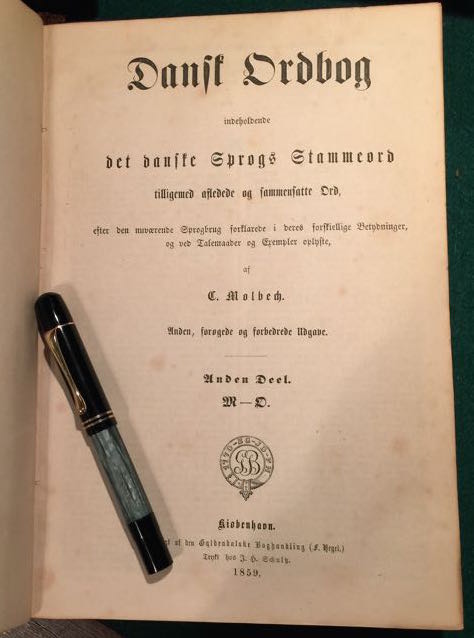
MolbechIs it possible, according to Kierkegaard, for a person to appreciate, on his own, that he is outside the truth, or in error? It would appear that Kierkegaard’s answer in Philosophical Crumbs is both yes and no. That is, on the one hand he says that since this is actually our situation, “the Socratic applies,” which is to say that we can “recollect” it, or come to appreciate it on our own. On the other hand, it looks like we can’t, at least according to the Hongs’ translation of Philosophiske Smuler.

The Hongs translate the following passage:

Dersom et Menneske oprindeligen er i Besiddelse af Betingelsen for at forstaae Sandheden, da tænker han, at Gud er til, derved at han selv er til. Dersom han er i Usandheden, da maa han jo tænke dette om sig selv, og Erindringen skal ikke kunne hjælpe ham uden til at tænke dette. Om han skal komme videre, maa Øieblikket afgjøre (om dette end allerede var virksomt i at lade ham indsee, at han er Usandheden). (Søren Kierkegaards Skrifter, Vol. 4, p. 229.)

as

If a person originally possesses the condition to understand the truth, he thinks that, since he himself is, God is. If he is in untruth, then he must of course think this about himself, and recollection will be unable to help him to think anything else but this. Whether or not he is to go any further, the moment must decide (although it already was active in making him perceive that he is untruth) (Philosophical Fragments, Princeton, 1985, p. 20).

The parenthetical remark asserts that “the moment” is active in helping people to understand that they are outside the truth, despite the fact that Kierkegaard had earlier said this was something we could discover on our own. So is Kierkegaard contradicting himself here or is there a problem with the Hongs’ translation?

The answer is that there is a problem with the Hongs’ translation. Here is how I translate this same passage.

If a person is originally in possession of the condition for understanding the truth, then he thinks there is a God, in that he exists himself. If he is in error, he may think this about himself, but recollection could not help him to think anything else. If he is to progress beyond this, the moment must decide (even if it were already active in allowing him to see that he was in error) (Philosophical Crumbs, Oxford, 2009, p. 97).

The parenthetical remark is what philosophers call a “counter-factual.” It is not saying that the moment had, in fact, been active in a person’s coming to understand himself as outside the truth, but that even if it had been active – i.e., had helped him to understand that he was outside the truth – he would need it again to get beyond this realization. That is, Kierkegaard is not taking a position here on whether one needs the moment to help one to the insight that one is outside the truth. He’s saying even if the moment had been active in helping one to this insight (a qualification that is perfectly consistent with its not being active), it would be needed again to get beyond the insight.

Of course you shouldn’t just assume that I know what I am talking about here. I need to marshal some evidence to support my claim that my translation: “even if it [i.e., the moment] were already active in allowing him to see that he was in error” is accurate whereas the Hongs’: “although it [i.e.., the moment] already was active in making him perceive that he is untruth” is not. So let’s go to the relevant reference works: Ferrall-Repp does not have “om end,” but only “om” which it translates as “if.” Vinterberg-Bodelsen has “(even) if,” before “(even) though.”

The really decisive proof that the parenthetical should be in the subjunctive comes from Christian Molbech’s Dansk Orbog from 1859 (this is the second edition and hence more reliable for questions of usage in the 1840s than is the first edition from 1833). Molbech lists a number of instances where “om” means either “if” or “whether,” but then gives the following example for “om end”: “Jeg tror det ikke, om end Alle sværge derpaa,” which translates as: “I don’t believe it, even if everyone would swear to it.”

Of course this begs the question in that I have chosen to translate “om end” as “even if” instead of “even though.” The justification for my translation comes after the first formulation. That is, immediately following the example “Jeg tror det ikke, om end Alle sværge derpaa” is a parenthetical clarification that reads “(Forskielligt i Meningen fra: ‘omendskiøndt han sværger derpaa,’ hvor der mere bestemt udtrykkes, at han sværger.)” This translates literally as “(Different in meaning from: ‘even though he swears to it,’ where the fact that he swears is expressed more definitively”.)

Hence it is clear that “om end” means “even if,” not “even though,” or “although” as the Hongs’ translation has it. The Hongs translation thus takes what is legitimately a question in the original and turns it into a fact, and a misleading fact at that.

Observations on the Various Editions of Kierkegaard’s Collected Works

SV 2 two pages

There are now four different Danish editions of Kierkegaard collected works. The first edition, edited by A.B. Drachman, J.L. Heiberg, and H.O. Lang was published by Gyldendal between 1901-1906 and comprised 14 volumes. The second edition, published between 1920-1936, was essentially a corrected version of the first edition with the inclusion of a very helpful fifteenth volume that contained author and subject indexes for all the individual volumes as well as a glossary of the more important terms in Kierkegaard’s authorship.

A third inexpensive popular edition of Kierkegaard’s collected works in 20 volumes was published in the 1960s. This edition was never intended for use by scholars and is marred by numerous errors that were more than likely a result of how quickly the edition was produced (one volume per month according to Tony Aalgaard Olesen).

The second edition is generally considered to be the best of the collected works as well as the most readily available. It’s still possible to find it in used bookstores in Denmark for a reasonable price. A casual web search I did just now turned up three copies at Vangsgaards Antikvariat for between 1,000DK and 1,800DK (approximately $150-$300).

The first edition is still preferred by scholars, however, because the second edition, produced as it was during a period of the resurgence of Nordic nationalism was printed in Blackletter, or Gothic type, and many contemporary scholars find that difficult to read. The English translations of Kierkegaard supervised by Howard V. Hong and Edna H. Hong and published by Princeton University Press in the ‘80s and ’90s thus have page correlation numbers to the first, rather than the second, edition of Kierkegaard’s collected works.

Unfortunately, the first edition of Kierkegaard’s collected works is increasingly difficult to find and generally very expensive. Fortunately, there is a new edition of Kierkegaard’s collected works. This new edition, produced by the Søren Kierkegaard Research Center in Copenhagen is distinguished from the earlier editions by a new title. Whereas all three earlier collected works were titled Søren Kierkegaards Samlede Værker (literally Søren Kierkegaard’s collected works, or SV), the new edition is titled Søren Kierkegaards Skrifter (Søren Kierkegaard’s writings, or SKS).

There is much to recommend the new edition. The individual volumes have been beautifully produced, at least from an aesthetic standpoint, and each is accompanied by a helpful companion volume of commentary. The edition purports to be a “critical” one, but unfortunately falls short of that ideal. It was produced too quickly to ensure the kind of quality that is requisite for a critical edition and the editorial staff was generally too inexperienced in that type of work. The 55 volumes were produced between 1997 and 2013, or 16 short years compared, for example, to the critical edition of Kant writings on which work began in 1900 and is apparently still continuing!

The haste with which this new edition was produced is likely the explanation for problems such as the one I identified in the notes to my translation of Kierkegaard’s Repetition. The fictional narrator of that work refers to the “disappearance” of the young man who was the subject of his observations. “[D]isappearance,” as I explain in a note, was originally “death.” Kierkegaard apparently changed “death” (Død) to “disappearance” (Forsvinden) after learning that his former fiancée, Regine Olsen, had become engaged. SKS has Forvinden (recovery), however, rather than Forsvinden. The original 1843 edition of Repetition, on the other hand, has Forsvinden, not Forvinden and since there is no explanation for the change in SKS, it appears it’s simply an error.

So the new edition is not perfect. The critical apparatus is extensive, but somewhat arbitrary in what it includes and does not include and the price for all 55 volumes (at approximately $100 each) is prohibitively expensive. Despite this, however, it will become the standard scholarly edition because not only can volumes be purchased individually, but the entire edition is available in searchable form online! For that reason alone, I find myself often referring to it.

In my opinion, however, the most reliable text is still that of the second edition. The type takes a little getting used to, but not so long as many people seem to fear. I’m very fortunate, actually, in that not only do I have a second edition in excellent condition, someone actually went through my edition and put page correlation numbers to the first edition in the margins. I kid you not, there are page correlation numbers on every single page of every single volume. Not only are there these numbers, whoever put them there also put a tiny mark at the point in the line of the text where the new page began.

You can see these lines, just barely, in the photo above. There’s one between “saa” and “aldeles” on the page at the left, and another after the dash and just before “Om” on the page at the right. Pretty cool, eh! My theory is that my copy of the second edition must have been used in the production of the page correlation tables in the third edition, or in Alastair McKinnon’s concordances. It’s hard to imagine someone would have undertaken the labor involved in putting in all those numbers unless he were being paid to do so. I’m grateful to whoever did it though. I can now quickly check the accuracy of the Hongs’ translations even though they include page correlation numbers only to the first edition.

This extremely rare (very likely one of a kind) copy of the second edition of Kierkegaard’s collected works is only one of the many antiquarian treasures I collected while I lived in Denmark. I plan to write about more of my treasures later.

Interview with Peter Tudvad

As I mentioned last week, Peter Tudvad was in New York recently doing research for his forthcoming book on Bonhoeffer. He graciously consented to be interviewed about the controversy surrounding his new book on Kierkegaard and anti-Semitism. The first part of that interview is below. I will post the second part next week.

Piety: Not much is known in the English-speaking world about the controversy over your new book. Can you give a brief summary of it?

Tudvad: That might be difficult as the row lasted for about two months, and was very intense. A newspaper, Berlingske Tidende, published an interview with me about three weeks before the book was actually published. The reporter was shocked by the quotations I had included in the preface, which I let him see, such as Kierkegaard writing that the Jews were typically usurers and as such bloodthirsty, that they had a penchant for money (due to an abstract character, as Kierkegaard supposes), and that they dominated the Christians. As I told the reporter, Kierkegaard was of the opinion that the Jews would eventually kill the European Christians – something which he wrote in an entry in his diary, but which was omitted from the Hong’s translation, I guess on purpose – and that they had an extraordinary sexual appetite and thus many children. They were, according to Kierkegaard, mundane and had no real spirit, no quest for the eternal bliss.

Never mind, the former head of the Søren Kierkegaard Research Center at the University of Copenhagen, Niels Jørgen Cappelørn, was interviewed too for the very same edition of the newspaper, and he actually agreed with me that what Kierkegaard had said about the Jews was something which we today must term antisemitism. He agreed, too, that the reason that we have seldom discussed this aspect of his theology might be that we were afraid of damaging his image, his reputation, thus losing the prostrate respect many have for one of the few internationally renowned Danish authors. Nevertheless, the day after, in another newspaper, Cappelørn said the opposite. Many other people seemed to be offended by my labelling Kierkegaard as an antisemite and began polemicising against me without ever having read my book. Especially theologians were eager to make the case smaller than I think it is, saying that it was only in entries in Kierkegaard’s private diary that he wrote bad things about the Jews – which, by the way, is not true, even though I don’t see why we should not discuss his “private” antisemitism, when we have discussed so many other “private” aspects of his thoughts. His diaries have always been considered a key to the understanding of his published works, so if one, for example, with the help of his entries can link his antisemitisme with his theology, and vice versa, I think we really ought to discuss the problem seriously

The rest of the interview with Tudvad will appear next week.