Page 2 of 2

Erasmus Montanus

Untitled 2
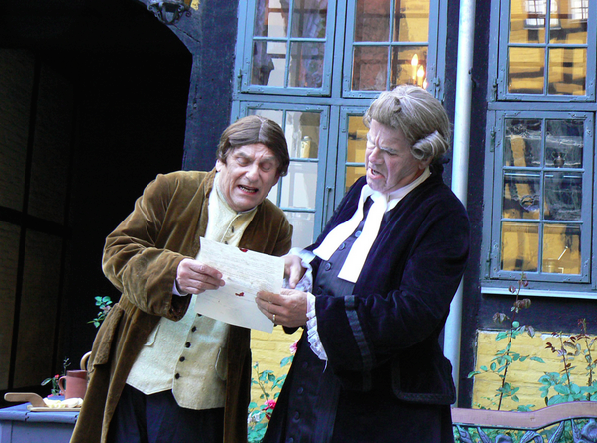
Scene from a production of Erasmus Montanus by Bagsværd Amatørescene, Photographer: Flemming Mortensen

There are two places in Kierkegaard’s published and unpublished works where he refers to the earth being “as flat as a pancake.” The first is in his review of H.C. Andersen’s failed attempt at a novel, Kun en Spillemand, that was published under the title of From the Papers of One Still Living, and the second is in his Concluding Unscientific Postscript to the Philosophical Crumbs

The second reference will no doubt be familiar to Kierkegaard scholars. It is in that passage where Kierkegaard, or Johannes Climacus, the pseudonym under which Kierkegaard published the Postscript, illustrates his claim that the mere utterance of an objective truth is not in itself evidence that the person who utters it is sane. “Let me recount an incident,” he begins, “that without any kind of adaptation from my side, comes straight from an insane asylum.” He then tells the story of a man who escapes from this asylum and on his way into town, finds a little skittle ball lying on the ground. He absent-mindedly picks up the ball and puts it in the tail pocket of his coat. As he walks, the ball gently hits him, explains Climacus, on his “a – “ and presumably, the fact of it’s being a ball, reminds him every time it strikes him that the earth is round. Since he knows that everyone agrees that the earth is round, he decides that the best way to convince people that he is sane is to go about saying continually ”the earth is round!”

“And indeed is not the earth round?” ask Climacus. “Does the asylum crave yet another sacrifice for this opinion as when everyone believed it to be as flat as a pancake?” (Hannay, 164). This reference to the earth being “flat as a pancake” is clearly an allusion to Ludvig Holberg’s play Erasmus Montanus. I cannot remember how I learned this. I could have sworn it was in an explanatory note in either one of the English translations of the Postscript or in the text as it appears in the new Søren Kierkegaards Skrifter. But I have searched in vain for such a note, though SKS does acknowledge that the first appearance of this phrase in Kierkegaard’s works, the one in From the Papers of One Still Living is an allusion to the Holberg play.

Since there are at least two references to this play in Kierkegaard’s works, I felt that I should read it. I didn’t own a copy, however, so I did a google search, in the hope that I could find a copy online. I did. Not only did I find a copy, but I found a download able copy in English translation!

The play is hilarious. The Danes like to claim Holberg as one of their own, but in fact, he was Norwegian. The thing is, Denmark ruled Norway back then, so Norwegians were viewed, more or less, as Danes, particularly if they distinguished themselves the way Holberg did. I’m telling you this because the play is clearly set in Norway, in that it concerns a people in a little mountain village and, well, there are no mountains in Denmark. Back in the 18th century, when the play is set, residents of Norway who wanted a university education typically attended the University of Copenhagen. So Rasmus Berg, the eldest son of a prosperous farmer does just that.

I don’t know if all the instruction was in Latin back then, but at least some of it was. Students were typically taught to argue in Latin and showy Latin disputations were part and parcel of university life. Rasmus Berg returns to his little mountain village as Erasmus Montanus, determined to impress everyone with his new learning. Unfortunately for him, the local deacon succeeds in convincing the poor townsfolk, none of whom know a word of Latin, that he is beating the pants off Berg, or Montanus, in Latin disputation even though the Latin he purports to be speaking is nothing but gibberish, bits and pieces of Latin grammar, and other odd words and phrases that he strings together to form nonsensical sentences that he utters with such passionate conviction that everyone feels sorry for poor Berg, or Montanus, for being shown up that way in public.

That isn’t the worst of it, though. The townsfolk are so scandalized when Berg, or Montanus, informs them that the earth is round, that his future father-in-law withdraws his permission for Berg to marry his daughter. Berg, or Montanus, is forced, finally, to recant his statement that the earth is round in order to win the hand of his ladylove.

Interesting, eh? Not only was Kierkegaard understandably taken with the play, the whole thing is kind of a metaphor for his life. There are lines in it about how the earth must be flat because everyone but Montanus thinks it is, and that truth is in numbers. There is the general backwardness of the mountain people that mirrors what Kierkegaard thought of as the backwardness, or philistinism, of the people in the little market town of Copenhagen. And then there is the fact that Montanus had to surrender his calling as an intellectual, to betray his learning, to betray what he knew to be true, in order to enjoy the pleasures of domestic life. This, as we all know, was a sacrifice Kierkegaard could not himself make.

I have come to believe that there are likely many more allusions to this particular play in Kierkegaard’s authorship than have yet been recognized as such. If you can find one yourself, please send it along. Perhaps we can write a collective paper on the influence this play on Kierkegaard’s works, and if there are enough of us, then everyone will have to admit that our claims are correct –– right?

(Hannay, who is generally an excellent translator of Kierkegaard, has inexplicably rendered the Danish Keglekugle as “skittle bowl” instead of “skittle ball.” Perhaps this is some kind of Anglicism with which I am unfamiliar. The object in question is indisputably a skittle ball, however, as both earlier English translations of the Postscript indicate, no matter what people in the UK call it.)


Kierkegaard’s Christian Epistemology

I said in my last post that I would write more about the Kierkegaard conference at Baylor last month. It was an extraordinarily rich conference in terms of  the breadth of topics covered and it was unusual in that there were several papers devoted to aspects of Kierkegaard’s epistemology. Indeed, there was an entire session entitled “Kierkegaardian Challenges to Epistemology.” This is testament to an increasing appreciation of the importance of epistemological concerns to Kierkegaard’s thought.

C. Stephen Evans gave an excellent presentation entitled “Kierkegaard the Natural Theologian? Kierkegaard on Natural Religious Knowledge,” in which he argued (as I argue in Ways of Knowing) that Kierkegaard assumes people have a natural knowledge of God, and that “[t]his natural religious knowledge is not without value” in that “it is part of what prepares a person to encounter the Christian Gospel”  (Evans’ handout).

Of course this natural knowledge of God, explained Evans, is distinguished from faith in Christ, or any knowledge that might come as a product of this faith. The latter sort of knowledge and how faith makes it possible was the subject of my own presentation “Encountering the Truth: Kierkegaard’s Existential Mysticism as a Corrective for the New Atheism.”  My argument was that according to Kierkegaard, an encounter with what he refers to in Philosophical Crumbs as “the god in time” (173) amounts to acquaintance knowledge of God (i.e., in the person of Christ) and that this acquaintance knowledge serves as the foundation for specifically Christian propositional knowledge that looks very unlike the sorts of views the “new atheists” routinely attribute to Christians.

That what Kierkegaard calls an encounter with the god in time can lead to specifically Christian propositional knowledge is a topic I cover in great detail in Ways of Knowing. What was new in the presentation was making clear the implications of Kierkegaard’s position for the kinds of criticisms of religion advanced by the new atheists.

Unfortunately, there are still people out there making arguments about Kierkegaard’s epistemology without really knowing very much about it. Aaron Fehir, for example, whose paper “Subjectivity and Conscience: A Kierkegaardian Resolution to the Problem of the Criterion” was part of the session entitled “Kierkegaardian Challenges to Epistemology,” had read neither Ways of Knowing, nor Anton Hügli’s excellent Die Erkenntnis der Subjektivität und die Objektivität des Erkennens bei Søren Kierkegaard (Basel, Switzerland: Editio Academica, 1973) nor Martin Slotty’s Die Erkenntnis Lehre S.A. Kierkegaards (Diss. Friedrich-Alexanders-Universität, 1915), with the result that in effect there was no Kierkegaardian solution, on his view, to the skeptical “problem of the criterion.”  Both the historical contemporary of Christ and someone who came later were equally poorly situated, argued Fehir during the question period, relative to the “unrecognizable” “god in time.”

You don’t actually have to have read anything on Kierkegaard’s epistemology, however, to appreciate that Kierkegaard’s point in Crumbs is not that both the contemporary and someone who comes later are equally poorly situated relative to “the god in time.” It’s pretty clear, I would argue, to anyone who is sufficiently attentive to the text, that Kierkegaard’s point is that both the contemporary and someone who comes later are equally well situated relative to the god in time. That’s the specific technical sense in which Kierkegaard uses the expression “contemporaneousness.” Anyone, according to Kierkegaard can be “contemporaneous” with the god in time, but (and this is an important qualification) that, for Kierkegaard, is the only way one can achieve a proper understanding of religious truth.

Fehir is a religious pluralist. Kierkegaard was not a religious pluralist. There is certainly room, I would argue, in Kierkegaard’s thought for the view that non-Christian religious traditions could embody elements of religious truth, could be on the right track, so to speak. It’s even possible to argue, based on Kierkegaard’s discussion in the Concluding Unscientific Postscript about the “how” that brings the “what” along with it, that the “pagan” who prays passionately enough encounters Christ (i.e., the god in time, or God in the person of Christ) in his prayers, but it’s Christ, for Kierkegaard that one would have to say he encounters, Christ with whom (through his passion) he achieves “contemporaneousness,” not God unmediated by Christ (remember, the Postscript is the postscript to the Crumbs).

Kierkegaard was no religious pluralist. He was, as I argue in an essay in the forthcoming Oxford Handbook of the Epistemology of Theology, a Christian mystic. That is, Kierkegaard believed in the possibility of a mystical communion with God in the person of Christ which he refers to as “contemporaneousness.” Both Hügli and Slotty agree that this encounter with the god in time provides a point of departure, according to Kierkegaard, for a new type of religious knowledge. The “criterion” of truth about which the skeptics were so concerned is what Kierkegaard refers to as “the certainty of faith.” That is, Kierkegaard does have a criterion of truth. It’s just that it is not one that religious pluralists are going to like.

Postscript

Daniel Mendelsohn said in a recent interview in the Prospect that he came from “a scholarly background.” He’d done a graduate degree in Classics, he explained, before he became a writer; “and in that world, the rule is that you can’t write anything until you’ve read everything.” That’s how I was trained as well. We could use a little more of that mentality in Kierkegaard studies.

Repetition and Philosophical Crumbs Online!

I made another great discovery a few days ago. My translation of Kierkegaard’s Repetition and Philosophical Crumbs (Oxford, 2009) is now on Google books. Yes, that’s right. It’s not the whole version, but only a portion of it. Still, what’s there is searchable. This is very good news because the print version has no index. Oxford decided against the inclusion of an index, I presume, because including one would have increased production costs and delayed publication (see below). Of course this wouldn’t have been a problem if Oxford had produced an ebook version along with the paperback. Unfortunately, Oxford does not appear to be so forward looking as Cambridge, which produced a Kindle edition of Alastair Hannay’s new translation of Kierkegaard’s Concluding Unscientific Postscript (which is not only searchable but is only $17.60 as opposed to $33.81 for the paperback).

I’d like to put in a plug here for ebooks, and, in particular, for the Kindle ebook reader. I won my Kindle in a contest sponsored by the German publisher Springer just over a year ago and fell completely in love with it. I can get books instantly on my Kindle from wherever I am, I can highlight and cut and paste text and make notes and then upload all this material to my computer. Kindle also allows me to move easily back and forth between text and notes. It’s a scholar’s dream. Yes, it is a way for Amazon to sell books, but what’s wrong with that. I was buying tons of books from Amazon already anyway. Now I am paying less for them. What people don’t know, however, is that many of the books in the “Kindle store” are actually free because they are in the public domain. When you search for a book, if it’s what you could call a classic, then you’ll normally get several pages of hits. If you don’t have to have a particular edition and you don’t want to pay for the book, you just have to look through the various editions until you find the free ones (there are often several free editions). You can also put ebooks that you already have as Word or pdf files on your Kindle.

Ebooks are both the future of reading and the future of scholarship.

I’m sure there’s more great stuff out there on Google books. If my new translations are up there, then there are going to be lots of other books you’ve been wanting but have put off buying because of the expense. Try a little web surfing yourself and if you find anything good, let me know!

(See blog entry from 1/16/11 for info about a free index to Repetition and Philosophical Crumbs.)

Happy New Year!