The Meaning of “Ethics” in Fear and Trembling
I belong to a really wonderful philosophy of religion reading group. We’re reading Eleanor Stump’s Wandering in Darkness. We just finished the chapter that looks at the story of Abraham and Isaac. Stump contrasts her interpretation of the story with Kierkegaard’s, famously put forward in Fear and Trembling. She acknowledges that she is not a Kierkegaard scholar, and that her interpretation of Fear and Trembling is not intended as a contribution to Kierkegaard scholarship, but explains that she’s using the story to “bring out the salient features of [her] differing interpretation.” Readers, she continues “should feel free to take the section of this chapter on Kierkegaard’s reading of the story as only a Kierkegaard-like interpretation” (p. 260).
Unfortunately, Stump’s interpretation of Kierkegaard’s reading of the story of Abraham and Isaac isn’t very “Kierkegaard-like.”
“[A]s I understand him,” writes Stump,
Kierkegaard takes Abraham to be caught in a dilemma; but he thinks that that dilemma is resoluble, because he supposes that God’s command produces a “teleological suspension of the ethical” for Abraham. The ethical prohibition against the killing of an innocent child is overridden by God’s command to sacrifice Isaac. That Abraham understands and accepts this feature of his situation is part of what makes him a hero of faith for Kierkegaard (pp. 260-261).
For Stump, on the other hand, there is no dilemma. “If we read the episode of the binding of Isaac,” she argues,
in the context of the whole narrative of Abraham’s life, in which Abraham’s double-mindedness about God’s goodness is manifest, and especially if we see that episode against the backdrop of the expulsion of Ishmael, then it is clear that God is not pitting his authority against morality in asking Abraham to sacrifice Isaac, as Kierkegaard apparently supposed. … God’s demand for Isaac and the requirements of morality are on the same side in this story (p. 303).
“The faith that makes Abraham the father of faith,” she continues, “has its root in Abraham’s acceptance of the goodness of God, Abraham’s belief that God will keep his promises, and Abraham’s willingness to stake his heart’s desire on that belief” (p. 304).
That is, Stump argues that God has repeatedly shown Abraham that he is trustworthy hence ethics requires that Abraham accept God as trustworthy. That, according to Stump, is what ethics demands. There’s no dilemma, no conflict between the requirements of ethics and God’s command. What God commands is precisely what the moral law requires.
Stump’s interpretation of Kierkegaard is not new. Many people have interpreted Fear and Trembling in the way Stump does. It is arguably difficult not to interpret it this way, given that Kierkegaard himself coined the phrase “teleological suspension of the ethical” (teleologisk Suspension af det Ethiske). Yet, there are ample clues in the work itself that Kierkegaard does not mean to suggest that God’s commands would ever conflict with genuine moral or ethical obligation.
But if Kierkegaard is not trying to argue that God’s command can potentially be in conflict with our ethical obligations and that when it is, our duty to God supersedes those obligations, what is he doing in Fear and Trembling?
One doesn’t have to know a lot about Kierkegaard to take issue with Stump’s reading of Fear and Trembling. In fact, one only needs to have read the introductions to Alastair Hannay’s and Sylvia Walsh’s translations of the work to get a decent idea of what sort of “dilemma” it presents.
“The opening pages of each of the three problemata,” explains Hannay
all follow a uniform pattern. First the ethical is defined as the universal, then a consequence drawn from this, followed by the observation that to accept this consequence is to concede that Hegel’s account of the ethical is right. Thereupon our author claims that if Hegel’s account is indeed right, then Hegelians have no right to talk of faith or to give credit to Abraham as its father, for according to each of the consequences in question Abraham must stand morally (even criminally) condemned. The three consequences of defining the ethical as ‘the universal’ are: (i) that the individual’s moral performance must be judged by its underlying social intention; (ii) that there are no duties to God other than duties that are in the first instance to the universal; and (iii) that it is a moral requirement that one not conceal one’s moral projects or the reasons one has for failing to carry them through. In each of the problemata Abraham is shown to infringe the principle of the ethical as the universal by failing to conform to the consequence, or implicated requirement, in question. Abraham acts as though there were a superior measure of moral performance that made social intentions irrelevant; he supposes himself to have an absolute duty to God that overrides the ethical defined as the universal; and he cannot reveal his intention to the parties concerned. (p. 28)
“Hegel defined ethical life (Kierkegaard uses a Danish expression, ‘det Sædelige’, which is a direct translation of Hegel’s ‘das Sittliche’),” Hannay continues,
as the identification of the individual with the totality of his social life. The basic idea behind an ethics of Sittlichkeit is that public morality, or the principles of social and political cohesion underlying any actual society, are expressions of universal human goals. If there is a human telos (goal) at all, that is where it finds expression. Thus in order to become moral the individual should conform to, and begin to want to act in accordance with, the principles of public morality that any State must be based on. ‘The State’, says Hegel, ‘in and by itself is the ethical whole.’ This is precisely the idea of the ethical as the universal which the problemata present as a hoop that Abraham must jump through in order to prove the morality of his action. Abraham consistently fails.
It isn’t merely, or even primarily, Hegel that Kierkegaard has in mind, I would argue, when he refers to “ethics in the sense of social convention.” It’s Hans Lassen Martensen, his former teacher and eventual Bishop of Copenhagen. “De Sædelige” is the title of the first section of the first volume of Martensen’s Den christelige Ethik (Christian Ethics). Sædelighed, which according to Martensen, has its foundation in the family unit, is the foundation of Christian ethics. Den christelige Ethik was not published until after Kierkegaard’s death, but Martensen was an ardent follower of Hegel from the beginning of his philosophical career and is repeatedly and mercilessly caricatured as such by Kierkegaard.
“The general thrust of Protestant liberal thought from Kant to Hegel,” observes C. Stephen Evans in his introduction to Sylvia Walsh’s translation of Fear and Trembling (Cambridge, 2006),
has been to understand genuine religious faith in ethical terms. Kant himself had closely linked true religious faith to the ethical life: “Apart from a good life-conduct, anything which the human being supposes that he can to do to become well-pleasing to God is mere religious delusion and counterfeit service of God.” When Kantian ethics is converted by Hegel to Sittlichkeit then the equation of faith with the ethical sets the stage for the triumph of Christendom and the identification of religious faith with social conformism. (p. xxix)
“Kierkegaard thinks that genuine faith,” continues Evans, “requires an individual relation with God that is personally transformative.” According to Kierkegaard, argues Evans, faith in God “is not reducible to fulfilling one’s social roles.” Such faith serves as the basis, he observes, however, of a renewal of the self and of social institutions.
Only ethics in this new, specifically religious sense really counts as ethics for Kierkegaard because only through a transformation of the individual is there any hope of that individual’s conforming his or her will to the substance of the moral law. Outside of Grace, guilt is too debilitating, to corruptive of the subjective determining ground of the will.
Hannay’s own view is that Kierkegaard “envisages some alternative” to the Hegelian principle of morality whereby there is no genuine conflict between what ethics requires and what God commands. Not only that, Hannay goes so far as to assert that Johannes de silentio, the pseudonymous author of Fear and Trembling, envisages such an alternative.
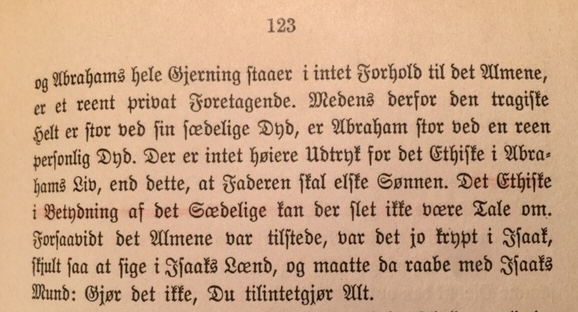
Evans doesn’t give Johannes de silentio so much credit as Hannay does, but they agree that the view of ethics that equates it with Sittlichkeit/Sædelighed was not one to which Kierkegaard himself subscribed. Such a view is amply supported by the repeated qualifications of “the ethical” in Fear and Trembling as “the universal,” and at least one completely unequivocal reference to “the ethical in the sense of social convention” (Det Ethiske i Betydning of det Sædelige” SKS 4, p. 153/SV, 2nd ed. III, p. 123). Unfortunately, the allusion to Hegel is obscured in both the Hongs’ and, more surprisingly, Hannay’s own translation of the relevant passage. The Hongs have “[t]he ethical in the sense of the moral” (p. 59) and Hannay has “[t]he ethical in the sense of ethical life” (p. 88).
That Kierkegaard envisages an alternative to the Hegelian view of ethics is widely recognized by scholars. Kierkegaard is a famous opponent of Hegel on this point, as well as on many others. Scholars are familiar with Kierkegaard’s hyphenated expression “ethical-religious.” Ethics cannot ultimately be separated from religion, according to Kierkegaard, in the manner that both Hegel and Martensen try to do. More particularly, ethics cannot be separated from Christianity, as is clear in, for example, Kierkegaard’s ethical treatise Works of Love.
If there is a God, then there is a way that God wants his creatures to relate to him (or her or it). That is, if there is a God, then the proper relation to God is the individual’s telos and insofar as the proper relation to God is going to involve relating in a particular way to the rest of creation, then ethics is subsumed under religion which means there cannot be any conflict between ethical duty and religious duty. The two are the same.
One doesn’t need to be a Kierkegaard scholar to appreciate this. Not only is the logic of the above identification of ethical and religious duty unassailable, Kierkegaard has left ample clues in Fear and Trembling to indicate that “the ethical” as it is presented there ought always to have quotation marks around it in that there is another higher ethics in the background, an ethics not unlike the one that Stump defends in her effort to provide an ethical justification for Abraham’s apparent willingness to sacrifice his son.
Except that Abraham isn’t actually willing to sacrifice his son, on Stump’s reading. His faith is that God won’t actually ask him to do it in the end.
Stump’s reading of the Abraham story has some very compelling elements, including the creative and original use she makes of Abraham’s earlier effective sacrifice of Ishmael. I would argue, however, that if Abraham’s faith was simply that God’s goodness would mean that he would not, in the end, require the sacrifice of Isaac, then Abraham comes off not as the father of faith, but merely as a really nice guy, unwilling, as Rhett Butler observes of Melanie Hamilton, to think ill of anyone she loves.
 There are sessions devoted to Kierkegaard at both the
  Piety on Kierkegaard