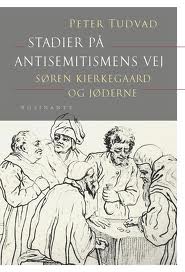
Stages on the Way of Anti-Semitism: Søren Kierkegaard and the Jews
By Peter Tudvad
Preface
I ran across a couple of articles on Søren Kierkegaaard from the beginning of the 1940s while doing research for a book about a Danish nurse in the German Red Cross during the Second World War. To stumble on article on Kierkegaard was in itself not surprising. What was surprising was that they were in National Socialisten [the National Socialist] and Jul i Norden [Jul in the North], two strongly anti-Semitic publications associated with the Nazi party in Scandinavia.
“Søren Kierkegaard is without question the greatest genius the Danish nation has produced” began one of the articles. Moreover, continues the author, “his writings contain the best instructions for the liberation of the Danish people from the spirit of Judaism which has come increasingly to dominate Denmark and which he saw himself as called by providence to fight. One could thus to this extent be justified in asserting that Søren Kierkegaard was the first Danish National Socialist.”[1]
The author would not have been able to support such a claim, even if he had done extensive research, given that Kierkegaard was vehemently opposed to every form of both nationalism and socialism. On the other hand, there is something to the claim that Kierkegaard wanted to free the Danish people–or preferably all of Christendom–from “the Jewish spirit” which he, like the Nazis, viewed as materialistic, and which he increasingly portrayed as essentially in opposition to Christianity.
A limited agreement with a later political ideology does not, of course, make Kierkegaard responsible for what was committed in its name, but when the agreement consists of an anti-Semitism that indisputably belongs to the historical and cultural presuppositions for the Nazi’s attempted extermination of the Jews, it should at least serve to dampen some of the hitherto unreserved enthusiasm for this national icon. Such, however, does not appear to have been the case in that Danish Kierkegaard scholarship–which the Nazi author, Richard Geill, disparages for other reasons–has rarely acknowledged the pronounced anti-Semitic tendencies in Kierkegaard’s authorship.
Geill asserts that “Jews in Denmark do their best to keep the [Danish] people ignorant about Kierkegaard by presenting a distorted and misleading picture of [Denmark’s] greatest son.”[2] He is referring here to a few Jewish scholars who had distinguished themselves in Kierkegaard research in the period before the war. Even after the war, however, the overwhelming majority of Christian scholars appeared not to find sufficient grounds for concerning themselves with the anti-Semitic side of Kierkegaard’s authorship. One can only speculate about the motives for such neglect. It seems reasonable to suppose, however, that there was a general reluctance to turn a critical eye on this aspect of Kierkegaard’s work and thus, and perhaps more importantly, on the theology that profited from the esteem in which Kierkegaard was held.
….
I realized to my own shame, after reading these two articles, that I had also been all too willing to ignore, or to explain away, Kierkegaard’s anti-Semitism. I thus wrote an article on this topic for the magazine of Jewish culture, Guldberg. I cited Kierkegaard’s references, just as had Geill, to a Jewish editor as a “Jøde Dreng” [Jew-boy] and to “en trællesindet Jøde øvende Herskermagt” [a servile Jew exercising power] as well as his observation concerning this same editor and the distribution of his paper that “only a Jew could be fitted for this most equivocal of all tyrannies, even more equivocal than that of a usurer (to which the Jew, however, is best suited).”
Kierkegaard, a philosopher ordinarily critical of the status quo, can also be accused of evincing the stereotypical view of the Jews’ purported “Forkerlighed [predeliction] for money” as well as for the assertion that death, in that it was like a merciless usurer, was “worse than the most bloodthirsty Jew.”[3]
….
The limitations on space placed on an article for a popular cultural magazine did not allow for a full treatment of the issue, but the issue clearly requires such treatment. “Kierkegaard’s relation to Jews and Judaism is an astonishingly neglected area of research”[4] noted a Norwegian philosopher and intellectual historian in 1996. At that time there was, to my knowledge, only one American historian who had done research on this issue and published the results of this research in an article in Kirkehistoriske samlinger (an anthology of church history) in 1992 and latter in two derivative pieces, first in ALEF-tidskrift for jødisk kultur (a magazine of Jewish culture) and then in Kierkegaardiana two years later.[5] “Kierkegaard is and remains one of the most profound and important thinkers for the present age,” he asserted, “but we need to look honestly at his remarks concerning Jews and Judaism. This may be unpleasant, but we must do it despite this.”[6]
He’s right. I believe, however, that even this historian shies away from recognizing the consequences of the premises he’s presented to the extent that he refers to Kierkegaard’s allegedly ubiquitous irony as if his anti-Semitic statements were not really meant seriously. He thus interprets Kierkegaard’s anti-Semitic remarks as camouflaged critiques of the Christianity of his contemporaries. They certainly were meant in this way. Kierkegaard could use Jews and Judaism as a caricatured picture of Christianity, however, only because his anti-Semitism is genuine. The credibility of this historian is further impugned when despite the fact that he asserts Kierkegaard’s anti-Semitism was intended to be ironical, he praises it for its straightforwardness in contrast to the feigned tolerance, that serves only to conceal an arrogant contempt for Jews, who it is assumed, will in the end convert to Christianity, or at least reject their antiquated religion.
“But to demand a pluralistic tolerance–i.e., a tolerance which the present age considers real, genuine tolerance–is perhaps too much, it’s perhaps to demand something that would have been anachronistic” continues this historian, as if a thinker one ordinarily praises for being ahead of his time was unable to transcend given boundaries, and as if there were no one during this time who gave more than lip service to a defense of tolerance, when in fact there were genuine defenders of tolerance during this period.
In any case, Kierkegaard in no way shared lukewarm liberal tolerance and his remarks can thus be offensive and even shocking. On the other hand, there is perhaps an advantage in such offensiveness in contrast to the insidiously “tolerant” forms of anti-Semitism that, each in its own way, furthers the gradual and unacknowledged disappearance of Judaism. Kierkegaard’s rhetoric is provocative. It forces us to take a position. And by taking the issue seriously we come to understand that however offensive the rhetoric may be, it has relatively little to do with Jews or Judaism but is primarily Kierkegaard’s confrontation with the lukewarm and irresponsible form Christianity had taken in his day.[7]
This convenient and self-contradictory apology has since been more or less sanctioned by two short and uncritical references to it by a church historian in an otherwise thorough and rigorous work on the relations between Christians and Jews in a period of Danish history that corresponds closely with that of Kierkegaard. He says first that ‘Kierkegaard’s references to the Jews were much harsher than those of other intellectuals of the period, but then that it is believed that he identified himself with Jews whom he thought were fundamentally unhappy.” He observes later that Kierkegaard emphasized “Judaism was the enemy of Christianity, but most of what he objected to in Judaism was precisely what he criticized contemporary Christianity for.”[8]
Once again, the reader is instructed to appreciate that despite Kierkegaard’s apparent anti-Semitism, he was not anti-Semitic in that his overarching purpose was an attack on the Christianity of his day rather an attack on Judaism, and it is in this light that one must understand his possible identification of himself with Jews as an unhappy people.
Even though there is more than a grain of truth in this, it is far from being a satisfactory answer to the question of to what extent Kierkegaard was anti-Semitic, whether he became increasingly anti-Semitic with time, and the respect in which his views on Jews and Judaism influenced his theology and vice versa. So far as I know, no one until now has answered these questions, despite the fact that a Danish scholar touched on aspects of the reciprocal relationship between Judaism and Christianity in Kierkegaard’s authorship in 1999.[9]
[1]Richard Geill, “Søren Kierkegaard og Jøderne. Kronic” (Søren Kierkegaard and the Jews. Chronicle), National Socialisten (the national socialist), 17 Feb. 1940, nr. 4f, p. 10.
[3] Peter Tudvad, “Stadier paa antisemitismens vej–Søren Kierkegaard og jøderne” (stages on the way of anti-Semitism: Søren Kierkegaard and the Jews), Goldberg, nr. 10, Nov. 2008, p. 34. See also NB 3: 20, SKS 20, 255, 14; NB3: 20, SKS 20, 255, 11f.: NB 10: 51, SKS 21, 283, 5-7: FF: 187, SKS 18, 111, 3 and Stadier paa Livets Vei (stages on life’s way), SKS 6, 308, 11.
[4] Håkan Harket, “Kierkegaards evige jøde” (Kierkegaard’s eternal [or wandering] Jew), Innøvelse I Kierkegaard. Fire essays (Practice in Kierkegaard. Four essays), (Oslo, 1996), p. 134.
[5] Bruce Kirmmse, “Kierkegaard, Jødedommen og Jøderne” (Kierkegaard, Judaism and the Jews), Kirkehistoriske samlinger (collections of church history) (Copenhagen, 1992), pp. 77-107. Also, “Kierkegaard, Jews and Judaism,” Kierkegaardiana, nr. 17, 1994, pp. 83-97, and “Søren Kierkegaard og det jødiske. Var filosoffen antisemit?” (Søren Kierkegaard and Jewishness. Was the philosopher an anti-Semite?) ALEF–tidskrift for jødisk kultur (magazine of Jewish culture), nr. 8, 1992, pp. 25-33.
[6] Kirmse, “Kierkegaard, jødedommen og jøderne (Kierkegaard, Judaism and the Jews), p. 96.
[8] Martin Schwarz Lausten, Frie jøder? Forholdet mellem kristne og jøder i Danmark fra Fridhedsbrevet 1814 til Grundloven 1849 (Free Jews? The relation between Christians and Jews in Denmark from the charter of 1814 until the constitution of 1849), Kierkehistoriske studier, 3, nr. 10, 2005, p. 134.
[9] Klaus Wivel, Næsten Intet. En jødisk kritic af Søren Kierkegaard (Almost Nothing: A Jewish critique of Søren Kierkegaard) (Copenhagen, 1999).