Report on 2016 Eastern APA Meeting
 The 2016 annual meeting of the Eastern Division of the American Philosophical Association took place on January 6-9 at the Marriott Wardman Park in Washington, D.C. The Søren Kierkegaard Society sponsored a session around the middle of the first day. Unfortunately, there was a mistake in the scheduling of that session. It was given a two-hour slot when it should have been given a three-hour slot. There were four speakers scheduled to present in that session and there is no way four people can present papers in a two hour session, so the session was moved to a three-hour time slot later that afternoon.
Jeffrey Hanson, who bears a striking resemblance to Kierkegaard, chaired the session, so he dutifully stood outside the room where the session should originally have taken place and alerted people to its new time and place. It looked to be a great session. The speakers were: Antony Aumann of Northern Michigan University, Jerome Gellman of Ben-Gurion University, Birte Loschenkohl of the University of Chicago, and Anthony Rudd, of St. Olaf College. Aumann’s paper was entitled “On Kierkegaard, Art, and Autonomy.” Gellman’s paper was “Volition and the Leap of Faith.” Loschenkohl’s was “Exception, Suspension, and Resistance in Kierkegaard (and Schmitt).” And Rudd’s was “Was Kierkegaard a Divine Command Theorist? Should He Have Been?”
Sadly, I cannot report on that session because I was scheduled to chair a session on the philosophy of religion that afternoon during the same time as the rescheduled Kierkegaard session.
So why am I writing on this year’s APA session if I cannot report on the Kierkegaard papers? Good question. I’m writing because it was otherwise a fantastic meeting, the best I have ever attended, and much of what made it so great touches on things near and dear to Kierkegaard, and to many Kierkegaard scholars.
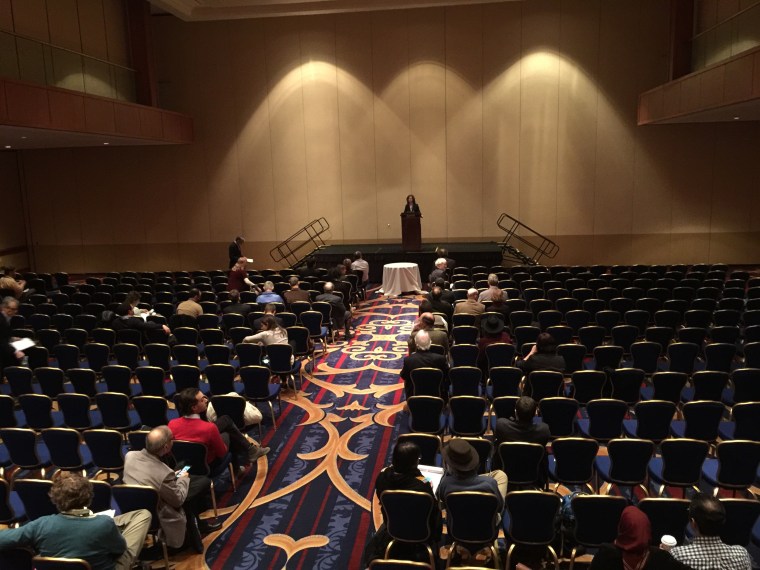
The first thing I liked about the meeting was that it was much smaller and hence more intimate and collegial than any of the earlier meetings I’ve attended. Just how small it was is apparent in the photo above of the plenary session in which the chair of the NEH spoke about two new NEH grant programs. (More about that below.)
Of course the reasons for low attendance at this year’s meeting are sad. Higher education is in trouble. Enrollments are down pretty much across the board, so there are not many new positions being advertised. Moreover, drops in enrollments mean there is less money to send hiring committees to the meeting to interview job candidates, as was standard practice in the past. Much interviewing is now done via Skype. The positive side of this was that the sometimes oppressive air of desperation generated by frantic job seekers (we’ve all been there) was conspicuously absent. My impression was that most attendees were established professionals and most of those people are understandably happier and less frantic than people on the job market.
The positive atmosphere of the meeting was enhanced even further by a pronounced focus on the responsibilities philosophers bear to the general public. This is the aspect of the meeting that I think will interest Kierkegaard scholars. Kierkegaard insisted that philosophy should be relevant to the life of the individual, that it should not be a purely abstract, or academic, activity.
The plenary address on Thursday was given by William “Bro” Adams, the Chair of the National Endowment for the Humanities. Adams spoke about two new grant programs the NEH has to encourage philosophers to reach out to the general public. The first is the Public Scholar Program. The is a grant program that gives support to individuals working on “well-researched books in the humanities intended to reach a broad readership.” The second program is “The Humanities in the Public Square.” This program “supports scholarly forums, public discussions, and educational resources related to the themes of a new NEH initiative, The Common Good: The Humanities in the Public Square.”
The plenary address was not the only part of the meeting that emphasized the duty of philosophers to engage with the general public. There was a session on the first day, sponsored by the Society for Applied Philosophy, on “Current Ethical and Justice Issues in Higher Education” that included a panel of seven scholars. There was a session the next day, sponsored by the APA Committee on Public Philosophy, entitled “Philosophy for the Public: Reports from the Field and National Endowment for Humanities Grants.” Lynne Tirrell of UMass Boston spoke on “Philosophy in Public: Modes of Engagements and Topics of Choice.” Peter Fristedt and Mark Silver, both from the NEH, spoke on the aforementioned NEH grant programs and offered advice on how to apply for them. Michael Lynch of U of Connecticut spoke on “Writing Philosophy for the Public,” and Gaurev Vazirani of Yale talked about Yale’s new philosophy blog WiPhi in a paper entitled “WiPhi: Developing Online Public Philosophy.”
Cool, eh? If you’ve been reading this blog since its launch in 2010, you have been in the forefront of the philosophical movement to bring philosophy to the general public. If you are a Kierkegaard scholar, you may be surprised to learn that many non-scholars also read this blog. I know because they occasionally email me about how much they love Kierkegaard even though they are not themselves scholars. I have actually endeavored to make this blog interesting to a wider public with the “Once Upon a Time in Copenhagen” and other similar posts. If you haven’t read any of those posts, I encourage you to go back and check them out. Some of them are pretty fun.
Also, if you haven’t yet checked out my other blog The Life of the Mind, definitely do that. I write there on a variety of issues of general interest, such as the First Amendment, race, and even the practical value of philosophical study, and I often manage to work in a reference to Kierkegaard. That blog now has more than 4,000 subscribers. How is that for engaging with the public!
I’m not done yet, however, in describing the emphasis at this most recent APA meeting on what philosophy can contribute to general public. There were two sessions sponsored by the National Philosophical Counseling Association (not to be confused with the American Philosophical Practitioners’ Association, another organization dedicated to philosophical counseling). Philosophical counseling is, I think, one of the most important ways that philosophers can show the relevance of philosophy to the lives of people who are not themselves professional philosophers. Different philosophical counselors practice their craft in different ways, of course. The most productive approach, I believe, however, is to view philosophical counseling as a kind of individual philosophical tutoring with an emphasis on how the mere activity of reflecting on one’s life can actually improve the quality of it.
The Society of Philosophers in America (SOPHIA) held a session entitled “The Obligations of Philosophers.” I particularly enjoyed Jackie Kegley’s paper. The title was, unfortunately, not listed in the conference program and I don’t now recall the title she gave it. It was very similar, however, to the title of her contribution to the volume Practicing Philosophy as Experiencing Life: Essays on American Pragmatism (Brill/Rodopi, 2015). I’d seen that volume in the Book Exhibit, but hadn’t bought it. I was so favorably impressed by Kegley’s talk, however, that I ran right back to the Book Exhibit after the session and bought what I believe was their only copy.
There were lots of other sessions, such as the one entitled “Philosophy and Happiness” (sponsored by the American Association for the Philosophic Study of Society) whose titles clearly indicated the topics discussed would be of interest to a broader audience than just scholars. I’d never seen anything like it in all my years of attending the APA. I don’t mean to suggest that professional philosophy has been transformed overnight from a vicious adversarial discipline to a unified udaimonistic movement. Daily Nous reported that “play nice” was overheard by at least a few conference attendees, so there is still work to be done.
All-in-all, however, this year’s meeting was an uplifting experience and highlighted that the discipline is indeed moving in new and more positive directions that will benefit not only professionals, but humanity as a whole. That is certainly something Kierkegaard would applaud!