The “Resources” page on this website is getting better and better. It now includes links not only to the most recent edition of Kierkegaard’s collected works in Danish and the crucially important Ferrall-Repp Danish-English Dictionary from 1845, but also links to the venerable Ordbog Over Det Danske Sprog (the Danish equivalent of the Oxford English Dictionary), Christian Molbech’s Dansk Ordsprog, a lexicon of Danish saying from Kierkegaard’s time and earlier, Peter Erasmus Müller’s Dansk Synonymik, a Danish thesaurus from 1853, Christian Molbech’s Dansk Ordbog, the definitive Danish-Danish dictionary from Kierkegaard’s lifetime, B.C. Grønberg’s Tydsk-Dansk og Dansk-Tydsk Haandorbog, the more comprehensive of the two German-Danish and Danish-German dictionaries Kierkegaard owned, J.C. Lindberg’s Hebraisk-Dansk Haand Lexicon, the Hebrew-Danish dictionary Kierkegaard owned, and Paul Arnesen’s Ny Latinsk Ordbog, the Latin-Danish dictionary that Kierkegaard owned.
There are two conspicuous absences, however, among these resources, because they appear not to be available yet online. The first is Ludvig Meter’s Fremmedordbog from 1853. This is a dictionary of foreign words that had come into Danish by the mid-nineteenth century. This is an absolutely indispensable resource for Kierkegaard scholars because Kierkegaard frequently uses such words and they are generally not found in Molbech. Fortunately, Ferrall-Repp lists many such words in a supplement at the back. Still, the Ferrall-Repp supplement is less comprehensive than Meyer’s and the definitions are very short. The good news is that Meyer’s is still easily available from many Danish antiquarians at reasonable prices. If you click on the image of Meyer to the left, it will take you to the page of an antiquarian where you can purchase the book.
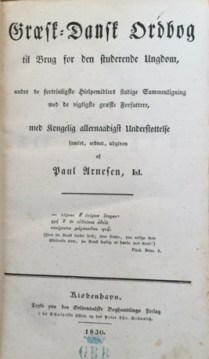
The other conspicuous absence is Paul Arnesen’s Græsk-Dansk Ordbog from 1830. This is a crucial resource not merely for scholars interested in how Kierkegaard understood and used concepts from the New Testament, but also for those who are interested in how Kierkegaard understood and used concepts from classical philosophy. I am very fortunate to own a copy of this book myself. Like Meyer, however, it is still possible to obtain a copy of this book at a reasonable price. Click on the image of Arnesen at the beginning of this post and you will be taken to a page of a Danish antiquarian where you can purchase this book.
I will continue adding resources to the “Resources” page over time and will endeavor to let readers know when new links go up.
I took Daphne Hampson to task in an earlier post for referring to Kierkegaard’s The Concept of Anxiety as The Concept Angst in her book Kierkegaard: Exposition and Critique. There are two problems with changing a title like that. First, it’s confusing to the reader, since there is no English translation of Kierkegaard’s Begrebet Angest with the title The Concept Angst. Second, it is far from clear that Kierkegaard’s “Angest,” or “Angst” (an alternative spelling) is, as Hampson argues “ill-rendered in English as ‘anxiety’” (Hampson, 109). Walter Lowrie, observes Hampson, translated Kierkegaard’s “Angst” (nouns were capitalized in Danish in the nineteenth century) as “dread.” “This is good,” she continues,
in so far as it conjures up the context of Romanticism. Kierkegaard can speak of a ‘sweet angst’ that tantalizes or invites. Angst, he will say, is ‘a sympathetic antipathy and an antipathetic sympathy’ (42). Philosophically the distinction between angst and anxiety (or fear) is said to be that whereas fear has an object, angst is devoid of any such. Animals can know fear, while the human may possess unfocused angst. (Hampson, 110).
I don’t mean to pick on Hampson. Her point isn’t original. I’ve heard many philosophers make essentially the same claim about the German “Angst.” The thing is, there isn’t much evidence to support such a claim. My Oxford-Duden electronic dictionary from 1999 defines “Angst” as “fear,” or “anxiety” with “fear” actually being listed first. Contemporary Danish-English dictionaries do effectively the same thing for the Danish “angst.” See, for example, the venerable Vinterberg-Bodelsen from 1966. It defines “angst” as “dread,” “fear,” “apprehension,” “alarm,” and “anxiety” in that order. Ferrall-Repp, the definitive nineteenth-century Danish-English dictionary defines “angst,” or “Angest” as “fear” or “dread.”
“Anxiety,” “fear,” and “dread,” as well as the German “Angst” and Danish “angst,” may or may not have an object. This can be seen in the online version of Duden, where “Angst” is defined first as “a state of excitement [in the face of danger], and then as “a vague feeling of menace.” I love the illustration for that entry. That’s why I chose it for this post. It makes clear that “Angst” can indeed have an object!
A practice has arisen in among the intellectual elite in English-speaking countries, however, of using the German “Angst” to refer to a generalized anxiety without a readily identifiable object, but that is simply an affectation as even a cursory glance at a German, or German-English, dictionary will make clear. “Angst” is more often used by Germans to identify such a generalized anxiety than is “Furcht,” i.e., fear, but that isn’t its exclusive meaning and indeed, dictionaries suggest such a use is the exception rather than the rule.
The same thing could be said about the English “anxiety.” It can sometimes have an object and sometimes not. One can be “anxious” about a test, for example, or the visit of a relative, or one can be just generally anxious. “Anxiety” is more often used to identify a generalized kind of fearfulness, than are either “fear” or “dread,” but that suggests that “anxiety” is actually a good translation of the German, or Danish “Angst,” rather than an inadequate one.
Texts, as I explain to my students over and over again, need to be interpreted. There are not magic words that always and unequivocally precisely convey an author’s meaning. “Angst” doesn’t more precisely convey to English speakers the meaning of the German or Danish “Angst” than does “anxiety.” In fact, it is arguably inferior in an English translation of Kierkegaard in that it is an affectation and Kierkegaard generally abhors such affectations and scrupulously avoids them in his writings, except, of course when he is using them satirically.
I had one of the best teaching experiences of my career last term. I taught an upper-level Kierkegaard seminar at Haverford College. Haverford, for those of you who do not know, is one of the best small liberal arts colleges in the country. It’s ranked number twelve on U.S. News and World Report’slist of 239 “National Liberal Arts Colleges in the U.S.
Haverford is a college based in the Quaker tradition. “The Quaker religion,” observes William James in The Varieties of Religious Experience, “is impossible to overpraise.” There’s always been a strong connection between Quakers and Kierkegaard because both emphasize the importance of the individual’s relation to God. My undergraduate professor and mentor, Bob Horn, the man who introduced me to Kierkegaard, taught briefly at Haverford before settling, finally, at Earlham College, another excellent Quaker institution, and the one from which I received my undergraduate degree.
Bob is a Kierkegaard scholar, and one of the most knowledgable people on Kierkegaard whom I have ever met. His Positivity and Dialectic, an examination of the thought of Hans Lassen Martensen, one of Kierkegaard’s teachers, is an essential resource for Kierkegaard scholars. Bob was succeeded at Haverford by Josiah Tompson, another Kierkegaard scholar. Thompson published The Lonely Labyrinth, an examination of Kierkegaard pseudonymous works, and Kierkegaard: A Collection of Critical Essays.
I knew first hand how intellectually stimulating is the environment of a small liberal arts college. A college with a Quaker history is even more inspiring, however, because there the emphasis is not merely on the development of the mind, but also of the spirit. I also knew of the Haverford-Kierkegaard connection, hence I was very excited when I was offered the opportunity to become, even if only briefly, a part of that tradition.
I could not have had a better group of students. We did a series of short essays in preparation for the term paper. Those essays were mostly summaries of various portions of the texts we were reading at the time they were assigned. This, I explained to them, was to help them become familiar with the practice of providing background for one’s argument before making the argument itself.
They were all good writers. Where they really shone, however, was in their term papers. Each one chose a challenging and important topic, and each did such a good job with the topic that I think their papers could actually be helpful to scholars wrestling with the same issues, so I asked them if I could post their papers to this blog. The students whose papers are mentioned below generously agreed to allow me to do that and to include their names. What follows is a short summary of each paper, along with a link to a pdf of the paper.
I’m going to present the papers in alphabetical order based on the student’s last name. First is Courtney Ahmed’s paper. Courtney’s paper, “Love in Philosophical Crumbs,” examines an issue that has always been of particular interest to me: the relation between human love and divine love. Here is the intro to Courtney’s paper. Remember, this is an undergraduate paper!
In Philosophical Crumbs, Søren Kierkegaard asserts the idea that Christian faith rests on the unequivocal acceptance that the eternal God’s temporal appearance in lowest human form was purely an act of love. Acceptance of this fact has the power to transform those who are able to both grasp and set aside its sheer implausibility. Is it possible, however, for one to understand and accept God’s love— the fundamental premise of Christianity— and thereby effect the transformation of faith without experiencing human love as a precursor? I will argue through the lens of Kierkegaard that no, it is impossible to know what it means to be loved by God unless one has experienced love manifested in human relationships.
Ian Andolsek was a senior philosophy major who actually wrote his senior thesis on Kierkegaard. Andolsek’s paper, “Towards a Deontic Kierkegaardian Virtue Ethics,” is not only well written, it displays an impressive grasp of the breadth of theoretical ethics. The following paragraph is extracted from early in the paper. I chose to post it, rather than the intro because I think it contains more information concerning the substance of Andolsek’s paper.
Kierkegaard’s ethical project is motivated by his strongly held the conviction that the purpose of ethics has been nearly universally misunderstood, from the Ancients, to Kant, to most notably, Hegel. My picture will present Kierkegaard as an analytically rigorous ethical philosopher who extends a cogent and compelling critique of Hegel’s ethical view in the Philosophy of Right to construct a positive ethical framework.
John Chip’s paper, “The Role of Aesthetics in Soren Kierkegaard’s Ethics and Beyond,” addresses an issue that could not be more important to those of use who love Kierkegaard not merely for the substance of his thought, but for the beauty of his prose style. Here is Chip’s intro:
Soren Kierkegaard was a Danish philosopher active in the 19th century. In this paper, I will explore Kierkegaard’s concept of aesthetics and its relation to ethics and religion and argue that, contrary to Kierkegaard’s claims, aesthetics can have a positive role in an ethical-religious life. First, I will discuss Kierkegaard’s primary concerns and summarize Kierkegaard’s views on how the conception of aesthetics functions in the ethical and religious life. Then, I will identify passages in which it is possible to understand aesthetics playing a positive role in an ethical-religious life.
Kevin Connolly’s paper “The Search for Eternal Happiness – Can Individual_s Subjects Assist One Another?” does just what it says. It examines the extent to which people can help one another in coming to understand eternal, unchanging truth. This is a hugely important topic in Kierkegaard scholarship because Kierkegaard often speaks as if he thinks people can have no role in helping one another to come to understand this truth. But if he really does believe this, then why, Connolly asks, did he write? Here is Connolly’s introduction.
In his Philosophical Crumbs and Concluding Unscientific Postscript, the philosopher Søren Kierkegaard describes the pursuit of an “eternal happiness” as being an essentially individual enterprise rooted in ethical-religious development. Although some readers may be inclined to interpret Kierkegaard as claiming that individual subjects can do nothing to assist one another in making ethical-religious progress, such a view is incommensurate with several other positions Kierkegaard takes throughout these works. Specifically, this paper will show this viewpoint to be incongruous with the many remarks Kierkegaard makes concerning a subject’s decision-making and relationship with God, an understanding of how interpersonal communication works, and his commentary pertaining to religious addresses. It will thereafter be clear that Kierkegaard believes that subjects can indirectly assist others by inducing them to act and forge their own way toward ethical-religious development, but cannot themselves guide them along a pre-charted path to ethical-religious development.
Leonor Suarez’s paper, “How Does One Learn that They are Outside of the Truth_?” looks at the issue of whether it is possible to come to know one is outside the truth without God’s help, which is to say that it looks at the relation between what Kierkegaard calls “guilt consciousness” and “sin consciousness.” Suarez’s intro is so short that rather than present it here, I’ll just direct you to the paper. You will not be disappointed!
My Kierkegaard seminar at Haverford was something special. It’s an experience I hope I will be able to repeat someday.
 The “Resources” page on this website is getting better and better. It now includes links not only to the most recent edition of Kierkegaard’s collected works in Danish and the crucially important Ferrall-Repp Danish-English Dictionary from 1845, but also links to the venerable Ordbog Over Det Danske Sprog (the Danish equivalent of the Oxford English Dictionary), Christian Molbech’s Dansk Ordsprog, a lexicon of Danish saying from Kierkegaard’s time and earlier, Peter Erasmus Müller’s Dansk Synonymik, a Danish thesaurus from 1853, Christian Molbech’s Dansk Ordbog, the definitive Danish-Danish dictionary from Kierkegaard’s lifetime, B.C. Grønberg’s Tydsk-Dansk og Dansk-Tydsk Haandorbog, the more comprehensive of the two German-Danish and Danish-German dictionaries Kierkegaard owned, J.C. Lindberg’s Hebraisk-Dansk Haand Lexicon, the Hebrew-Danish dictionary Kierkegaard owned, and Paul Arnesen’s Ny Latinsk Ordbog, the Latin-Danish dictionary that Kierkegaard owned.
 There are two conspicuous absences, however, among these resources, because they appear not to be available yet online. The first is Ludvig Meter’s Fremmedordbog from 1853. This is a dictionary of foreign words that had come into Danish by the mid-nineteenth century. This is an absolutely indispensable resource for Kierkegaard scholars because Kierkegaard frequently uses such words and they are generally not found in Molbech. Fortunately, Ferrall-Repp lists many such words in a supplement at the back. Still, the Ferrall-Repp supplement is less comprehensive than Meyer’s and the definitions are very short. The good news is that Meyer’s is still easily available from many Danish antiquarians at reasonable prices. If you click on the image of Meyer to the left, it will take you to the page of an antiquarian where you can purchase the book.

 Piety on Kierkegaard