Page 6 of 20

The Meaning of “Ethics” in Fear and Trembling
img_3925

I belong to a really wonderful philosophy of religion reading group. We’re reading Eleanor Stump’s Wandering in Darkness. We just finished the chapter that looks at the story of Abraham and Isaac. Stump contrasts her interpretation of the story with Kierkegaard’s, famously put forward in Fear and Trembling. She acknowledges that she is not a Kierkegaard scholar, and that her interpretation of Fear and Trembling is not intended as a contribution to Kierkegaard scholarship, but explains that she’s using the story to “bring out the salient features of [her] differing interpretation.” Readers, she continues “should feel free to take the section of this chapter on Kierkegaard’s reading of the story as only a Kierkegaard-like interpretation” (p. 260).

Unfortunately, Stump’s interpretation of Kierkegaard’s reading of the story of Abraham and Isaac isn’t very “Kierkegaard-like.”

“[A]s I understand him,” writes Stump,

Kierkegaard takes Abraham to be caught in a dilemma; but he thinks that that dilemma is resoluble, because he supposes that God’s command produces a “teleological suspension of the ethical” for Abraham. The ethical prohibition against the killing of an innocent child is overridden by God’s command to sacrifice Isaac. That Abraham understands and accepts this feature of his situation is part of what makes him a hero of faith for Kierkegaard (pp. 260-261).

For Stump, on the other hand, there is no dilemma. “If we read the episode of the binding of Isaac,” she argues, 

in the context of the whole narrative of Abraham’s life, in which Abraham’s double-mindedness about God’s goodness is manifest, and especially if we see that episode against the backdrop of the expulsion of Ishmael, then it is clear that God is not pitting his authority against morality in asking Abraham to sacrifice Isaac, as Kierkegaard apparently supposed. … God’s demand for Isaac and the requirements of morality are on the same side in this story (p. 303).

“The faith that makes Abraham the father of faith,” she continues, “has its root in Abraham’s acceptance of the goodness of God, Abraham’s belief that God will keep his promises, and Abraham’s willingness to stake his heart’s desire on that belief” (p. 304).

That is, Stump argues that God has repeatedly shown Abraham that he is trustworthy hence ethics requires that Abraham accept God as trustworthy. That, according to Stump, is what ethics demands. There’s no dilemma, no conflict between the requirements of ethics and God’s command. What God commands is precisely what the moral law requires. 

Stump’s interpretation of Kierkegaard is not new. Many people have interpreted Fear and Trembling in the way Stump does. It is arguably difficult not to interpret it this way, given that Kierkegaard himself coined the phrase “teleological suspension of the ethical” (teleologisk Suspension af det Ethiske). Yet, there are ample clues in the work itself that Kierkegaard does not mean to suggest that God’s commands would ever conflict with genuine moral or ethical obligation.

But if Kierkegaard is not trying to argue that God’s command can potentially be in conflict with our ethical obligations and that when it is, our duty to God supersedes those obligations, what is he doing in Fear and Trembling? 

One doesn’t have to know a lot about Kierkegaard to take issue with Stump’s reading of Fear and Trembling. In fact, one only needs to have read the introductions to Alastair Hannay’s and Sylvia Walsh’s translations of the work to get a decent idea of what sort of “dilemma” it presents. 

“The opening pages of each of the three problemata,” explains Hannay 

all follow a uniform pattern. First the ethical is defined as the universal, then a consequence drawn from this, followed by the observation that to accept this consequence is to concede that Hegel’s account of the ethical is right. Thereupon our author claims that if Hegel’s account is indeed right, then Hegelians have no right to talk of faith or to give credit to Abraham as its father, for according to each of the consequences in question Abraham must stand morally (even criminally) condemned. The three consequences of defining the ethical as ‘the universal’ are: (i) that the individual’s moral performance must be judged by its underlying social intention; (ii) that there are no duties to God other than duties that are in the first instance to the universal; and (iii) that it is a moral requirement that one not conceal one’s moral projects or the reasons one has for failing to carry them through. In each of the problemata Abraham is shown to infringe the principle of the ethical as the universal by failing to conform to the consequence, or implicated requirement, in question. Abraham acts as though there were a superior measure of moral performance that made social intentions irrelevant; he supposes himself to have an absolute duty to God that overrides the ethical defined as the universal; and he cannot reveal his intention to the parties concerned. (p. 28)

“Hegel defined ethical life (Kierkegaard uses a Danish expression, ‘det Sædelige’, which is a direct translation of Hegel’s ‘das Sittliche’),” Hannay continues, 

as the identification of the individual with the totality of his social life. The basic idea behind an ethics of Sittlichkeit is that public morality, or the principles of social and political cohesion underlying any actual society, are expressions of universal human goals. If there is a human telos (goal) at all, that is where it finds expression. Thus in order to become moral the individual should conform to, and begin to want to act in accordance with, the principles of public morality that any State must be based on. ‘The State’, says Hegel, ‘in and by itself is the ethical whole.’ This is precisely the idea of the ethical as the universal which the problemata present as a hoop that Abraham must jump through in order to prove the morality of his action. Abraham consistently fails.

It isn’t merely, or even primarily, Hegel that Kierkegaard has in mind, I would argue, when he refers to “ethics in the sense of social convention.” It’s Hans Lassen Martensen, his former teacher and eventual Bishop of Copenhagen. “De Sædelige” is the title of the first section of the first volume of Martensen’s Den christelige Ethik (Christian Ethics). Sædelighed, which according to Martensen, has its foundation in the family unit, is the foundation of Christian ethics. Den christelige Ethik was not published until after Kierkegaard’s death, but Martensen was an ardent follower of Hegel from the beginning of his philosophical career and is repeatedly and mercilessly caricatured as such by Kierkegaard.

“The general thrust of Protestant liberal thought from Kant to Hegel,” observes C. Stephen Evans in his introduction to Sylvia Walsh’s translation of Fear and Trembling (Cambridge, 2006), 

has been to understand genuine religious faith in ethical terms. Kant himself had closely linked true religious faith to the ethical life: “Apart from a good life-conduct, anything which the human being supposes that he can to do to become well-pleasing to God is mere religious delusion and counterfeit service of God.” When Kantian ethics is converted by Hegel to Sittlichkeit then the equation of faith with the ethical sets the stage for the triumph of Christendom and the identification of religious faith with social conformism. (p. xxix)

“Kierkegaard thinks that genuine faith,” continues Evans, “requires an individual relation with God that is personally transformative.” According to Kierkegaard, argues Evans, faith in God “is not reducible to fulfilling one’s social roles.” Such faith serves as the basis, he observes, however, of a renewal of the self and of social institutions. 

Only ethics in this new, specifically religious sense really counts as ethics for Kierkegaard because only through a transformation of the individual is there any hope of that individual’s conforming his or her will to the substance of the moral law. Outside of Grace, guilt is too debilitating, to corruptive of the subjective determining ground of the will. 

Hannay’s own view is that Kierkegaard “envisages some alternative” to the Hegelian principle of morality whereby there is no genuine conflict between what ethics requires and what God commands. Not only that, Hannay goes so far as to assert that Johannes de silentio, the pseudonymous author of Fear and Trembling, envisages such an alternative. 

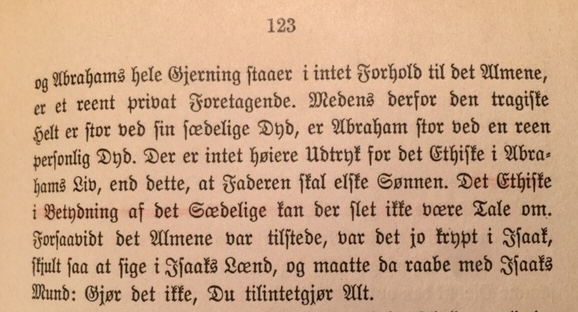
Evans doesn’t give Johannes de silentio so much credit as Hannay does, but they agree that the view of ethics that equates it with Sittlichkeit/Sædelighed was not one to which Kierkegaard himself subscribed. Such a view is amply supported by the repeated qualifications of “the ethical” in Fear and Trembling as “the universal,” and at least one completely unequivocal reference to “the ethical in the sense of social convention” (Det Ethiske i Betydning of det SædeligeSKS 4, p. 153/SV, 2nd ed. III, p. 123). Unfortunately, the allusion to Hegel is obscured in both the Hongs’ and, more surprisingly, Hannay’s own translation of the relevant passage. The Hongs have “[t]he ethical in the sense of the moral” (p. 59) and Hannay has “[t]he ethical in the sense of ethical life” (p. 88). 

That Kierkegaard envisages an alternative to the Hegelian view of ethics is widely recognized by scholars. Kierkegaard is a famous opponent of Hegel on this point, as well as on many others. Scholars are familiar with Kierkegaard’s hyphenated expression “ethical-religious.” Ethics cannot ultimately be separated from religion, according to Kierkegaard, in the manner that both Hegel and Martensen try to do. More particularly, ethics cannot be separated from Christianity, as is clear in, for example, Kierkegaard’s ethical treatise Works of Love. 

If there is a God, then there is a way that God wants his creatures to relate to him (or her or it). That is, if there is a God, then the proper relation to God is the individual’s telos and insofar as the proper relation to God is going to involve relating in a particular way to the rest of creation, then ethics is subsumed under religion which means there cannot be any conflict between ethical duty and religious duty. The two are the same. 

One doesn’t need to be a Kierkegaard scholar to appreciate this. Not only is the logic of the above identification of ethical and religious duty unassailable, Kierkegaard has left ample clues in Fear and Trembling to indicate that “the ethical” as it is presented there ought always to have quotation marks around it in that there is another higher ethics in the background, an ethics not unlike the one that Stump defends in her effort to provide an ethical justification for Abraham’s apparent willingness to sacrifice his son. 

Except that Abraham isn’t actually willing to sacrifice his son, on Stump’s reading. His faith is that God won’t actually ask him to do it in the end. 

Stump’s reading of the Abraham story has some very compelling elements, including the creative and original use she makes of Abraham’s earlier effective sacrifice of Ishmael. I would argue, however, that if Abraham’s faith was simply that God’s goodness would mean that he would not, in the end, require the sacrifice of Isaac, then Abraham comes off not as the father of faith, but merely as a really nice guy, unwilling, as Rhett Butler observes of Melanie Hamilton, to think ill of anyone she loves.

Something on Johannes de silentio

IMG_3634Adam Kirsch’s inexplicable addition of a definite article in front of “Silentio” in his mention of Johannes de silentio, the pseudonym under which Kierkegaard published what is perhaps his most famous work, Fear and Trembling (see the post just before this one), got me thinking again about that pseudonym and how little attention has actually been paid to it.
It is generally presented as a straightforward name, like Constantin Constantius, Johannes Climacus, and Vigilius Haufniensis, the pseudonyms Kierkegaard used for Repetition, Philosophical Crumbs, and The Concept of Anxiety, respectively. It isn’t a name, though, at least the de silentio part isn’t. It’s a description. Kierkegaard’s other pseudonyms use upper-case letters to begin what functions as the surname. Johannes de silentio doesn’t. The pseudonym appears in all caps on the original title page, but only “Johannes” is capitalized at the end of the preface (see the illustration for this article).

Part of the reason scholars have missed this, is that translators have missed it. Alasdair Hannay got it right in his translation for Penguin, but both Princeton translations, the first by Walter Lowrie, done in 1941, and the second by Howard and Edna Hong, done in 1983, get it wrong. Unfortunately, the Princeton translations are the ones that have long been preferred by scholars. The result is that this point about the pseudonym under which Kierkegaard published Fear and Trembling has gone unnoticed.

Johannes de silentio is typically taken, as Kirsch does in his review, to mean John of Silence, or John who cannot speak. Since, however, the “de silentio” is clearly a description rather than a surname, Johannes di silentio could be interpreted to mean John from silence, which is to say, not John who is silent, but John who is attempting to break a silence, John who is attempting to explain what is perhaps inexplicable: the situation of Abraham.

Hannay actually discusses this in the introduction to his translation of Fear and Trembling. We notice, he writes

that Kierkegaard has given his author the name ‘Johannes de silentio’, which is allegedly borrowed from one of the Grimms’ fairy-tales, ‘The Faithful Servant’. Kierkegaard’s John of Silence is not, however, at all a silent person. If he was he wouldn’t be an author. Nor was the faithful servant in the fairy-tale. He told his master, the young king, of three dangers threatening him, though realizing that in doing so he would be turned to stone. (To anticipate a further connection with Fear and Trembling, when the royal couple later got two sons they gave the lives of these in sacrifice in order to bring Johannes back to life, whereupon Johannes brought the children back to life.) (p. 10.)

Hannay was right. Johannes, the putative author of Fear and Trembling, is far from silent. Like his German counterpart, he warns of three dangers. Kierkegaard’s Johannes arguably attempts, through his description of the situation of Abraham, to warn his readers of three dangers presented in the form of questions that comprise the three Problemata of the work.

The connection between the fairy tale and the subject of Fear and Trembling is even closer, however, than Hannay suggests. The royal couple didn’t volunteer the lives of their sons in order to bring their faithful servant back to life. After faithful Johannes was turned to stone, the king, realizing what had happened, was so grief stricken that he took the stone statue of Johannes and placed it beside his bed.

Once when the queen was at church, the story reads

and the two children were sitting beside their father and playing, he again looked sadly at the stone statue and said, “Oh, if only I could bring you back to life again, my most faithful Johannes,”

Then the stone began to speak and said, “You can bring me back to life again if you will in return give up what is dearest to you.”

The king cried, “For you I will give up everything I have in the world.”

“The stone continued, “If you will cut off the heads of your two children with your own hand, then sprinkle their blood on me, I shall be restored to life.”

The King was horrified when he heard that he would have to kill his own dearest children, but he thought of faithful Johannes’s great loyalty and how he had died for him, then drew his sword and with his own hand cut off the children’s heads. And when he had smeared the stone with their blood, it returned to life, and faithful Johannes stood before him again, healthy and well.

He said to the king, “Your faith [Treue] shall not go unrewarded,” then taking the children’s heads, he put them on again, then rubbed the wounds with their blood, at which they became immediately whole again, and jumped about and went on playing as if nothing had happened.

Kierkegaard was a lover of fairy tales and among his many collections of fairy tales was the second edition of Grimms’ Kinder- und Hausmärchen, where the story in question, “Der treue Johannes,” or “Faithful Johannes,” appears as number no. 6.

Kierkegaard was likely taken by the title “Faithful Johannes” (my emphasis), as well as by the strength of the parallel with the Abraham story.

In fact, the fairy tale puts a decidedly Christian slant on the story because in “Faithful Johannes” not only is the king is required to sacrifice the lives of his children if he wishes to rescue Johannes, the king does this because Johannes “had died for him” (für ihn gestorben war).

Perhaps the silence that Johannes, the author of Fear and Trembling, is attempting, in a somewhat cryptic way, to break is the silence concerning Kierkegaard’s severing of his engagement with Regine Olsen. That is, perhaps he is attempting to communicate, not merely to his former fiancée, but to all of literate Copenhagen, the reasons behind what many viewed as his callous and unprovoked violation of social convention, not to mention of an innocent young woman’s trust.

This is not the first time, of course, that such an explanation has been offered for Fear and Trembling. I think it may be the first time, however, that the parallel to the Grimms’ fairy tale has been explored in depth and that the decidedly Christian slant the story places on the requirement of filicide as a demonstration of faith has been exposed.


APA Report and Book Giveaway

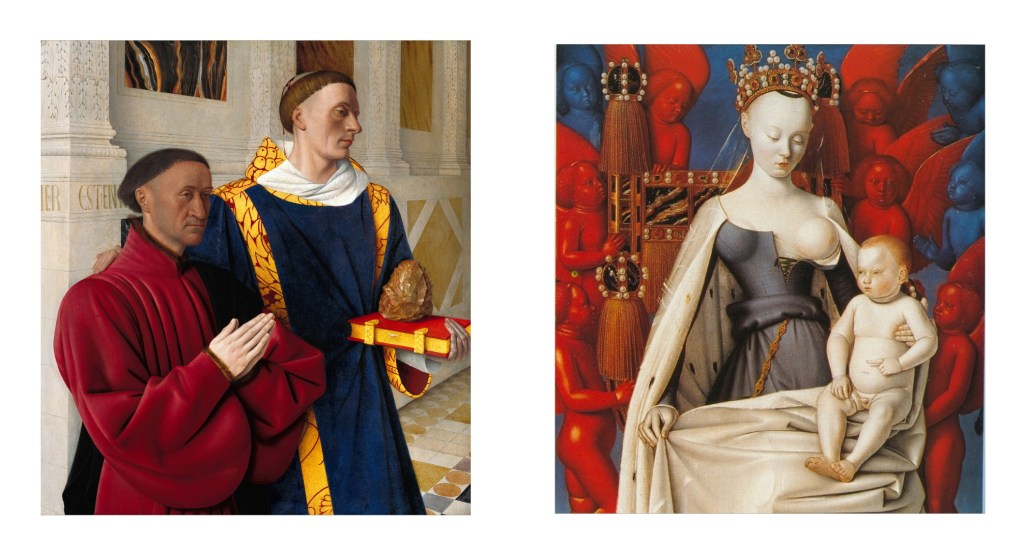
Diptyque_de_Melun_reconstitué
The Melun Diptych

The annual meeting of the Eastern Division of the American Philosophical Association was in Philadelphia last weekend. I chaired a session organized by the Søren Kierkegaard Society entitled “Kierkegaard on Practice and Inner Strength.” The speakers were excellent and we were very fortunate in that despite the fact that the session was in the very last slot on the very last day of the conference, we had a decent-sized audience and an excellent discussion.

The first speaker was Dylan Bailey, a graduate student working with John Davenport at Fordham University. Bailey’s paper was entitled “Kierkegaard and Socrates on Midwifery and Practical Understanding.” One of the things I particularly liked about the paper is that it didn’t merely look at Kierkegaard and Socrates. It placed the views of both in the context of contemporary work on understanding such as Christopher Baumberger, Claus Beisbart, and Georg Brun’s, “What is Understanding? An Overview of Recent Debates in Epistemology and Philosophy of Science,’ in Explaining Understanding. New Perspectives from Epistemology and Philosophy of Science (Routledge, 2016). Bailey is one to watch. His paper was excellent and he is working with one of the best Kierkegaard scholars in the business!

The second speaker was Kevin T. Di Camillo. Di Camillo’s paper was entitled “Jean Fouquet’s The Melun Diptych: Weaning in Kierkegaard’s Fear and Trembling, and Melanie Klein’s Guilt, Love and Reparation — A Study in Kenosis and Theosis.” One of the things that made the session so excellent was the non-traditional nature of Di Camillo’s paper and its placement between two more traditional papers. I’ve always found it difficult to sit through three dense scholarly papers in a row. Di Camillo’s paper was a departure, however, from the traditional dense scholarly paper. It was dense, but in a different way. It was rich with references to the painting that was its subject, so it required audience members to repeatedly search the two posters Di Camillo had made of the painting for illustrations of his points. That is, it was sort of an audience-participation presentation, made even more enjoyable by the fact that Di Camillo had thoughtfully provided the audience with two transcendently delicious pandoros from his family’s prize winning Di Camillo Bakery. (I’m a big fan of pandoro and panettone. I’m ashamed to say, however, that I had been buying them from TJMax. Never again Di Camillo’s pandorro was a revelation!).

There was a lively discussion of whether weaning was always necessarily traumatic in the way that Klein and Kierkegaard appear to suggest. Chandler Rogers, a Teaching Fellow at Boston College, interjected that Vanessa Rumble points out in “Why Moriah?: weaning and the trauma of transcendence in Kierkegaard’s Fear and Trembling” that Kierkegaard’s impression of weaning was likely influenced by the deaths of sisters as a consequence of childbirth. “Weaning normally calls to mind,” writes Rumble,

the movement of individuation and dawning consciousness/ self-consciousness, a passing moment of separation and mourning. The infant emerges from a state which, retrospectively, will appear as one of unity, plenitude, into the difficult reality of mediating between the necessary and the possible, the real and the ideal, in short, into the reality of our freedom and its limits. In the experience of Kierkegaard and his siblings, however, weaning is tied, through the pronouncements of the midwives, to horrific loss. Milk, the infant’s earliest nourishment, and the mother’s first medium for communicating her love, care and attention, becomes, in the accounts which Kierkegaard heard swirling about his sisters’ deathbeds, a poison which attacks the mother’s brain. The milk that was to join the mother to the child and sustain the child destroys the mother, separating them brutally and definitively. And after the trauma comes the invariable question: what is all this to mean? (259)

Rumble’s paper is one of my all-time favorites. It isn’t just an exceptionally rigorous and insightful piece of scholarship. It is beautiful. If I remember correctly, I heard her present an early version of it at a conference. It can be found now, however, in Kierkegaard’s Fear and Trembling: A Critical Guide (Cambridge, 2015) which is available in a very reasonably priced ebook edition.

That brings me to the one really sour note of the conference. I found what looked to be a very interesting new book from Routledge entitled The Kierkegaardian Mind. It’s a big volume with lots of subject divisions and an impressive list of contributors. Here’s the thing: The ebook version is $184! It’s actually more expensive, on Amazon anyway, than the hardcover, which retails on Amazon for $173! There’s no excuse for that. Routledge has a lot of good books on Kierkegaard, but most of them are far too expensive for individuals and not every university library will have them. What that means is that they are not going to be cited as much as they deserve to be. I won’t be citing this one, in any case, unless I can get a copy from Penn’s library and even then, given that I will have it for only a very finite period of time, I won’t cite it so much as I would otherwise.

It’s important that presses such as Routledge publish works on Kierkegaard. Scholars can’t get tenured without publications. They can’t make reputations, however, if people don’t cite their work. An essay in a book that few people ever read and hence fewer still actually cite, will take a career only so far. An increasing number of humanities departments are looking not just at publications when considering tenure and promotion decisions, but also at how often a scholar’s work is cited. That’s not so unfair as it sounds because there are also an increasing number of predatory journals and presses so it is becoming easier for scholars to get their work published in purportedly peer-reviewed journals and books. Few scholars can keep up with the proliferation of such journals and presses and this is even more true of administrators who are not themselves scholars. The thinking is that a scholar whose work is any good will be cited by other scholars. Presses such as Routledge, whose books are astronomically overpriced, are wreaking havoc with that logic. Belt tightening that has effected nearly all institutions of higher education outside the Ivy League has meant that many universities no longer automatically purchase every book that comes out of a university press, not even out of the top university presses. That means lots of excellent scholarship is failing to reach as wide an audience as it deserves.

On the topic of the affordability of scholarly works, I’ve decided to give away five copies of Ways of Knowing: Kierkegaard’s Pluralist Epistemology (Baylor, 2010) to graduate students who would like to use the book as part of their research for their dissertations. I got these copies at deeply discounted prices when Baylor came out with the paperback. All you need to do to secure a copy is send me an email with a brief summary of your dissertation, an explanation of the use you plan to make of the book, your dissertation director’ name, and your address, and I will put a copy in the mail to you. I have only these five copies to give away, though, so they will be available on a first-come, first-served basis.

The two papers described above were not the only papers in the SKS session. I am going to save the last paper, Siobhan Marie Doyle’s excellent “Gender and the Practical Dimensions of Kierkegaard’s Existential Philosophy” for my next blog post.