Page 4 of 20

Kierkegaard and MacDonald on Genuine Community

I recently discovered a thinker whose views are very similar to Kierkegaard’s and that has given me an opportunity to share once again my thoughts on Kierkegaard’s views on the nature of genuine community. Kierkegaard famously disparages what he refers to as “the crowd” and its “leveling” tendencies, but that does not mean he had a negative view of all collectivities. He makes very few references to positive collectivities, but that was likely first because he felt they were exceptionally rare, and second, and more importantly, because he felt describing such collectivities wasn’t his specific life’s task. His task, as he conceived it, was to encourage people to separate from the crowd, to become individuals.

Christianity, writes Kierkegaard in Works of Love, turns our attention completely away from the external, turns it inward (WOL, 376). In the stillness of God’s house, he writes in Three Discourses on Imagined Occasions, “[t]here is no fellowship—each one is by himself; there is no call for united effort—each one is called to individual responsibility” (TDIO, p. 10). 

And yet, he continues later in the same work, “in the stillness, what beautiful harmony with everyone! Oh, in this solitude, what beautiful fellowship with everyone!” (TDIO, p. 38).

It may appear that Kierkegaard is contradicting himself here, but I don’t think he is. I think what he means is that in the stillness before God, there is no “fellowship” in the sense that there is no escaping into the crowd, no hiding behind others, no opportunity for leveling reassurances that after all, it is unreasonable to expect moral perfection. 

“God wants each individual,”writes Kierkegaard, for the sake of certainty and of equality and of responsibility, to learn for himself the Law’s requirement. When this is the case, there is durability in existence, because God has a firm hold on it. There is no vortex, because each individual begins, not with ‘the others’ and therefore not with evasions and excuses, but begins with the God-relationship and therefore stands firm (WOL, p. 118).

God is the “middle term” for Kierkegaard in any genuinely loving relationship, whether that relationship is one of preferential love or neighbor love. But when God is the middle term, then genuine community is possible. 

That brings me to my discovery. I take painting lessons. I have to drive more than an hour every Saturday to get to my painting class. I enjoy the drive because the landscape through which I drive is mostly rural. Still, the drive is nicer if I have something to listen to. Sadly, the radio in my 1999 Mazda Protegé long ago bit the dust, so I have to stream whatever I listen to on my phone with the help of a small bluetooth speaker. I like to listen to books, when possible. I found something called The Hope of the Gospels, by George MacDonald on YouTube. I’d never heard of MacDonald, but I like theological works, so I thought I would give it a try. 

It was amazing! MacDonald’s writing is every bit as beautiful and inspiring as Kierkegaard’s best edifying writing and there is an uncanny similarity of views between the two. 

“Although I say, every man stands alone in God,” writes MacDonald in Miracles of Our Lord, “I yet say two or many can meet in God as they cannot meet save in God; nay, that only in God can two or many truly meet; only as they recognize their oneness with God can they become one with each other” (The Complete Works of George MacDonald, p. 13,394)

What MacDonald is describing is precisely the “beautiful fellowship” with others that a genuine God relationship not only makes possible according to Kierkegaard, but actually necessary.

“Christianity,” according to Kierkegaard, “turns our attention completely away from the external, turns it inward, and makes every one of your relationships to other people into a God-relationship (WOL, p. 376). “God just repeats everything you say and do to other people; he repeats it with the magnification of infinity. God repeats the words of grace or of judgment that you say about another; he says the same thing word for word about you (WOL, pp. 384-385). 

But this unity of the divine and the human as exemplified in the neighbor is not merely for purposes of judgment.

“Love is a need, the deepest need, in the person in whom there is love for the neighbor,” writes Kierkegaard, “he does not need people just to have someone to love, but he needs to love people. Yet there is no pride or haughtiness in this wealth, because God is the middle term, and eternity’s shall binds and guides this great need so that it does not go astray and turn into pride. But there are no limits to the objects, because the neighbor is all human beings, unconditionally every human being” (WOL, p. 67). 

“All communities are for the divine sake of individual life,” writes MacDonald, “for the sake of the love and truth that is in each heart, and is not cumulative—cannot be in two as one result. But all that is precious in the individual heart depends for existence on the relation the individual bears to other individuals: alone—how can he love? alone—where is his truth? It is for and by the individuals that the individual lives. A community is the true development of individual relations. Its very possibility lies in the conscience of its men and women. No setting right can be done in the mass. There are no masses save in corruption. Vital organizations result alone from individualities and consequent necessities, which fitting the one into the other, and working for each other, make combination not only possible but unavoidable. Then the truth which has informed in the community reacts on the individual to perfect his individuality. In a word, the man, in virtue of standing alone in God, stands with his fellows, and receives from them divine influences without which he cannot be made perfect” ( The Complete Works of George MacDonald, p. 13,393).

Kierkegaard could not have said it better himself!

I am devouring everything MacDonald wrote, at least all the theological writings. Theological writings were not all he wrote. Kierkegaard and MadDonald have more in common than the substance of their theologies. Kierkegaard, as is widely known, loved fairy tales. MacDonald loved them as well. In fact, he actually wrote fairy tales and it appears his fantastical works were enormously influential on a number of later thinkers including J.R.R.Tolkein and C.S. Lewis.

Unfortunately, the only hard copy edition of MacDonald’s collected theological writings that I have been able to find is part of his much larger complete works that retails on Abebooks.com for $1,980.53, which is just a little more than my current book-buying budget allows. Fortunately, there is an ebook version of MacDonald’s complete works that is available through Amazon for a measly $1.99! 

It is profoundly mysterious to me that MacDonald is not better known. There is a George MacDonald Society, but I’ve never seen any sessions devoted to his works at the annual meeting of the American Academy of Religion. I’ve been attending the annual meetings of the AAR for more than twenty years and I had never run across his name before. I would’t go so far as to argue that no attention has ever been paid to MacDonald at the AAR, but if there has been any attention given to MacDonald, it has been very slight, and it appears no attention whatever has been given to the relation between MacDonald’s thought and Kierkegaards. 

That has got to change!
BIG BOOK GIVEAWAY!!!

IMG_4407Two of my biggest supporters throughout my career have been the late Robert L. Perkins and Sylvia Walsh Perkins. I met them both at the very first Kierkegaard conference I attended at the College of Wooster, when I was still only a graduate student. One of my professors, George L. Kline learned I planned to attend the conference and suggested that I should try to make contact there with Bob Perkins. Perkins’ work on Kierkegaard, George explained, was very good, so it would be good for me to get to know him. 

I didn’t know anyone at that conference, so I was happy to have something of an information introduction to Bob. I approached him during one of the breaks early in the conference. I liked him immediately. Despite being one of the top people in Kierkegaard studies in the world, he was very warm and modest and self effacing. When I mentioned to him how his work had been recommended to me by George Kline, he seemed pleased, but immediately changed the subject. “You should read Sylvia Walsh’s work,” he exclaimed with enthusiasm. “Now there is a scholar who is really good!”

I’m paraphrasing, of course, because that first meeting was so long ago that I don’t remember exactly what Bob said. In fact, that first meeting was so long ago that Bob and Sylvia weren’t even married yet. I followed Bob’s advice and sought out Sylvia at that same conference. I quickly became friends with both of them, and not because they were the first Kierkegaard scholars I met, but because they were both truly lovely people, passionate and gifted scholars, warm, kind, and socially conscious. Bob and Sylvia supported me throughout my career. In fact, it is no exaggeration to say that without the support of Bob, Sylvia, and C. Stephen Evans, I wouldn’t have a career. 

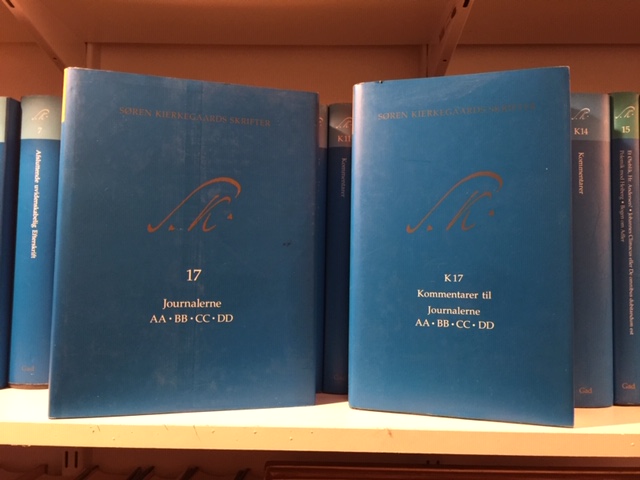
I was therefore deeply moved when Sylvia contacted me recently to ask whether I would be interested in any of the books she was planning to get rid of. She said she was winding down her scholarly activity and hence unlikely to need all the books in the large library she and Bob has amassed over the years. Among the books Sylvia offered me was a complete set of the new Søren Kierkegaards Skrifter, the most recent edition of Kierkegaard’s collected works in Danish, as well as a complete set of the new Kierkegaard’s Journals and Notebooks, the English translation of Kierkegaard’s journals and papers that is based on the new SKS. 

Sylvia was also getting rid of the old Hongs’ translation of the journals and papers that they had done for Indiana University Press. I’m not a huge fan of the Hongs’ translations, as readers of this blog are likely aware. The earlier translations tend to be better than the later ones, though, and their translations of the journals and papers are very early. Also, while the new Kierkegaard’s Journals and Notebooks is far more comprehensive than the old Hongs’ translation that went under the title Kierkegaard’s Journals and Papers, the actual translations in the new edition are often no better, and sometimes even worse, than those in the older edition. The thing I like best about the Hongs’ translation of the journals and papers, though, is that it is organized thematically rather than chronologically. That makes it a pleasure simply to sit and read. 

I’d wanted a set of the Hongs’ Journals and Papers for years. It is still available through Indiana, as well as Abebooks.com. It’s quite expensive, though, to get a complete set, even used. Given that I already had a complete set of the Papirer (which I had also earlier gotten from Bob and Sylvia), and given that Princeton had come out with the new Journals and Notebooks, it seemed extravagant to lay out money for the now obsolete Hongs’ translation. 

But then, out of nowhere, or so it seemed, I got an email from Sylvia, whom I had come to regard as sort of my scholarly guardian angel, asking me if I wanted a collection of books that included this set. Of course the Journals and Papers are not the most important of the works Sylvia has so generously given me. They are the books, however, for which I had nurtured a secret longing. After all SKS is available online, and KJN is disappointing in some respects.  

And now I have my very own set of Kierkegaard’s Journals and Papers! Thank you, Sylvia!

It seemed wrong to pick and choose books from the list Sylvia sent me, so I told her just to send them all and that I would find homes for any books I already had. Hence the title of this post. I’ve created a list of the duplicates and will send them to anyone who is willing to pay for the postage. Just write me and let me know which books you would like and why. The reason I would like you to explain why you want the book, or books, in question is in case several people write at the same time that they want the same book, or books. Basically, I will distribute the books based on a first come, first served basis, but if two or more people request the same books at the same time, an explanation of why each wants the book, or books, will help me to decide who should get them. I will let you know what it will cost to ship them and will not ship them until I hear that you are okay with that cost. 

Again, I’ve attached a list of the books I am giving away. Some highlights are a complete third edition of Kierkegaard’s collected works in Danish, selected volumes of both SKS and KJN. Check out the attached list, though, for exciting finds!

The Decline of Editing

The annual meeting of the American Academy of Religion took place last week. As usual, there were three Kierkegaard sessions. I missed the first session, which was on Kierkegaard and “public philosophy.” The other two sessions were excellent. The theme of both sessions, which were sponsored by the Kierkegaard, Religion, and Culture Group of the AAR, was “Kierkegaard, Contagion, Class, and Corporeal Vulnerability,” so the sessions were timely, with frequent references to the COVID-19 pandemic.

I was particularly interested in “Kierkegaard, Emotional Contagion, and Affective Sociability,” a paper by Wojciech Kaftanski, who is affiliated with The Human Flourishing Program at Harvard, a program with which Jeffrey Hanson, another Kierkegaard scholar is also affiliated. (Ironically, The Human Flourishing Program is housed at Harvard’s Institute for Quantitative Social Science. Kierkegaard must be spinning in his grave!).

There was one passage of Kaftanski’s paper in which I was particularly interested. The passage is below, followed by the original Danish text.

“Nowadays…efforts are made in the states to bring about this irrationality, the existence of a prodigious monstrosity with many heads or, more correctly and accurately, a thousand-, according to the circumstances, a hundred-thousand-legged monstrosity, the crowd, an irrational enormity, or an enormous irrationality, that nevertheless has physical force, the force of the shout and uproar, also an amazing virtuosity in making everything commensurable with the hands raised to vote or with the decision of fists lifted up for a brawl. This abstraction is an inhuman something whose power is certainly enormous, but whose enormous power cannot be defined humanly but can be more accurately defined as the power of a machine”

“…sørges nutildags i Staterne for, at dette Ufornuftige finder Sted, at der existerer et eventyrligt Monstrum ||—|| med mange Hoveder, eller (rigtigere og) sandere, et Tusind-, efter Omstændighederne , et Hundredetusind-Been: Mængden, et ufornuftigt Uhyre eller et uhyre Ufornuftigt, som dog sandseligt har Magten, Skrigets og Larmens, item en beundringsværdigt Virtuositet it at gjøre Alt commensurabelt for de til Ballotation oprakte Hænders eller de til Slagsmaal opløftede Nævers Afgjørelse. Dette Abstractum er et umenneskeligt Noget, hvis Kraft dog ikke kan bestemmes menneskeligt, men rigtigere som man bestemmer en Maskines, at den har saa og saa mange Hestes Kraft; Mængdens Kraft er altid Hestekraft.” Pap. Vol. IX B24, p. 324.

It took me awhile to find the text because the first reference Kaftanski sent me was incomplete. He very kindly supplied me with the complete reference, however, after I pointed out the problem. I wanted to use the Danish text in something I was writing, so rather than type it all out from the hard my hard copy of the Papirer, I just typed “Hundredetusind-Been: Mængden” into the search field of the online edition of SKS. The online edition of SKS boasts that it is the complete text of everything, both published and unpublished, that Kierkegaard ever wrote, so I was confident that I would find the text there.

I didn’t.

See the screen shot that serves as an illustration for this post. Notice the text in the “Søgeresultater” (i.e., search results) field and the “Ingen resultater funded” (i.e., no results found). That’s right, the text of the passage that is there for all the world to see in the hard copy of the Papirer does not come up when one searches on any of the various phrases from the passage that I tried in my repeated vain attempts to save myself the trouble of retyping all the text.

I had actually considered getting rid of my hard copy of the Papirer since I has assumed everything that I would ever need would be at my electronic fingertips. Good thing I didn’t, eh?

So let that be a lesson to those of you who had assumed, as I had, that you didn’t any longer need to have hard copies of Kierkegaard’s works in Danish.

But back to Kaftanski’s paper. I enjoyed the paper, though I’m at a loss now to summarize it. Wojciech indicated to me, however, that it was roughly the same as a section of his recently published Kierkegaard, Mimesis, and Modernity, so I decided to just go ahead and buy the whole book. I can’t weigh in on the book yet. I will do that at a later date. The purpose of this post is to vent about, as the title suggests, the decline in editing at academic presses. There are two problems quite early in Wojciech’s book that an editor should have caught. They are minor, and likely won’t cause any problems in understanding the text, but they’re annoying and should not have made it past an editor. They’re actually on the same page, page 6, according to my ebook version. The first is an anachronistic reference to a “cocktail party.” The sentence is:

“This phenomenon Kierkegaard sees chiefly in the young and privileged who spend their time strolling through the city, visiting department stores, frequenting theaters and amusement parks, but also meeting at cafes or cocktail parties to exchange gossip about the next series of novelties coming to town and discussing whether or not to engage with them.”

The problem is that while the first reference to a “cocktail” appears to have occurred around the end of the eighteenth century, the expression “cocktail party” is much later. The phenomenon of the cocktail party dates from the early part of the 20th century. What Kaftanski meant, I’m sure, was that “the young and privileged” met in cafes and in literary and social “salons” in private homes.

The second problem is a reference to “salaried labor,” when what Kaftanski clearly means is not salaried labor but wage labor. The sentence is:

“In factories, wool mills, and servitude, engaged in salaried labor, people were reduced to performing tedious manual and alienating work, which consisted mainly of producing multitudes of copies.”

The sentence is a little bit labored, beginning as it does with a relative clause. The problem, though, is that 19th-century workers of the sort Kaftanski describes would not generally be spoken of as “salaried.” They would have been paid “wages.” Salaried labor usually involves a contract that specifies the terms of employment. Wage labor typically does not. Salaried labor is generally of a higher status than wage labor. The two terms are sometimes used interchangeably, but they shouldn’t be in a scholarly work of this sort.

These two minor stylistic problems should not affect the reader’s understanding of the text, but they are still annoying. They aren’t Kaftanski’s fault because English is not his mother tongue. It IS the mother tongue, I presume, however, of the editors over at Routledge. Did the editors even look at the manuscript before they sent it to press? Poor editing is one of my pet peeves. I guess it bothers me so much in part because I’ve had a lot of demanding teachers who have drilled points like those above home to me, and in part because I’ve been a victim of poor editing myself.

There’s increasing talk of reducing the time to both an undergraduate and a graduate degree. The idea, of course, is to save money. I’m sympathetic with the motivation, but concerned that we are losing our grip on scholarly standards as it is. I hate to think of what books will look like that have been produced by editors who are products of accelerated degree programs!