Page 13 of 20

Observations on the Various Editions of Kierkegaard’s Collected Works

SV 2 two pages

There are now four different Danish editions of Kierkegaard collected works. The first edition, edited by A.B. Drachman, J.L. Heiberg, and H.O. Lang was published by Gyldendal between 1901-1906 and comprised 14 volumes. The second edition, published between 1920-1936, was essentially a corrected version of the first edition with the inclusion of a very helpful fifteenth volume that contained author and subject indexes for all the individual volumes as well as a glossary of the more important terms in Kierkegaard’s authorship.

A third inexpensive popular edition of Kierkegaard’s collected works in 20 volumes was published in the 1960s. This edition was never intended for use by scholars and is marred by numerous errors that were more than likely a result of how quickly the edition was produced (one volume per month according to Tony Aalgaard Olesen).

The second edition is generally considered to be the best of the collected works as well as the most readily available. It’s still possible to find it in used bookstores in Denmark for a reasonable price. A casual web search I did just now turned up three copies at Vangsgaards Antikvariat for between 1,000DK and 1,800DK (approximately $150-$300).

The first edition is still preferred by scholars, however, because the second edition, produced as it was during a period of the resurgence of Nordic nationalism was printed in Blackletter, or Gothic type, and many contemporary scholars find that difficult to read. The English translations of Kierkegaard supervised by Howard V. Hong and Edna H. Hong and published by Princeton University Press in the ‘80s and ’90s thus have page correlation numbers to the first, rather than the second, edition of Kierkegaard’s collected works.

Unfortunately, the first edition of Kierkegaard’s collected works is increasingly difficult to find and generally very expensive. Fortunately, there is a new edition of Kierkegaard’s collected works. This new edition, produced by the Søren Kierkegaard Research Center in Copenhagen is distinguished from the earlier editions by a new title. Whereas all three earlier collected works were titled Søren Kierkegaards Samlede Værker (literally Søren Kierkegaard’s collected works, or SV), the new edition is titled Søren Kierkegaards Skrifter (Søren Kierkegaard’s writings, or SKS).

There is much to recommend the new edition. The individual volumes have been beautifully produced, at least from an aesthetic standpoint, and each is accompanied by a helpful companion volume of commentary. The edition purports to be a “critical” one, but unfortunately falls short of that ideal. It was produced too quickly to ensure the kind of quality that is requisite for a critical edition and the editorial staff was generally too inexperienced in that type of work. The 55 volumes were produced between 1997 and 2013, or 16 short years compared, for example, to the critical edition of Kant writings on which work began in 1900 and is apparently still continuing!

The haste with which this new edition was produced is likely the explanation for problems such as the one I identified in the notes to my translation of Kierkegaard’s Repetition. The fictional narrator of that work refers to the “disappearance” of the young man who was the subject of his observations. “[D]isappearance,” as I explain in a note, was originally “death.” Kierkegaard apparently changed “death” (Død) to “disappearance” (Forsvinden) after learning that his former fiancée, Regine Olsen, had become engaged. SKS has Forvinden (recovery), however, rather than Forsvinden. The original 1843 edition of Repetition, on the other hand, has Forsvinden, not Forvinden and since there is no explanation for the change in SKS, it appears it’s simply an error.

So the new edition is not perfect. The critical apparatus is extensive, but somewhat arbitrary in what it includes and does not include and the price for all 55 volumes (at approximately $100 each) is prohibitively expensive. Despite this, however, it will become the standard scholarly edition because not only can volumes be purchased individually, but the entire edition is available in searchable form online! For that reason alone, I find myself often referring to it.

In my opinion, however, the most reliable text is still that of the second edition. The type takes a little getting used to, but not so long as many people seem to fear. I’m very fortunate, actually, in that not only do I have a second edition in excellent condition, someone actually went through my edition and put page correlation numbers to the first edition in the margins. I kid you not, there are page correlation numbers on every single page of every single volume. Not only are there these numbers, whoever put them there also put a tiny mark at the point in the line of the text where the new page began.

You can see these lines, just barely, in the photo above. There’s one between “saa” and “aldeles” on the page at the left, and another after the dash and just before “Om” on the page at the right. Pretty cool, eh! My theory is that my copy of the second edition must have been used in the production of the page correlation tables in the third edition, or in Alastair McKinnon’s concordances. It’s hard to imagine someone would have undertaken the labor involved in putting in all those numbers unless he were being paid to do so. I’m grateful to whoever did it though. I can now quickly check the accuracy of the Hongs’ translations even though they include page correlation numbers only to the first edition.

This extremely rare (very likely one of a kind) copy of the second edition of Kierkegaard’s collected works is only one of the many antiquarian treasures I collected while I lived in Denmark. I plan to write about more of my treasures later.

Merry Christmas!

Ebba and Willie Mørkeberg's Christmas Tree, Frederiksværk, Denmark
Ebba and Willie Mørkeberg’s Christmas Tree, Frederiksværk, Denmark

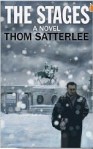
Merry Christmas Everyone! I have a few Christmas goodies for you. First, I thought you might like to know about a new mystery by the writer Thom Satterlee entitled Stages. The protagonist is an American living in Copenhagen who becomes a suspect in a murder investigation. The action takes place in Copenhagen and includes Kierkegaard scholars among its cast of characters. Satterlee says the novel grew out of his interest in Kierkegaard.

“I began, originally,” Satterlee says, “to write poems about Kierkegaard. But then I got the notion, what if I pretended to be Kierkegaard, as he pretended to be other people? What if I imagined him as a closet poet, secreting away his poems …. [W]hat if a manuscript were discovered close to the time of his 200th birthday (May 5, 2013) …. I wrote the poems, but I became more interested in the story of how they would be received by his fellow Danes, now in the 21st century … In my mind, a mystery began to take shape. The mystery involved the theft of this priceless manuscript and a murder.”

Satterlee coverThe novel is available as an ebook for $2.99! Don’t let the price fool you though. Satterlee is an award-winning poet and literary translator. His bio on Amazon notes that ‘[h]is collection of poems Burning Wyclif was an American Literary Association Notable Book and a Finalist for the L.A. Times Book Award.” His other awards include an American-Scandinavian Foundation Translation Prize and a National Endowment for the Arts Fellowship.

My advice is to buy The Stages and start reading it today! It’s Christmas after all. You should do something fun!

For more fun, check out Michael McIntyre’s blog Extravagant Creation. WordPress is great about promoting the work of its bloggers. I got an email from WordPress about a month ago informing me that Michael McIntyre had subscribed to my blog. Included in the email was a link to McIntyre’s blog, so I checked it out. I try always to do that, not simply because it seems only right and proper to me that, as a blogger, I should support the work of other bloggers, but also because I’ve found some great stuff that way. There’s some amazing writing coming out of WordPress, both in terms of form and in terms of content.

McIntyre’s blog is a scholar’s dream. There’s lots there that would be of interest to Kierkegaard scholars, including entries on Johann Georg Hamann, N.F.S. Grundtvig, K.E. Løgstrup and Lev Shestov. There’s other great stuff as well, though, including posts on topics of more general appeal such as ethics, theology, and music. Spend a little time today perusing McIntyre’s blog. You won’t regret it!

Finally, I’d like to put in a plug for Peter Tudvad’s book from 2009 Sygeplejerske i Det Tredje Rige: En Danskers Historie (Nurse in the Third Reich: the story of a Dane). The book has nothing directly to do with Kierkegaard, but it is written by one of my favorite Kierkegaard scholars, Peter Tudvad, and the subject is a dear friend and long-time patron of Kierkegaard scholarship Ebba Mørkeberg. Ebba tutored me in German for about five years when I was living in Denmark. She also helped me with the more difficult German material that was included in my dissertation and, later, my book Ways of Knowing, and she expanded my personal library of 19th century Danish literature, philosophy, and theology, through repeated gifts from her own extensive library.

Ebbe Mørkeberg at the launch of Syplejerske i Det Tredje Rige, May 5th 2009

Ebba is a great lady and the story of her experiences in Germany in WWII is riveting.The book, alas, is available only in Danish, but for those of you who are tired of practicing your Danish by reading Kierkegaard, this book would be a welcome change. It will give you insight not merely into the life of it’s subject, but into the Danish psyche and to an important period in Danish history.

Merry Christmas to everyone!

Kierkegaard and Traditionalism

As I write this scholars of religion are milling about the book exhibit at the annual meeting at the American Academy of Religion in Chicago. The AAR meeting is one of my favorite academic conferences. There’s something for everyone there. From Wiccans to the Eastern Orthodox. I decided not to attend this year’s meeting, however, because I’m not on the program and that means I’d have to foot the bill myself. There are always a multitude of interesting papers, more than I would ever be able to get to even if none of them ran concurrently. I think what I miss most of all though is the book exhibit.

The book exhibit is wonderful. Every major academic and scholarly publisher is represented, including many foreign and esoteric presses. I’ve taken, in recent years, to carrying my Kindle with me through the rows of exhibitors. If I see a book I like, I quickly check to see if it is available on Kindle. Not only are Kindle versions often cheaper than the regular or hardcover editions (even with the substantial conference discount), but they do not add to the bulk of the luggage I have to tote back home.

Some books though, are simply not the same on a Kindle, or other electronic reading device because they’re not just text, but aesthetic objects. Such a book is The Christian Spirit from World Wisdom publishers. It’s sort of a modern version of an illuminated manuscript. No one has more (both in quantity and in quality) beautiful books than World Wisdom publishers. And no press has a more congenial staff. The year I bought The Christian Spirit I struck up a conversation with the people who were staffing the World Wisdom booth and the longer I stood there and talked, the more books they gave me. Yes, they gave me books. I can’t remember how many books I bought, somewhere around a half a dozen, I think, but they gave me at least that many for free. The conversation would turn in the direction of a subject covered in a book I had not bought, and no sooner than I would shake my head in disappointment that I really could not afford to buy yet another book, would I find it thrust into my hands for free if I would simply promise to read it.

I love the people at World Wisdom. When I arrived home and began to peruse some of my new treasures, I kept coming upon the terms “traditionalism,” and “perennialism.” The two terms are used more or less interchangeably to refer to the same movement. The movement was founded by René Guénon, Frithjof Schuon, and Ananda Coomaraswamy. It’s a religious, or spiritual, movement that is at once pluralistic and conservative. Traditionalists believe that all religions have their origin in the same transcendent source–God, but that each must be respected for its own inherent integrity. It has unfortunately been associated with rightwing movements in Europe, which is probably part of the reason it is not better known in the U.S. It’s far from clear, however, that the core beliefs and values of traditionalism cohere with such movements.

What is clear, however, is that traditionalism is in at least some vague sense politically conservative. Seyyed Hossein Nasr, one of the leading proponents of contemporary traditionalism quotes Schuon as asserting that the worst king is better than the best president. That remark gave me pause, not simply because one doesn’t expect to hear such an assertion from a contemporary Western scholar, but because it sounded so remarkably like Kierkegaard.

“A mediocre ruler,” asserts Kierkegaard, “is a much better constitution than the abstraction of 100,000 growling non-human beings” (“En maadelig Regent er en | meget bedre Forfatning end dette Abstractum, 100,000 brummende U-Msker.”  [NB4 :114 1848, SKS 20, 339]). “Every movement that really wants to be progressive,” he asserts, “must have its origin in one thing–it must be clear that God is involved, that the whole thing really issues from him” (Enhver Bevægelse, der virkelig skal være et Fremskridt, maa udgaae fra Een – at det kan være tydeligt, at Gud er med i Spillet, saa det Hele egl. udgaaer fra ham [NB4 :114 1848, SKS 20, 339]).

“Nasr had cited Kierkegaard, at the beginning of a talk he gave at a conference entitled “Tradition in the Modern World, as one of the bad guys, one of the modernist thinkers (which means “bad guy” to traditionalists).

It’s not surprising Nasr would put Kierkegaard in the class of modernist thinkers. Most people who don’t know much about Kierkegaard probably think about him that way. Even Alasdair MacIntyre presents Kierkegaard that way in his otherwise excellent book After Virtue. Most serious Kierkegaard scholars know, however, that such a view of Kierkegaard is mistaken (cf., e.g., Kierkegaard After MacIntyre). Kierkegaard’s political conservatism is, in fact, the source of a great deal of embarrassment among Kierkegaard scholars who think of themselves as politically progressive.

It’s time such scholars (and I place myself among them) acknowledged, however, that despite what we like to see as the potential of Kierkegaard’s thought to contribute to a progressive political ideology, it is unlikely that Kierkegaard would have approved of such a project himself. No “progress” is possible for Kierkegaard without God and fitting God into any organized movement, political or otherwise, is a project that Kierkegaard all too often speaks as if he believes is doomed to failure.

A monarch is a better regent, for Kierkegaard, than a mob because a monarch can, as an individual, have a personal relation to God, while a mob cannot. It’s not clear, however, whether all collectives can be fairly characterized, from Kierkegaard’s perspective, as “mobs.” Despite his bitter disappointment with “Christendom,” he seems to hold out some hope that there could be such a thing as a community of believers.

What would such a community look like? Is it something the traditionalists would recognize? Is that what they also are trying to effect in the modern world? The traditionalists’ rejection of modern secularism and their call to return to an explicit acknowledgment of what they view as man’s spiritual essence certainly coheres with the substance of Kierkegaard’s thought. It ought to be attractive as well to progressives in its pluralism. There is, I would argue, the potential for a great deal of fruitful scholarship on the relation between Kierkegaard’s political views and the contemporary traditionalist movement.