Page 14 of 21

Once Upon a Time in Denmark

j9987For as long as I can remember I’ve had what Kierkegaard would call “an extraordinary hankering” to get into The New York Review of Books. In fact, my entire literary and scholarly production: my translation, my book, my many articles and two blogs, has been one long and elaborate attempt to attract the attentions of Robert Silvers, the editor of the Review, in the hope that my work would so impress him that he would decide to add me to his stable of reviewers. So when I saw that Princeton University Press had released a new edition of Kierkegaard’s The Seducer’s Diary with a foreword by John Updike, I was immediately reminded of the one time I did actually make it into the NYRB–sort of.

I’ve been an avid reader of the NYRB since I was a child. My father, who was an editorial writer for a newspaper, used to get it at work and bring it home for me to read. I loved the NYRB. The articles were always so interesting and so well written. I would read nearly the whole thing, cover to cover.

Naturally, I tried to keep up with it even during the years lived in Denmark. I don’t remember whether I subscribed to it then, or whether I simply collected my father’s old copies on my occasional trips to the U.S. Somehow though, I kept up with it, despite the fact that it was nearly impossible to find a copy on a newsstand in Denmark (a detail that will be important later in this story).

I was pleased, one day in 1997, to see an article by Updike on “The Seducer’s Diary” portion of Kierkegaard’s Either-Or in the May 29, edition of the Review. Updike is a wonderful writer, so I knew the piece would be good.

I was disappointed, however, to see Updike cite the apocryphal story that Kierkegaard had once visited a brothel as if it were well-documented historical fact. Most Kierkegaard scholars know that the story is pure speculation, but almost no one knows how the speculations got started. That is, no one except my then boyfriend Paul A. Bauer who, though I don’t think he had read any Kierkegaard when I met him, had spent the seven years we’d been living together in Denmark acquainting himself with the more arcane facts surrounding Kierkegaard’s life and writings.

“God I wish I knew how that story got started,” I complained to Paul.

“I’ll tell you how it got started,” he answered placidly. “P.A. Heiberg started it. [Heiberg was one of the editors of the first edition of Kierkegaard’s collected works.] Heiberg decided,” Paul continued, “that Kierkegaard’s account in the book Stages on Life’s Way of a man who visits a prostitute and becomes obsessed with the idea that he might thus have fathered a child was autobiographical. He didn’t have any real evidence to support this theory though,” Paul explained. “All he had in the way of ‘support’ was a few drafts of that passage from Stages and the fact that there was a gap in Kierkegaard’s journals of about six to seven weeks from the end of April until the beginning of June in 1836. Heiberg figured the brothel visit had occurred around the beginning of that period and that it has so traumatized Kierkegaard that he couldn’t write again for weeks.”

Paul knew this because among the arcana that made up his growing library was a monograph by Heiberg entitled En Episode i Kierkegaards Ungdomsliv (an episode in Kierkegaard’s youth) from 1912 and a book entitled Et Segment af Søren Kierkegaards religiøse Udvikling (a segment of Kierkegaard’s religious development) from 1918 where Heiberg presented these speculations, and Paul, unlike probably anyone else alive today, had actually read both these works.

Ecstatic at the realization that I was more knowledgeable about something than was John Updike (well, okay, Paul was the one who was really more knowledgeable), and that maybe I could leverage this knowledge to get into the NYRB, I suggested we write a letter to the Review pointing out Updike’s error in presenting mere speculation as fact.

We drafted the letter and sent it off directly to the NYRB. I assumed we’d be notified if they decided to print the letter, which I was initially confident they would, since revealing as it did for the first time in modern memory, the source of this famous story about Kierkegaard, it promised to create something of a stir in scholarly circles.

Weeks passed.  The whole thing had faded from my memory when my eyes unexpectedly lit upon my own name in a sort of “Heard About Town”column entitled “Dyt-båt” (that’s supposedly the sound of an old Model-T horn) in the Danish newspaper Weekendavisen.

“Two University of Copenhagen students really took it to John Updike in the most recent edition of The New York Review of Books” the column blared.

I leapt right out of my chair.

“We’ve got to get a copy of The New York Review of Books!” I exclaimed to Paul.

I can’t remember now how long it took us to find a copy. I do remember, though, that we combed almost the entire city looking for one. When we finally found one, we went immediately to the “Letters” section at the back. There it was, our letter in all its lengthy erudition. My joy at this triumph was somewhat short lived, however, because following our letter was a disappointingly curt reply from Updike, who appeared to think that our objection to the brothel-visit story had been motivated by some kind of prudishness.

So there you have it. That is the story of how my longtime ambition to appear in the pages of The New York Review of Books was finally realized–sort of.
The Curse!

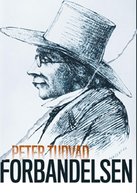
1586255t137Peter Tudvad is has yet another book on Kierkegaard scheduled to appear this coming Tuesday, April 16th, 2013. I’d been hoping  his next book would be a biography. This book isn’t a biography though, it’s a biographical novel entitled Forbandelsen (i.e., the curse). The blurb on the back of the book says that it’s a

“dramatic portrayal of [the life of] Søren Kierkegaard, the brilliant, and at times mad, intellectual giant who revolutionized philosophy and shook theology with his emphasis on ‘the individual’ and ‘discipleship.’

“In the tradition of Dostojevski and Kafka, The Curse situates the protagonist in a universe where crime and punishment, sin and grace shift continuously between actuality and illusion, so that the reader is pulled into Kierkegaard’s thoughts and takes part in his existential battle with both God and humanity.

“The Curse is thus a theological novel and precisely as such provides a psychological portrait of a man who, with tragic pathos, sets heaven and earth in motion in an attempt to find a truth for which he can live and die.

“Kierkegaard’s antagonists, Bishop Mynster and Professor Martensen, his unhappy love, Regine, his brother Peter and friend Emil, along with many other figures, all appear in this grand story of piety and perversion, of death and perjury, of the Church’s distortion of the Gospels–and of a shepherd boy’s fateful cursing of God”

The book, from Tudvad’s usual publisher Politiken, is 494 pages and costs 350 kroner (that’s about $60). It hasn’t been reviewed yet, but I’ll fill you in on the reviews when they begin to appear. In the meantime, if you would like a little “smagsprøve,” as the Danes say, of the book you can actually print out an entire chapter (unfortunately, not the first chapter) here.

Rumor has it that Joakim Garff also has a book scheduled to appear soon. This will be the first book Garff has published since his biography of Kierkegaard back in 2000. You can bet he hasn’t been idle though, my sources say he has been laboring diligently and that this book is only one of several projects he has in the works.

Observations on the Various Editions of Kierkegaard’s Collected Works

SV 2 two pages

There are now four different Danish editions of Kierkegaard collected works. The first edition, edited by A.B. Drachman, J.L. Heiberg, and H.O. Lang was published by Gyldendal between 1901-1906 and comprised 14 volumes. The second edition, published between 1920-1936, was essentially a corrected version of the first edition with the inclusion of a very helpful fifteenth volume that contained author and subject indexes for all the individual volumes as well as a glossary of the more important terms in Kierkegaard’s authorship.

A third inexpensive popular edition of Kierkegaard’s collected works in 20 volumes was published in the 1960s. This edition was never intended for use by scholars and is marred by numerous errors that were more than likely a result of how quickly the edition was produced (one volume per month according to Tony Aalgaard Olesen).

The second edition is generally considered to be the best of the collected works as well as the most readily available. It’s still possible to find it in used bookstores in Denmark for a reasonable price. A casual web search I did just now turned up three copies at Vangsgaards Antikvariat for between 1,000DK and 1,800DK (approximately $150-$300).

The first edition is still preferred by scholars, however, because the second edition, produced as it was during a period of the resurgence of Nordic nationalism was printed in Blackletter, or Gothic type, and many contemporary scholars find that difficult to read. The English translations of Kierkegaard supervised by Howard V. Hong and Edna H. Hong and published by Princeton University Press in the ‘80s and ’90s thus have page correlation numbers to the first, rather than the second, edition of Kierkegaard’s collected works.

Unfortunately, the first edition of Kierkegaard’s collected works is increasingly difficult to find and generally very expensive. Fortunately, there is a new edition of Kierkegaard’s collected works. This new edition, produced by the Søren Kierkegaard Research Center in Copenhagen is distinguished from the earlier editions by a new title. Whereas all three earlier collected works were titled Søren Kierkegaards Samlede Værker (literally Søren Kierkegaard’s collected works, or SV), the new edition is titled Søren Kierkegaards Skrifter (Søren Kierkegaard’s writings, or SKS).

There is much to recommend the new edition. The individual volumes have been beautifully produced, at least from an aesthetic standpoint, and each is accompanied by a helpful companion volume of commentary. The edition purports to be a “critical” one, but unfortunately falls short of that ideal. It was produced too quickly to ensure the kind of quality that is requisite for a critical edition and the editorial staff was generally too inexperienced in that type of work. The 55 volumes were produced between 1997 and 2013, or 16 short years compared, for example, to the critical edition of Kant writings on which work began in 1900 and is apparently still continuing!

The haste with which this new edition was produced is likely the explanation for problems such as the one I identified in the notes to my translation of Kierkegaard’s Repetition. The fictional narrator of that work refers to the “disappearance” of the young man who was the subject of his observations. “[D]isappearance,” as I explain in a note, was originally “death.” Kierkegaard apparently changed “death” (Død) to “disappearance” (Forsvinden) after learning that his former fiancée, Regine Olsen, had become engaged. SKS has Forvinden (recovery), however, rather than Forsvinden. The original 1843 edition of Repetition, on the other hand, has Forsvinden, not Forvinden and since there is no explanation for the change in SKS, it appears it’s simply an error.

So the new edition is not perfect. The critical apparatus is extensive, but somewhat arbitrary in what it includes and does not include and the price for all 55 volumes (at approximately $100 each) is prohibitively expensive. Despite this, however, it will become the standard scholarly edition because not only can volumes be purchased individually, but the entire edition is available in searchable form online! For that reason alone, I find myself often referring to it.

In my opinion, however, the most reliable text is still that of the second edition. The type takes a little getting used to, but not so long as many people seem to fear. I’m very fortunate, actually, in that not only do I have a second edition in excellent condition, someone actually went through my edition and put page correlation numbers to the first edition in the margins. I kid you not, there are page correlation numbers on every single page of every single volume. Not only are there these numbers, whoever put them there also put a tiny mark at the point in the line of the text where the new page began.

You can see these lines, just barely, in the photo above. There’s one between “saa” and “aldeles” on the page at the left, and another after the dash and just before “Om” on the page at the right. Pretty cool, eh! My theory is that my copy of the second edition must have been used in the production of the page correlation tables in the third edition, or in Alastair McKinnon’s concordances. It’s hard to imagine someone would have undertaken the labor involved in putting in all those numbers unless he were being paid to do so. I’m grateful to whoever did it though. I can now quickly check the accuracy of the Hongs’ translations even though they include page correlation numbers only to the first edition.

This extremely rare (very likely one of a kind) copy of the second edition of Kierkegaard’s collected works is only one of the many antiquarian treasures I collected while I lived in Denmark. I plan to write about more of my treasures later.