Page 14 of 20

Observations on the Various Editions of Kierkegaard’s Collected Works

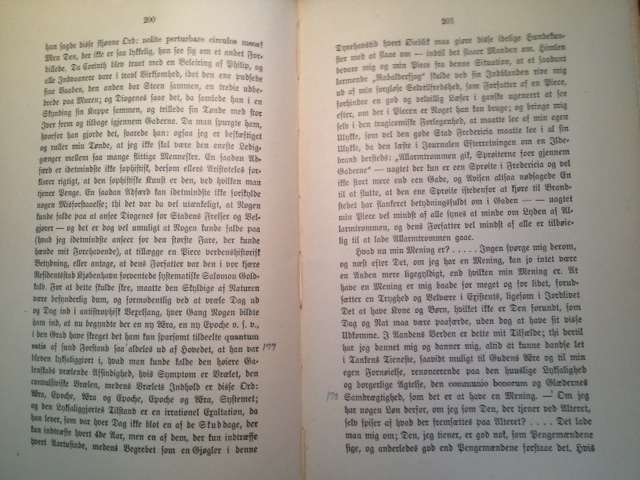
SV 2 two pages

There are now four different Danish editions of Kierkegaard collected works. The first edition, edited by A.B. Drachman, J.L. Heiberg, and H.O. Lang was published by Gyldendal between 1901-1906 and comprised 14 volumes. The second edition, published between 1920-1936, was essentially a corrected version of the first edition with the inclusion of a very helpful fifteenth volume that contained author and subject indexes for all the individual volumes as well as a glossary of the more important terms in Kierkegaard’s authorship.

A third inexpensive popular edition of Kierkegaard’s collected works in 20 volumes was published in the 1960s. This edition was never intended for use by scholars and is marred by numerous errors that were more than likely a result of how quickly the edition was produced (one volume per month according to Tony Aalgaard Olesen).

The second edition is generally considered to be the best of the collected works as well as the most readily available. It’s still possible to find it in used bookstores in Denmark for a reasonable price. A casual web search I did just now turned up three copies at Vangsgaards Antikvariat for between 1,000DK and 1,800DK (approximately $150-$300).

The first edition is still preferred by scholars, however, because the second edition, produced as it was during a period of the resurgence of Nordic nationalism was printed in Blackletter, or Gothic type, and many contemporary scholars find that difficult to read. The English translations of Kierkegaard supervised by Howard V. Hong and Edna H. Hong and published by Princeton University Press in the ‘80s and ’90s thus have page correlation numbers to the first, rather than the second, edition of Kierkegaard’s collected works.

Unfortunately, the first edition of Kierkegaard’s collected works is increasingly difficult to find and generally very expensive. Fortunately, there is a new edition of Kierkegaard’s collected works. This new edition, produced by the Søren Kierkegaard Research Center in Copenhagen is distinguished from the earlier editions by a new title. Whereas all three earlier collected works were titled Søren Kierkegaards Samlede Værker (literally Søren Kierkegaard’s collected works, or SV), the new edition is titled Søren Kierkegaards Skrifter (Søren Kierkegaard’s writings, or SKS).

There is much to recommend the new edition. The individual volumes have been beautifully produced, at least from an aesthetic standpoint, and each is accompanied by a helpful companion volume of commentary. The edition purports to be a “critical” one, but unfortunately falls short of that ideal. It was produced too quickly to ensure the kind of quality that is requisite for a critical edition and the editorial staff was generally too inexperienced in that type of work. The 55 volumes were produced between 1997 and 2013, or 16 short years compared, for example, to the critical edition of Kant writings on which work began in 1900 and is apparently still continuing!

The haste with which this new edition was produced is likely the explanation for problems such as the one I identified in the notes to my translation of Kierkegaard’s Repetition. The fictional narrator of that work refers to the “disappearance” of the young man who was the subject of his observations. “[D]isappearance,” as I explain in a note, was originally “death.” Kierkegaard apparently changed “death” (Død) to “disappearance” (Forsvinden) after learning that his former fiancée, Regine Olsen, had become engaged. SKS has Forvinden (recovery), however, rather than Forsvinden. The original 1843 edition of Repetition, on the other hand, has Forsvinden, not Forvinden and since there is no explanation for the change in SKS, it appears it’s simply an error.

So the new edition is not perfect. The critical apparatus is extensive, but somewhat arbitrary in what it includes and does not include and the price for all 55 volumes (at approximately $100 each) is prohibitively expensive. Despite this, however, it will become the standard scholarly edition because not only can volumes be purchased individually, but the entire edition is available in searchable form online! For that reason alone, I find myself often referring to it.

In my opinion, however, the most reliable text is still that of the second edition. The type takes a little getting used to, but not so long as many people seem to fear. I’m very fortunate, actually, in that not only do I have a second edition in excellent condition, someone actually went through my edition and put page correlation numbers to the first edition in the margins. I kid you not, there are page correlation numbers on every single page of every single volume. Not only are there these numbers, whoever put them there also put a tiny mark at the point in the line of the text where the new page began.

You can see these lines, just barely, in the photo above. There’s one between “saa” and “aldeles” on the page at the left, and another after the dash and just before “Om” on the page at the right. Pretty cool, eh! My theory is that my copy of the second edition must have been used in the production of the page correlation tables in the third edition, or in Alastair McKinnon’s concordances. It’s hard to imagine someone would have undertaken the labor involved in putting in all those numbers unless he were being paid to do so. I’m grateful to whoever did it though. I can now quickly check the accuracy of the Hongs’ translations even though they include page correlation numbers only to the first edition.

This extremely rare (very likely one of a kind) copy of the second edition of Kierkegaard’s collected works is only one of the many antiquarian treasures I collected while I lived in Denmark. I plan to write about more of my treasures later.

Publishing News!

Rudd's Self, Value, Narrative (cover)Anthony Rudd has a new book! Rudd, as many of you will know, is one of my favorite Kierkegaard scholars, not simply because he’s a lovely human being, but because his work is of uniformly high quality. His new book is Self, Value and Narrative: A Kierkegaardian Approach (Oxford, 2012). The description on Amazon reads:

Self, Value, and Narrative … defends a series of interrelated claims about the nature of the self. [Rudd] argues that the self is not simply a given entity, but a being that constitutes or shapes itself. But it can only do this non-arbitrarily if it has a sense of the good by which it can be guided as it chooses to endorse some of its desires or dispositions and repudiate others. This means that there is an … ethical or evaluative dimension to selfhood, and one which has an essentially teleological character. Such self-constitution takes place in narrative terms, through one’s telling–and, more importantly, living–one’s own story. …. Rudd develops these ideas in a way that is importantly different from others familiar in the literature. He takes his main inspiration from Kierkegaard’s account of the self, and argues (controversially) that this account belongs in the Platonic rather than the Aristotelian tradition …. Through close engagement with much contemporary philosophical work, Rudd presents a convincing case for an ancient and currently unfashionable view: that the polarities and tensions that are constitutive of selfhood can only be reconciled through an orientation of the self as a whole to an objective Good.

Rudd showed me a paper several years ago in which he was developing this idea of the Platonic roots of Kierkegaard’s concept of the self. If I remember correctly, he was scheduled to give that paper at a meeting of the Central Division of that APA and wanted some feedback on it. I thought then that it was excellent and am very pleased to see that the ideas he expressed in that paper have now been more fully developed and made available to the general public in this volume.

I’m less excited about the publisher. When I went to purchase the book on Amazon, I was shocked to discover that Amazon’s discounted price was $75 and that it was not yet available as an ebook. I shouldn’t have been surprised by the price. Both Oxford and Cambridge are notorious for pricing their books out of the range of everyone but the independently wealthy–and university libraries. I had suggested to Rudd, when he was shopping for a publisher, that he try Baylor. Baylor did a fantastic job with my book Ways of Knowing, and they priced it at a very reasonable $49.95 (hard cover). I actually made money off that book, more money, in fact, than I made off the translations I did for Oxford (which makes me wonder just what Oxford is doing with all the money they are making off authors).

More annoying is the fact that the book is not yet available as an ebook. What’s up with that Oxford? I buy almost exclusively ebooks these days. I’m an unabashed fan of them, despite the recent propaganda campaign against them. I’m going to buy Rudd’s book, of course, because I know it will be excellent. I don’t have to buy it immediately, however, because I won’t be able to get to it immediately, so I encourage everyone to go to the Amazon page for the book and click the “Tell the publisher! I’d like to read this book on Kindle.” Maybe if enough people do that, it will be out in a Kindle edition soon.

I have more good news on the publishing front. Thom Satterlee has sold the Danish rights to his book The Stages: A Novel. It’ll be translated and published by Rosenkilde & Bahnhof in time for SK’s b-day this May. Congrats Thom!

Merry Christmas!

Ebba and Willie Mørkeberg's Christmas Tree, Frederiksværk, Denmark
Ebba and Willie Mørkeberg’s Christmas Tree, Frederiksværk, Denmark

Merry Christmas Everyone! I have a few Christmas goodies for you. First, I thought you might like to know about a new mystery by the writer Thom Satterlee entitled Stages. The protagonist is an American living in Copenhagen who becomes a suspect in a murder investigation. The action takes place in Copenhagen and includes Kierkegaard scholars among its cast of characters. Satterlee says the novel grew out of his interest in Kierkegaard.

“I began, originally,” Satterlee says, “to write poems about Kierkegaard. But then I got the notion, what if I pretended to be Kierkegaard, as he pretended to be other people? What if I imagined him as a closet poet, secreting away his poems …. [W]hat if a manuscript were discovered close to the time of his 200th birthday (May 5, 2013) …. I wrote the poems, but I became more interested in the story of how they would be received by his fellow Danes, now in the 21st century … In my mind, a mystery began to take shape. The mystery involved the theft of this priceless manuscript and a murder.”

Satterlee coverThe novel is available as an ebook for $2.99! Don’t let the price fool you though. Satterlee is an award-winning poet and literary translator. His bio on Amazon notes that ‘[h]is collection of poems Burning Wyclif was an American Literary Association Notable Book and a Finalist for the L.A. Times Book Award.” His other awards include an American-Scandinavian Foundation Translation Prize and a National Endowment for the Arts Fellowship.

My advice is to buy The Stages and start reading it today! It’s Christmas after all. You should do something fun!

For more fun, check out Michael McIntyre’s blog Extravagant Creation. WordPress is great about promoting the work of its bloggers. I got an email from WordPress about a month ago informing me that Michael McIntyre had subscribed to my blog. Included in the email was a link to McIntyre’s blog, so I checked it out. I try always to do that, not simply because it seems only right and proper to me that, as a blogger, I should support the work of other bloggers, but also because I’ve found some great stuff that way. There’s some amazing writing coming out of WordPress, both in terms of form and in terms of content.

McIntyre’s blog is a scholar’s dream. There’s lots there that would be of interest to Kierkegaard scholars, including entries on Johann Georg Hamann, N.F.S. Grundtvig, K.E. Løgstrup and Lev Shestov. There’s other great stuff as well, though, including posts on topics of more general appeal such as ethics, theology, and music. Spend a little time today perusing McIntyre’s blog. You won’t regret it!

Finally, I’d like to put in a plug for Peter Tudvad’s book from 2009 Sygeplejerske i Det Tredje Rige: En Danskers Historie (Nurse in the Third Reich: the story of a Dane). The book has nothing directly to do with Kierkegaard, but it is written by one of my favorite Kierkegaard scholars, Peter Tudvad, and the subject is a dear friend and long-time patron of Kierkegaard scholarship Ebba Mørkeberg. Ebba tutored me in German for about five years when I was living in Denmark. She also helped me with the more difficult German material that was included in my dissertation and, later, my book Ways of Knowing, and she expanded my personal library of 19th century Danish literature, philosophy, and theology, through repeated gifts from her own extensive library.

Ebbe Mørkeberg at the launch of Syplejerske i Det Tredje Rige, May 5th 2009

Ebba is a great lady and the story of her experiences in Germany in WWII is riveting.The book, alas, is available only in Danish, but for those of you who are tired of practicing your Danish by reading Kierkegaard, this book would be a welcome change. It will give you insight not merely into the life of it’s subject, but into the Danish psyche and to an important period in Danish history.

Merry Christmas to everyone!