Page 2 of 4

Summer at “The Farm”

img_1074
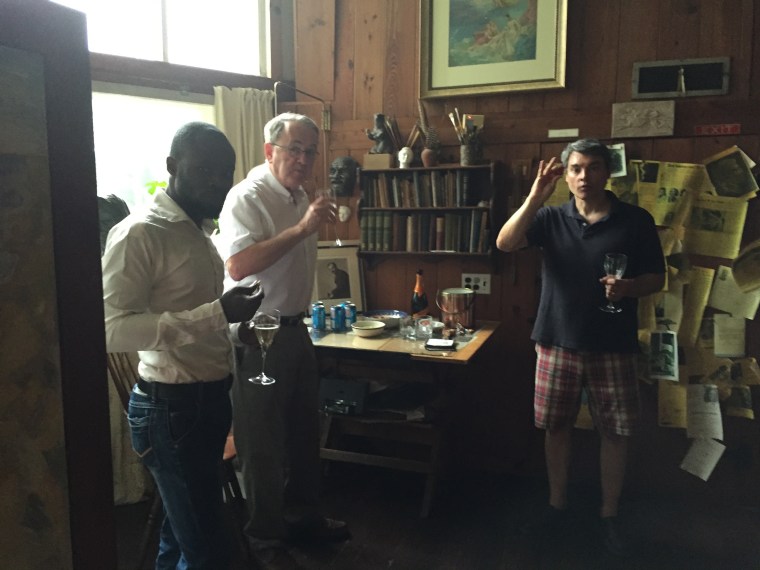
Nigerian Kierkegaard scholar Benneth Anozie, American Kierkegaard scholar Vincent A. McCarthy, and Brian J. Foley, Esq.

Bucks County has got to be one of the most beautiful places in PA, if not in the entire U.S. It has long attracted artists and was the home of the famous Bucks County impressionists. I am very fortunate to have a friend, David Leopold, who owns a large property in Bucks County that was once the home of Bucks County impressionist Ben Solowey. David, who is the archivist for both Al Hirschfeld and David Levine, as well as a freelance curator, is also the director of the Studio of Ben Solowey, a small museum and art gallery that was once Solowey’s studio. I house sit for David for several weeks every summer.

I was house sitting this summer when I received an email from Vincent A. McCarthy. McCarthy had met a Nigerian scholar, Benneth Anozie at a conference at St. Olaf College. Anozie, he explained, was eager to meet me because he was working on a dissertation on Kierkegaard’s epistemology. Would I be around to get together with Anozie, asked McCarthy? When I explained that I was not actually in Philly, but at a farm in Bucks County, McCarthy said that would not be a problem, that he and Anozie could drive up there. I was surprised at first by McCarthy’s willingness to undertake such a long drive for a short meeting. Little did I know that McCarthy is a man of extraordinarily refined tastes. He also has a property in Bucks County. “I need to mow my lawn anyway,” he explained. So I told him to come on up and we would make a day of it.

My husband, Brian, and I gave Benneth and Vincent a champagne tour of the then current exhibition Homage: Ben Solowey’s Art Inspired by his Influences. It was a wonderful visit that included a sumptuous meal with more wine. We didn’t talk too much about Kierkegaard. I did get a few minutes, however, to talk to Anozie about Kierkegaard’s epistemology and we are now connected through Linkedin. I was also very fortunate in that Vincent brought me a copy of his new book Kierkegaard as Psychologist (Northwestern, 2015). I’ve only just started it so I can’t say very much about it yet. I can say, however, that the introduction is one of the best short introductions to Kierkegaard that I have ever read. The book, explains McCarthy

is intended to highlight the incredibly rich and deep psychological dimensions of Kierkegaard’s thought, to offer an appreciation and assessment of it, and to serve somewhat as an introduction and commentary on Kierkegaard’s psychology for general readers with an interest in, but not necessarily in possession of detailed knowledge of Kierkegaard’s corpus and Kierkegaard scholarship as such.

That said, a brief survey of the table of contents, combined with an appreciation of the depth of McCarthy’s understanding of Kierkegaard as exhibited in the introduction suggests that the book will be of enormous help to dedicated Kierkegaard scholars as well. There’s a bizarre lacuna in Kierkegaard scholarship concerning Kierkegaard’s psychology. There’s Kresten Nordentoft’s eponymous book from 1972, Steve Evans’ excellent Søren Kierkegaard’s Christian Psychology: Insight for Counseling and Pastoral Care from 1990, and the essays collected in Kierkegaard’s Truth: The Disclosure of the Self, vol. 5 of a series entitled Psychiatry and the Humanities, from 1981, but that’s not very much given how important human psychology was among Kierkegaard’s interests and how profound are his insights into that psychology.

Kierkegaard’s authorship, asserts McCarthy at the end of the introduction,

stresses what he holds to be a timeless prescription as it engages in a profound analysis of forms of alienation and dis-ease with oneself. The “patients” he selects are modeled on nineteenth-century types, but he quickly penetrates beneath the nineteenth-century surface to reveal souls whose restlessness and discontent Augustine in the fourth century and we in the twenty-first have little trouble recognizing. And it is because of his penetration to a problem that transcends but is not unconnected with any particular age and society that Kierkegaard can seem very modern indeed, that he can sometimes seem a contemporary of Freud and Maslow and not just Brahms and Liszt.

I could not have said it better myself. I can’t wait to read more of this book. I’ll present more thoughts on it in later posts.

img_1073
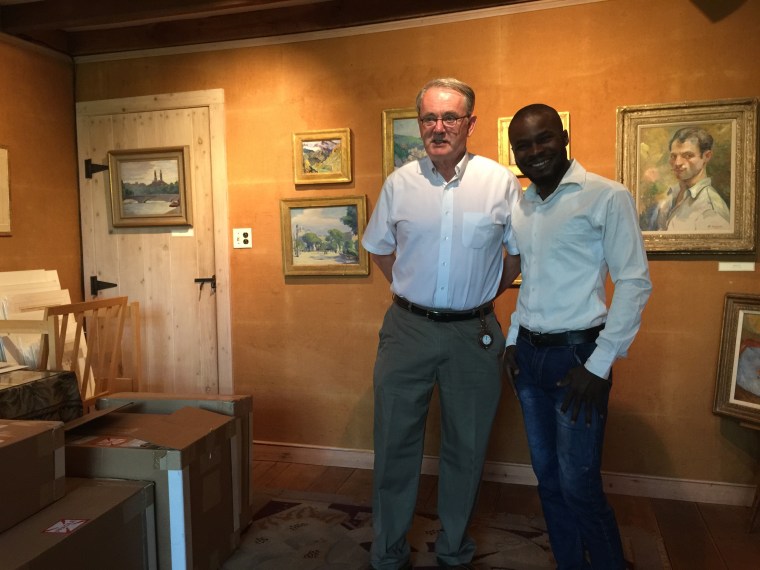
McCarthy and Anozie with a self-portrait of Solowey behind Anozie

Irenaeus and Kierkegaard on Christian Knowledge

Keynote panel
Jonathan Lear, Tanya Luhrmann, Elaine Pagels, and Jeffry Kripal

I presented a paper at a conference entitled The Psychology of Religion/The Religion of Psycholgy at the University of Chicago in March of 2015. I meant to post my thoughts on that conference immediately after its conclusion, but a number of other commitments kept me from being able to do that. The conference, sponsored by the Martin Marty Center for the Advanced Study of Religion, was extraordinarily stimulating. The keynote speakers were Jeffry Kripal, J. Newton Rayzor Chair in Philosophy and Religious Studies, Rice University, Jonathan Lear, John U. Nef Distinguished Service Professor at the Committee on Social Thought, University of Chicago, Tanya Marie Luhrmann, Watkins University Professor in the Department of Anthropology (and Psychology, by courtesy), Stanford University, and Elaine Pagels, Harrington Spear Paine Foundation Professor of Religion, Princeton University.

I was excited to be on the same program with Jonathan Lear and Elaine Pagels. I am a huge admirer of both scholars. Lear is an extraordinarily talented scholar who has done some wonderful work on Kierkegaard as well as on classical philosophy and psychoanalysis and although Pagels has not, to my knowledge, written on Kierkegaard, her books on the history of Christianity in general, and Gnosticism in particular have been very helpful to me.

It was Pagels’ presentation, “’Making a Difference’: How Promoting Exploration of Human Experience Became Heresy,” that prompted this post. Much of that presentation was directed against Irenaeus and his attacks on the Gnostics. Pagels argued that Irenaeus was dismissive of human experience and antagonistic to the idea, so central to Gnosticism, that human beings could achieve knowledge of the divine. In fact, she attributed this antagonism, as the title of her presentation suggests, not merely to Irenaeus, but to orthodox Christianity more generally.

Irenaeus
Slide of Irenaeus from Pagels’ presentation

As I said, I am a huge admirer of Pagels, but that account of Irenaeus, and the Christian tradition more generally struck me as simply false and I said as much during the question period. Knowledge of the divine is clearly possible according to Kierkegaard, as I argue in my book Ways Of Knowing: Kierkegaard’s Pluralist Epistemology (Baylor, 2010). God, observes Kierkegaard in Philosophical Crumbs, did not take on human form “to ridicule human beings. His intention cannot thus be to go through the world in such a way that not a single person ever came to know [vide] it. He does indeed want something of himself to be understood [forstaae]” (Crumbs, 126).

The claim that knowledge of God is possible through an encounter with Christ may seem heretical to those who view Christianity as a religion based on faith. This passage from Crumbs is strikingly similar, however, to Irenaeus’ claim in The Scandal of the Incarnation: Irenaeus Against the Heresies (Ignatius Press, 1990) that “the Lord did not say that the Father and the Son could not be known at all [μη γινωσκεσθαι] for in that case his coming would have been pointless” (Against the Heresies, p. 45).

Irenaeus is specifically concerned in Against the Heresies to reject the claim of the Gnostic Valentinus that the message of the incarnation was God’s inaccessibility to human knowledge. “What the Lord really taught,” asserts Irenaeus, “is this: no one can know God unless God teaches him; in other words, without God, God cannot be known [ανευ Θεου μη γινωσκεσθαι τον Θεον]. What is more,” continues Irenaeus, “it is the Father’s will that God be known [αυτο δε το γινωσκεσθαι αυτον θλημα ειναι του Πατρος]” (Against the Heresies, 45).

Man’s imperfection, or sin, is for Irenaeus, the obstacle to his attaining specifically Christian knowledge. Thus Irenaeus observes that “the Word of the Father [i.e., Christ] and the Spirit of God [i.e., faith in Christ], united to the ancient substance of Adam’s formation [i.e., man], made man living and perfect capable of knowing the perfect Father” (Against the Heresies, p. 57). But sinful man is no longer perfect and hence is incapable of knowing God without the intermediacy of Christ. Thus Irenaeus asserts that “no one can know God unless God teaches him.”

Can “the truth be taught?” asks Kierkegaard in Crumbs (88). His answer, of course, is yes–if God himself teaches it. In other words, Kierkegaard’s claim in Crumbs that union with God is necessary in order for specifically Christian knowledge to be possible echoes exactly Irenaeus’ claim in Against the Heresies that “no one can know God unless God teaches him.”

I presented a paper concerning the similarity of Kierkegaard’s view on the possibility of religious knowledge with those of both Irenaeus and Clement of Alexandria at the annual meeting of the American Academy of Religion in 2011 and was figuratively besieged by admiring Patristics scholars throughout the rest of the conference.

I’m not in a position, of course, to comment upon Pagels’ more general claim that Irenaeus, and the later Christian tradition, was dismissive of human experience. She is certainly correct to the extent that Christianity assumes human experience, characterized as it is by sin, is profoundly problematic as a means for coming to understand the truth. The picture of Irenaeus’ objection to Gnosticism that one gets from Against the Heresies relates, however, to the Gnostics’ condemnation of physical reality, as well as to their elitism, or their view that only a tiny select group of human beings, the πνευματικοι, could know God.

I was very fortunate to share drinks with both Pagels and Luhrmann just before the conference dinner and Pagels assured me then that there were other works by Irenaeus that would support her view that he was dismissive of human experience. She neglected to mention what works those were. But it is not inconceivable that other writings by Irenaeus might display a certain ambivalence about what one could call the “authority” of human experience, since the Christian tradition more generally is ambivalent about this “authority.” Human experience certainly has a kind of authority, however, for Irenaeus. It just isn’t the same kind of authority it has for the Gnostics.

It is clear, however, both that Irenaeus believed human beings could achieve knowledge of the divine and that this view is an important part of the Christian tradition.


Kierkegaard’s Journals and Notebooks–OH NO!

I have only the first volume of the new English translations of Kierkegaard’s Journals and Notebooks published by Princeton University Press and the reason I have that volume is that I was given a free copy by the Scottish Journal of Theology when I agreed to review it for them. The editors include some scholars, such as Alastair Hannay and Vanessa Rumble, who have an excellent command of Danish. I was suspicious, however, of the rate at which they were cranking out the translations.

Translation is hard work. Good translations take some time to produce. It was hard for me to imagine that anyone could translate all of Kierkegaard’s journals and papers in the short time Princeton had projected it would take and actually do a decent job. The first volume in the Princeton series appeared in 2007. Since then, nine of the projected 11 volumes have appeared. That’s more than a volume a year.

I’ve not made a serious study of these new translations of Kierkegaard’s journals, since I did my review of the fist volume. I generally work with the original Danish versions that are available for free in searchable editions online. I’m working on a paper on humor in Kierkegaard right now, however, and I ran across a passage from one of Kierkegaard’s journals that I wanted to use for my article. The late, and venerable George Kline taught me that even if one has an excellent command of a particular language, if there exists a definitive English translation of a work in that language from which one wishes to quote, it is incumbent upon one to use the language of the translation. It’s a courtesy to the reader. If everyone who knew German, for example, did his own translations of Kant when quoting Kant, those poor souls who did not know German would have a hard time locating the passage in question. So I figured that I should use the wording of the new Kierkegaard’s Journals and Notebooks and dutifully looked up the passage that was, fortuitously, in the one volume of KJN that I happened to own. The translation reads as follows:

Humor is irony taken to its maximum vibration. Although the Xn aspect is the real primus motor, there are still people in a Christian Europe who have not come to describe more than irony, which is why they have also been unable to practice the absolutely isolated humor that subsists in the person alone.

That sounds kind of weird, doesn’t it? What is “the absolutely isolated humor that subsists in the person alone”? That doesn’t even sound like English, does it? I worked for many years as a translator when I lived in Denmark. I also know a little bit about translation theory. If I ever teach translation, or translation theory, which I hope one day to do, I am going to drill home to my students that translations should never sound awkward unless the original is awkward.

As I said, translation can be very difficult. It took me several days to come up with my translation of the passage from Repetition that I referred to in the blog post from 5 December 2015 Since, however, a translation is going to be around for a very long time, haste in seeing it to press is unadvisable. How does that saying go: “Translate in haste, repent in leisure”?

Here is the Danish for the passage in question:

Humoren er den til sin største Vibration gjennemførte Ironie, og omendskjøndt det Χhristelige er den egl. primus motor, saa kan der desuagtet findes i et christeligt Europa Folk, som ikke er kommen til at beskrive mere end Ironien, og derfor hell. ikke have kunnet gjenemføre den absolut-isolerede, personlig-ene-bestaaende Humor, d. 4 Aug. 37.

Here is my translation:

Humor is irony taken to its maximum vibration. Even though Christianity [det Xhristelige] is the genuine primus motor [prime moving force], it is still possible to find peoples in Christian Europe who have come no further than describing irony and who are hence incapable of achieving the absolutely isolated, uniquely personal humor.

My wording of the first sentence is identical to the wording of KJN. After that, the two translations diverge. There is nothing in the Danish that corresponds to KJN’s “aspect.” That’s an attempt on the part of the translator, or translators, to make sense of Kierkegaard’s “det Xhristlige” which translates literally as “the Christian” where “Christian” functions as an adjective. The thing is, there is no noun that it qualifies, so the translator simply added “aspect” without indicating that it was added. That in itself is no great crime (though it is a crime, interpolated material should be enclosed within brackets). The problem is, that it is actually misleading rather than helpful.

All genuine humor, according to Kierkegaard, has its foundation in Christianity. I won’t try to defend that claim here, suffice it to say in this context that it does. Kierkegaard is not talking here about some aspect of humor being Christian. How could some “aspect” of irony or humor be the “prime mover” that propels irony into the territory of humor? The prime mover has to be fundamental to the thing in question, not merely an “aspect” of it.

The “a” in front of “Christian Europe” is literally correct, but it’s unnecessary. What other kind of Europe was there? Danish, like German, uses articles more often than does English so to include them all in a translation is not only unnecessary, it yields a translation that is unidiomatic.

“[D]escribing” is a toughie. The Danish term in question is “beskrive,” a cognate of “describe.” It appears, in this context, to mean “describe” in the sense of “describing an arc.” That is, it appears to mean something like “exhibiting,” or better, “performing.” In fact, I think it means something closer to “understanding,” I was, therefore, tempted to use “understanding” instead of the more literal “describing.” What decided me against that was the fact that an astute reader could figure that out by him, or herself. Generally, a translator should not interpret the text for the reader unless that is the only way of making it comprehensible. There are often instances in which that is the only way to make a text comprehensible, but this did not seem to me to be one of them.

“Folk” unequivocally refers, however, to “a people,” and not to “people.” It’s a stab at the Danish people as a group. They are the “Folk” in “Christian Europe” to which Kierkegaard is snidely referring. If he had meant “people,” he’d have written “mennesker” (or “Mennesker” given that he was writing in the nineteenth century).

The worst problem with this translation, however, is the very last part: “the absolutely isolated humor that subsists in the person alone.” Really? That’s the best this august translation team could come up with? It doesn’t even sound like English. The minimum criterion for an English translation, it seems to me, is that it should sound like English, even if the translator needs to be rather free in the translation in order to achieve that effect. What is bizarre about the KJN version of this passage is that it is not, in fact, as one might expect, a literal translation. The Danish is: “den absolut-isolerede, personlig-ene-bestaaende Humor.” That translates literally as: “the absolutely isolated, uniquely personal humor.” Really, I kid you not. “[P]ersonlig” you can probably figure out for yourself, and “ene-bestaaende” translates as “unique.” Don’t take my word for it. Type it (or the contemporary “enebestaende”) into Google translate.

My guess is that the translators elected to use “subsists in the person alone” rather than the literal “uniquely personal” because Kierkegaard’s text has “personlig-ene-bestaaende” rather than “personlig enebestaaende.” That is, Kierkegaard appears to want to highlight the root words of “enebestaaende”: “ene” (which according to Ferrall-Repp means “alone, by oneself, solely”) and “bestaaende” (which according to Ferrall-Repp means “to consist in; to consist – be composed of; to subsist, exist, continue, endure”).

This shows the limits, however, of translation because while Kierkegaard can emphasize the parts of “enebestaaende” without losing the whole, a translation cannot do this. The translators, in this instance, appear to have elected to emphasize the parts, with the effect that they have lost the whole. Not only have they lost the whole, they’ve diminished what one could call the music of the text in the process. It is the chief sin of the Hongs’ translations, I believe, that they very often lose the music of the originals. Unfortunately, this would appear to be a problem with these new translations of Kierkegaard’s journals as well.

I don’t mean to suggest here that all the text of the new KJN is as bad as this particular passage. It isn’t. It is very disappointing, however, to see stuff like this in new translations when the point of producing new translations is precisely to make improvements on earlier translations.